Press

2025
2024
2023
2022
2020-2021
2019
2018
2017
2016
2015
2014
2013
2012
2011
2010
2009

 SEPTEMBER 2019

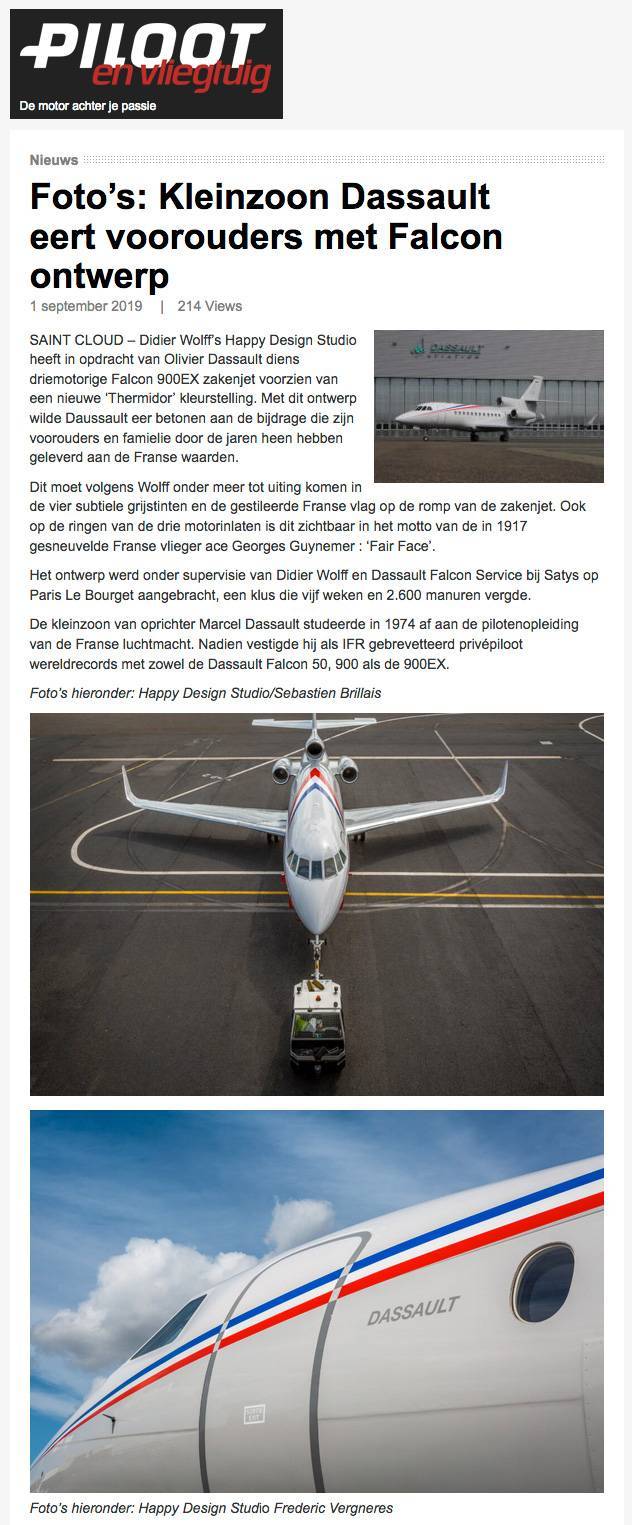
Read full article (text version) Source :PILOOT EIN VLIEGTUIG / This article is reproduced for archival purposes. SAINT-CLOUD — Het Happy Design Studio van Didier Wolff heeft in opdracht van Olivier Dassault de drievoudige straaljager Falcon 900EX voorzien van een nieuwe kleurstelling genaamd “Thermidor”. Met dit ontwerp wilde Dassault de bijdrage benadrukken die zijn voorouders en familie door de jaren heen hebben geleverd aan de waarden van Frankrijk. Volgens Wolff komt dit onder meer tot uiting in vier subtiele grijstinten en ineen gestileerde Franse vlag op de romp van de zakenjet. Ook op de ringen rond de drie motorgondels is dit zichtbaar, met het motto van de in 1917 gesneuvelde Franse vliegeraas Georges Guynemer : “Faire Face”. Het ontwerp werd onder toezicht van Didier Wolff aangebracht bij Dassault Falcon Service, met Satys op Paris-Le Bourget Airport, en vereiste ongeveer vijf weken werk en 2.600 arbeidsuren . De kleinzoon van oprichter Marcel Dassault volgde in 1974 een opleiding tot piloot bij de Franse luchtmacht. Daarna vestigde hij zich als IFR-gecertificeerd privé-piloot en vestigde hij verschillende wereldrecords met de Dassault Falcon 50, 900 en 900EX Foto’s: Happy Design Studio / Sébastien Brillais Foto’s hieronder: Happy Design Studio / Frédéric Vergneres

ARTICLE N°277 / PILOOT EIN VLIEGTUIG

 SEPTEMBER 2019

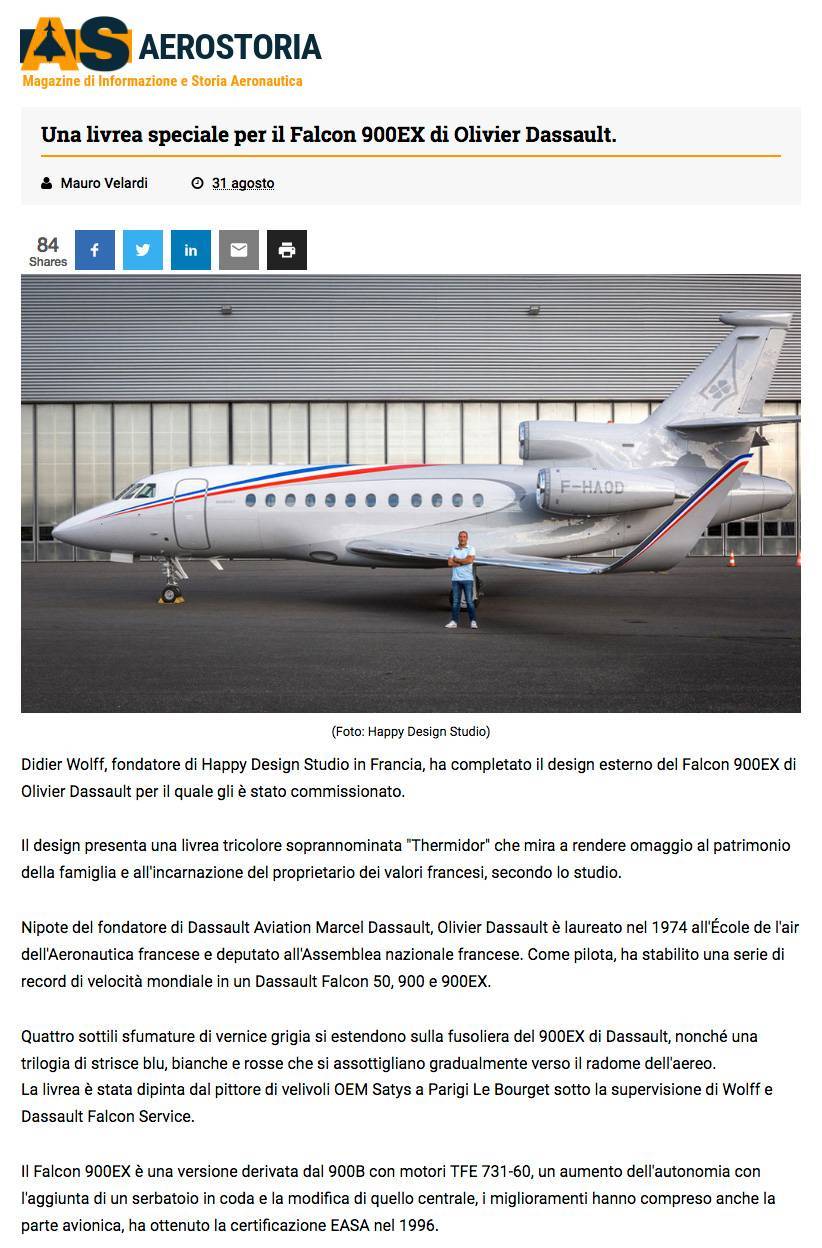
Read full article (text version) Source AEROSTORIA / This article is reproduced for archival purposes. Magazine di Informazione e Storia Aeronautica Una livrea speciale per il Falcon 900EX di Olivier Dassault. Mauro Velardi — 31 agosto (Foto: Happy Design Studio) Didier Wolff, fondatore di Happy Design Studio in Francia, ha completato il design esterno del Falcon 900EX di Olivier Dassault per il quale gli è stato commissionato. Il design presenta una livrea tricolore soprannominata “Thermidor” che mira a rendere omaggio al patrimonio della famiglia e all’incarnazione del proprietario dei valori francesi, secondo lo studio. Nipote del fondatore di Dassault Aviation Marcel Dassault, Olivier Dassault è laureato nel 1974 all’École de l’air dell’Aeronautica francese e deputato all’Assemblea nazionale francese. Come pilota, ha stabilito una serie di record di velocità mondiale in un Dassault Falcon 50, 900 e 900EX. Quattro sottili sfumature di vernice grigia si estendono sulla fusoliera del 900EX di Dassault, nonché una trilogia di strisce blu, bianche e rosse che si assottigliano gradualmente verso il radome dell’aereo. La livrea è stata dipinta dal pittore di velivoli OEM Satys a Parigi Le Bourget sotto la supervisione di Wolff e Dassault Falcon Service. Il Falcon 900EX è una versione derivata dal 900B con motori TFE 731-60, un aumento dell’autonomia con l’aggiunta di un serbatoio in coda e la modifica di quello centrale, i miglioramenti hanno compreso anche la parte avionica, ha ottenuto la certificazione EASA nel 1996.

ARTICLE N°276 / AEROSTORIA

 SEPTEMBER 2019

Read full article (text version) Source :AINonline / This article is reproduced for archival purposes. BUSINESS AVIATION Dassault Grandson’s 900EX Gets Custom Livery by Jerry Siebenmark – August 30, 2019, 10:03 AM Didier Wolff of Happy Design Studio was commissioned to design the livery for Olivier Dassault’s new Falcon 900 EX. (Photo: Happy Design Studio) Didier Wolff, founder of Happy Design Studio in France, has completed the exterior design of Olivier Dassault’s Falcon 900EX for which he was commissioned. The design features a tri-color livery dubbed “Thermidor” that aims to pay homage to the family’s heritage and the owner’s embodiment of French values, according to the studio. The grandson of Dassault Aviation founder Marcel Dassault, Olivier Dassault is a 1974 graduate of the French Air Force’s École de l’air and a deputy in the French National Assembly. As a pilot, he has set a number of world speed records in a Dassault Falcon 50, 900, and 900EX. Four subtle shades of gray paint stretch across the fuselage of Dassault’s 900EX as well as a trilogy of blue, white, and red stripes that gradually thin toward the aircraft’s radome. The words, “Faire face,” are painted near the jet’s engine intakes, which is the motto of French fighter pilot Georges Guynemer who was killed in action in 1917. The livery was painted by OEM aircraft painter Satys at Paris Le Bourget under the supervision of Wolff and Dassault Falcon Service over five weeks and 2,600 man-hours.

ARTICLE N°275 / AIN ONLINE

 SEPTEMBER 2019

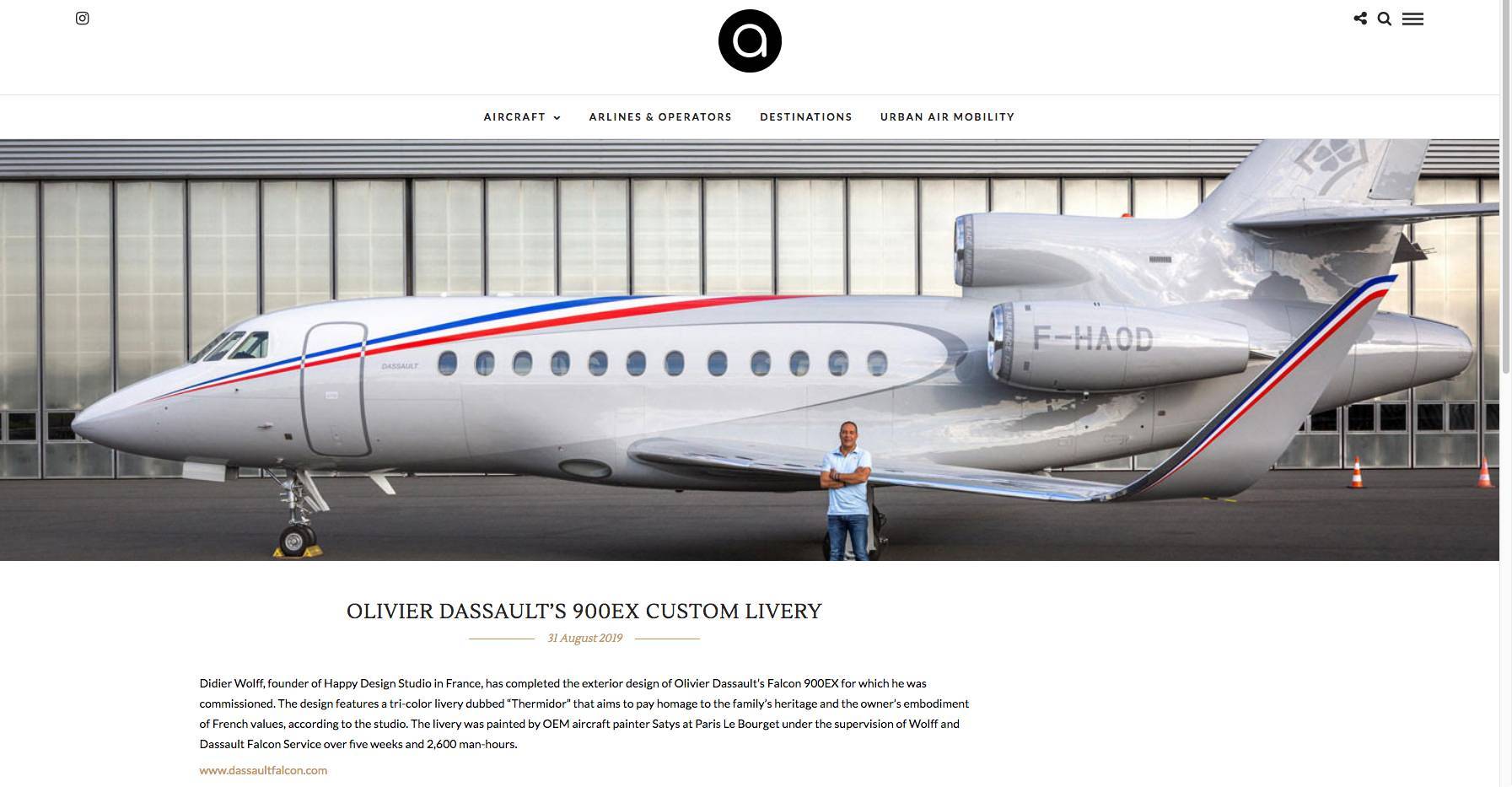
Read full article (text version) Source : AIR SPIRIT / This article is reproduced for archival purposes. OLIVIER DASSAULT’S 900EX CUSTOM LIVERY 31 August 2019 Didier Wolff, founder of Happy Design Studio in France, has completed the exterior design of Olivier Dassault’s Falcon 900EX for which he was commissioned. The design features a tri-color livery dubbed “Thermidor” that aims to pay homage to the family’s heritage and the owner’s embodiment of French values, according to the studio. The livery was painted by OEM aircraft painter Satys at Paris Le Bourget under the supervision of Wolff and Dassault Falcon Service over five weeks and 2,600 man-hours.

ARTICLE N°274 / AIR SPIRIT

 SEPTEMBER 2019

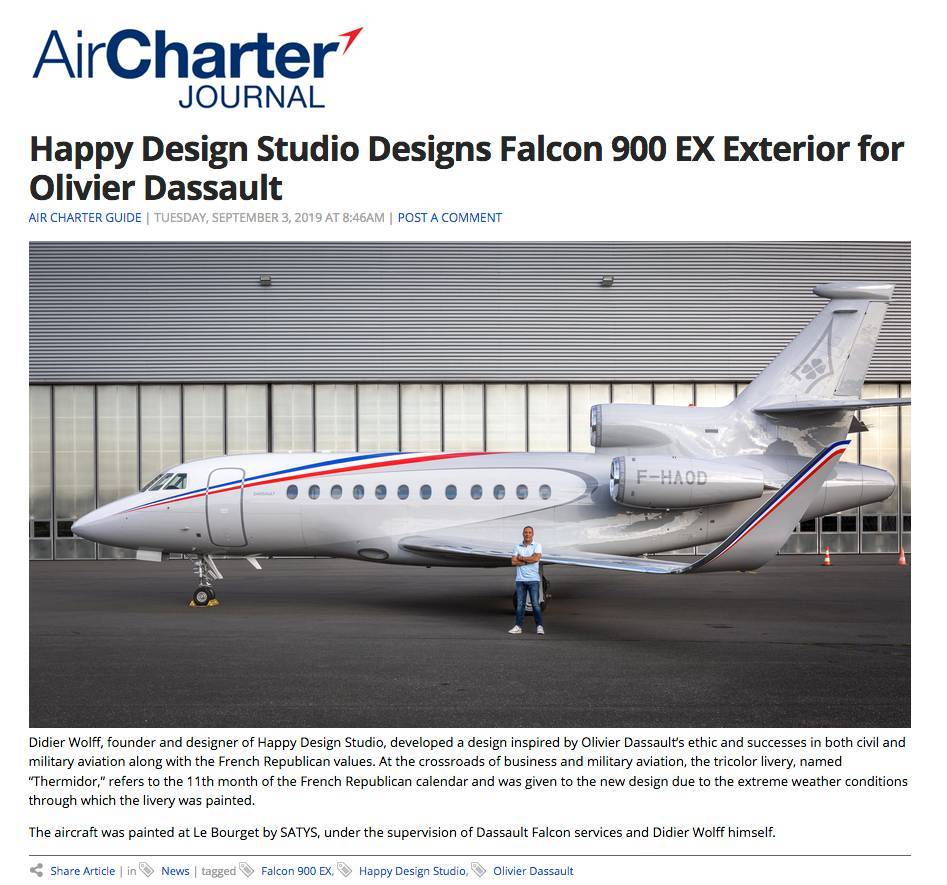
Read full article (text version) Source : AIR CHARTER JOURNAL AirCharter Journal / This article is reproduced for archival purposes. Happy Design Studio Designs Falcon 900 EX Exterior for Olivier Dassault AIR CHARTER GUIDE | TUESDAY, SEPTEMBER 3, 2019 AT 8:46AM | POST A COMMENT Didier Wolff, founder and designer of Happy Design Studio, developed a design inspired by Olivier Dassault’s ethic and successes in both civil and military aviation along with the French Republican values. At the crossroads of business and military aviation, the tricolor livery, named “Thermidor,” refers to the 11th month of the French Republican calendar and was given to the new design due to the extreme weather conditions through which the livery was painted. The aircraft was painted at Le Bourget by SATYS, under the supervision of Dassault Falcon services and Didier Wolff himself. Share Article | in News | tagged Falcon 900 EX, Happy Design Studio, Olivier Dassault

ARTICLE N°273 / AIR CHARTER JOURNAL

 SEPTEMBER 2019

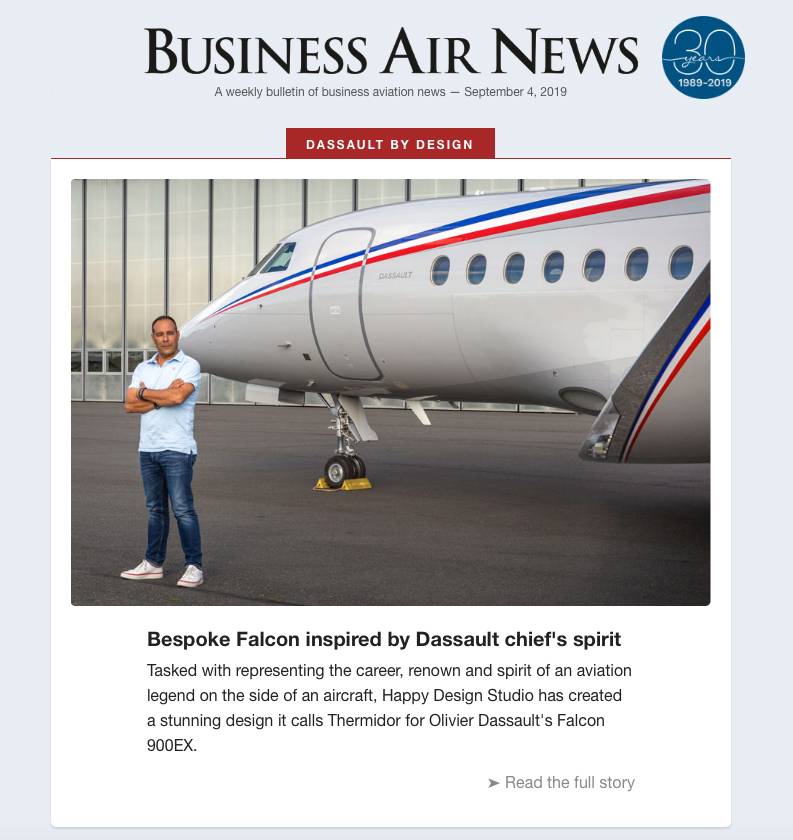
Read full article (text version) Source : BUSINESS AIR NEWS / This article is reproduced for archival purposes. A weekly bulletin of business aviation news — September 4, 2019 DASSAULT BY DESIGN Bespoke Falcon inspired by Dassault chief’s spirit Tasked with representing the career, renown and spirit of an aviation legend on the side of an aircraft, Happy Design Studio has created a stunning design it calls Thermidor for Olivier Dassault’s Falcon 900EX.

ARTICLE N°272 / BUSINESS AIR NEWS

 APRIL 2019

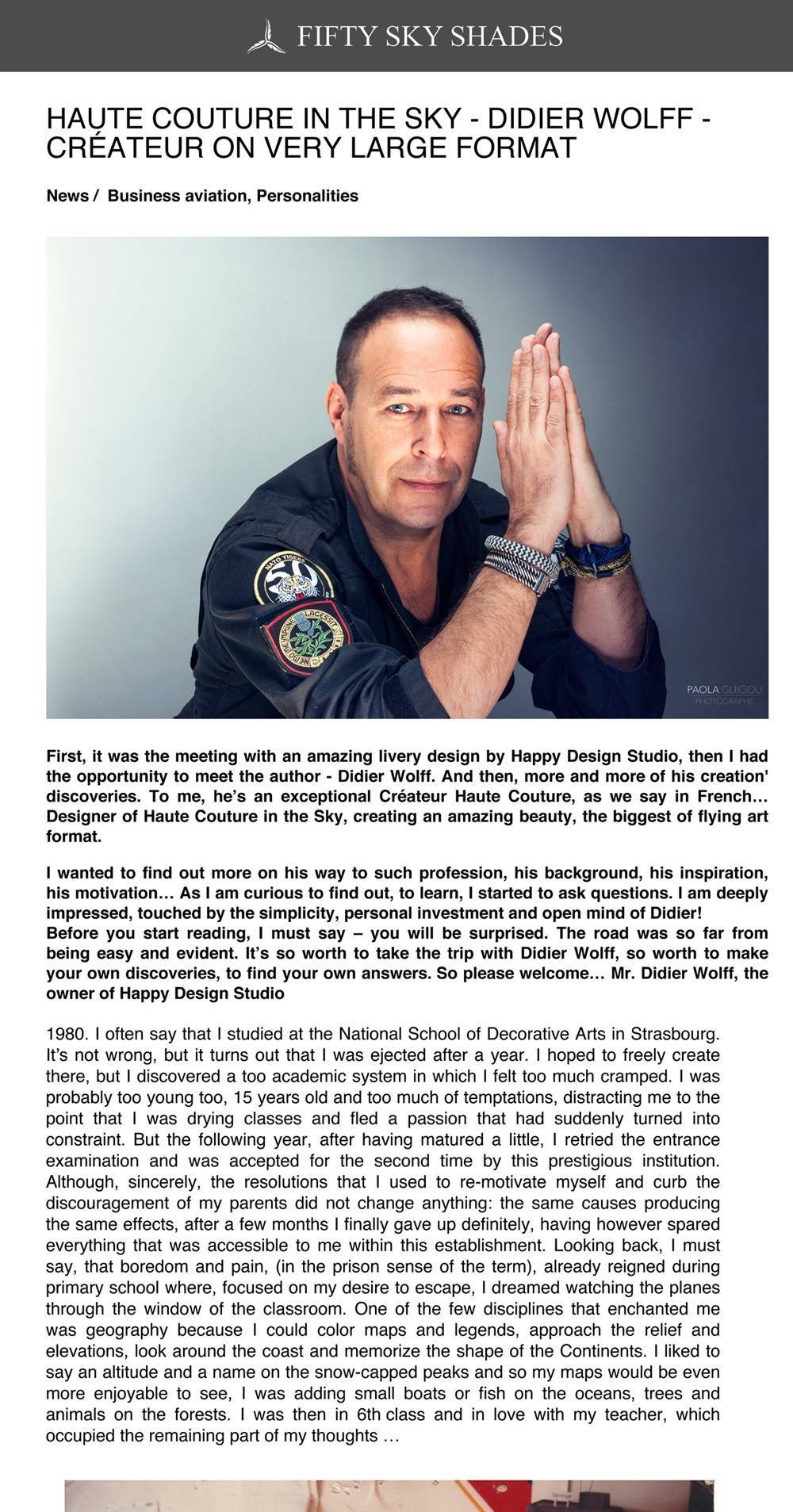
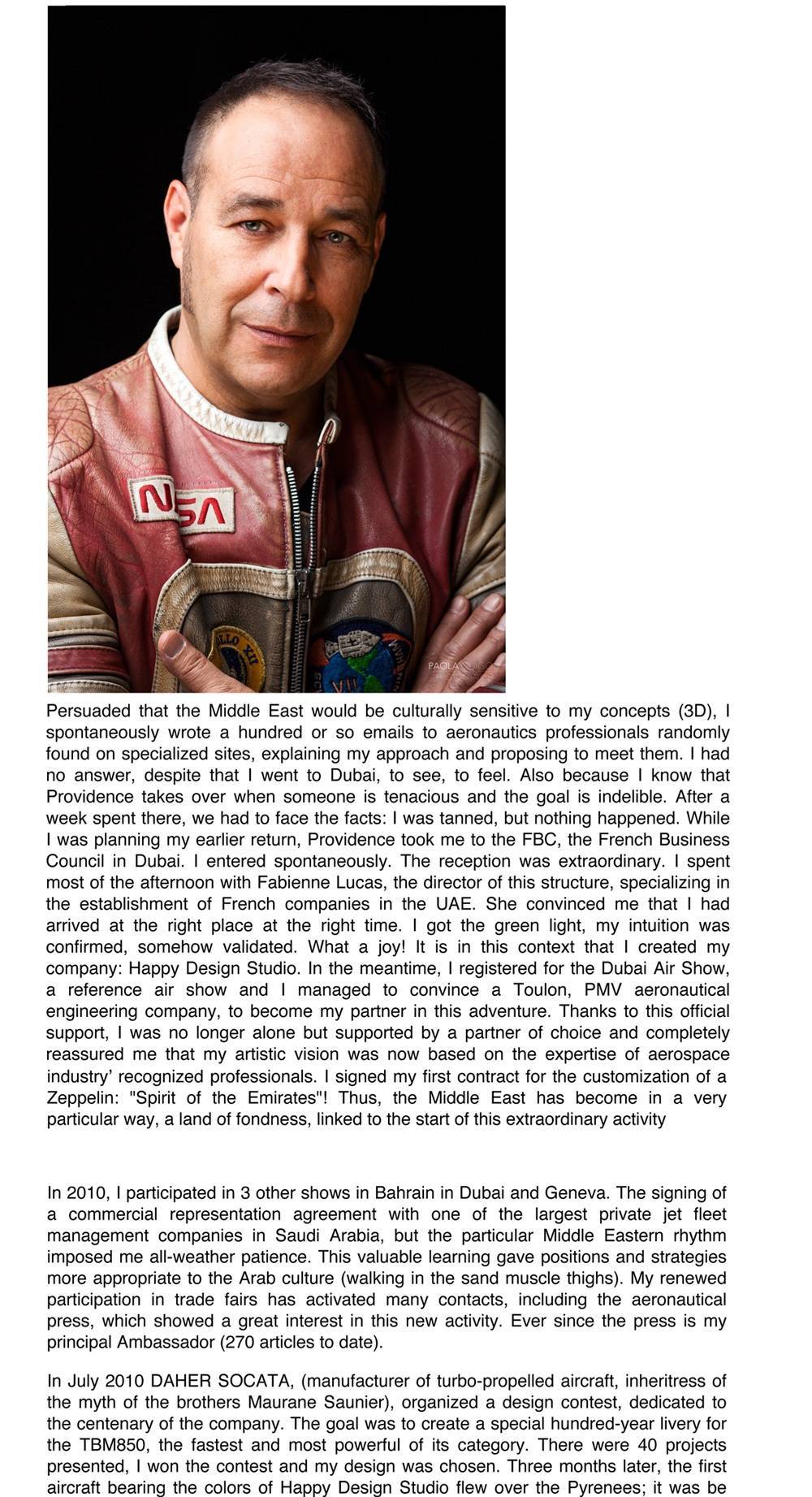
Read full article (text version) Source :FIFTY SKY SHADES / This article is reproduced for archival purposes. HAUTE COUTURE IN THE SKY – DIDIER WOLFF – CRÉATEUR ON VERY LARGE FORMAT News / Business aviation, Personalities First, it was the meeting with an amazing livery design by Happy Design Studio, then I had the opportunity to meet the author – Didier Wolff. And then, more and more of his creation’ discoveries. To me, he’s an exceptional Créateur Haute Couture, as we say in French… Designer of Haute Couture in the Sky, creating an amazing beauty, the biggest of flying art format. I wanted to find out more on his way to such profession, his background, his inspiration, his motivation… As I am curious to find out, to learn, I started to ask questions. I am deeply impressed, touched by the simplicity, personal investment and open mind of Didier! Before you start reading, I must say – you will be surprised. The road was so far from being easy and evident. It’s so worth to take the trip with Didier Wolff, so worth to make your own discoveries, to find your own answers. So please welcome… Mr. Didier Wolff, the owner of Happy Design Studio 1980 I often say that I studied at the National School of Decorative Arts in Strasbourg. It’s not wrong, but it turns out that I was ejected after a year. I hoped to freely create there, but I discovered a too academic system in which I felt too much cramped. I was probably too young too, 15 years old and too much of temptations, distracting me to the point that I was drying classes and fled a passion that had suddenly turned into constraint. But the following year, after having matured a little, I retried the entrance examination and was accepted for the second time by this prestigious institution. Although, sincerely, the resolutions that I used to re-motivate myself and curb the discouragement of my parents did not change anything: the same causes producing the same effects, after a few months I finally gave up definitely, having however spared everything that was accessible to me within this establishment. Looking back, I must say, that boredom and pain, (in the prison sense of the term), already reigned during primary school where, focused on my desire to escape, I dreamed watching the planes through the window of the classroom. One of the few disciplines that enchanted me was geography because I could color maps and legends, approach the relief and elevations, look around the coast and memorize the shape of the Continents. I liked to say an altitude and a name on the snow-capped peaks and so my maps would be even more enjoyable to see, I was adding small boats or fish on the oceans, trees and animals on the forests. I was then in 6th class and in love with my teacher, which occupied the remaining part of my thoughts … Persuaded that the Middle East would be culturally sensitive to my concepts (3D), I spontaneously wrote a hundred or so emails to aeronautics professionals randomly found on specialized sites, explaining my approach and proposing to meet them. I had no answer, despite that I went to Dubai, to see, to feel. Also because I know that Providence takes over when someone is tenacious and the goal is indelible. After a week spent there, we had to face the facts: I was tanned, but nothing happened. While I was planning my earlier return, Providence took me to the FBC, the French Business Council in Dubai. I entered spontaneously. The reception was extraordinary. I spent most of the afternoon with Fabienne Lucas, the director of this structure, specializing in the establishment of French companies in the UAE. She convinced me that I had arrived at the right place at the right time. I got the green light, my intuition was confirmed, somehow validated. What a joy! It is in this context that I created my company: Happy Design Studio. In the meantime, I registered for the Dubai Air Show, a reference air show and I managed to convince a Toulon, PMV aeronautical engineering company, to become my partner in this adventure. Thanks to this official support, I was no longer alone but supported by a partner of choice and completely reassured me that my artistic vision was now based on the expertise of aerospace industry’ recognized professionals. I signed my first contract for the customization of a Zeppelin: “Spirit of the Emirates”! Thus, the Middle East has become in a very particular way, a land of fondness, linked to the start of this extraordinary activity In 2010, I participated in 3 other shows in Bahrain in Dubai and Geneva. The signing of a commercial representation agreement with one of the largest private jet fleet management companies in Saudi Arabia, but the particular Middle Eastern rhythm imposed me all-weather patience. This valuable learning gave positions and strategies more appropriate to the Arab culture (walking in the sand muscle thighs). My renewed participation in trade fairs has activated many contacts, including the aeronautical press, which showed a great interest in this new activity. Ever since the press is my principal Ambassador (270 articles to date). In July 2010 DAHER SOCATA, (manufacturer of turbo-propelled aircraft, inheritress of the myth of the brothers Maurane Saunier), organized a design contest, dedicated to the centenary of the company. The goal was to create a special hundred-year livery for the TBM850, the fastest and most powerful of its category. There were 40 projects presented, I won the contest and my design was chosen. Three months later, the first aircraft bearing the colors of Happy Design Studio flew over the Pyrenees; it was be

ARTICLE N°271 / FIFTY SKY SHADES

 JANUARY 2019

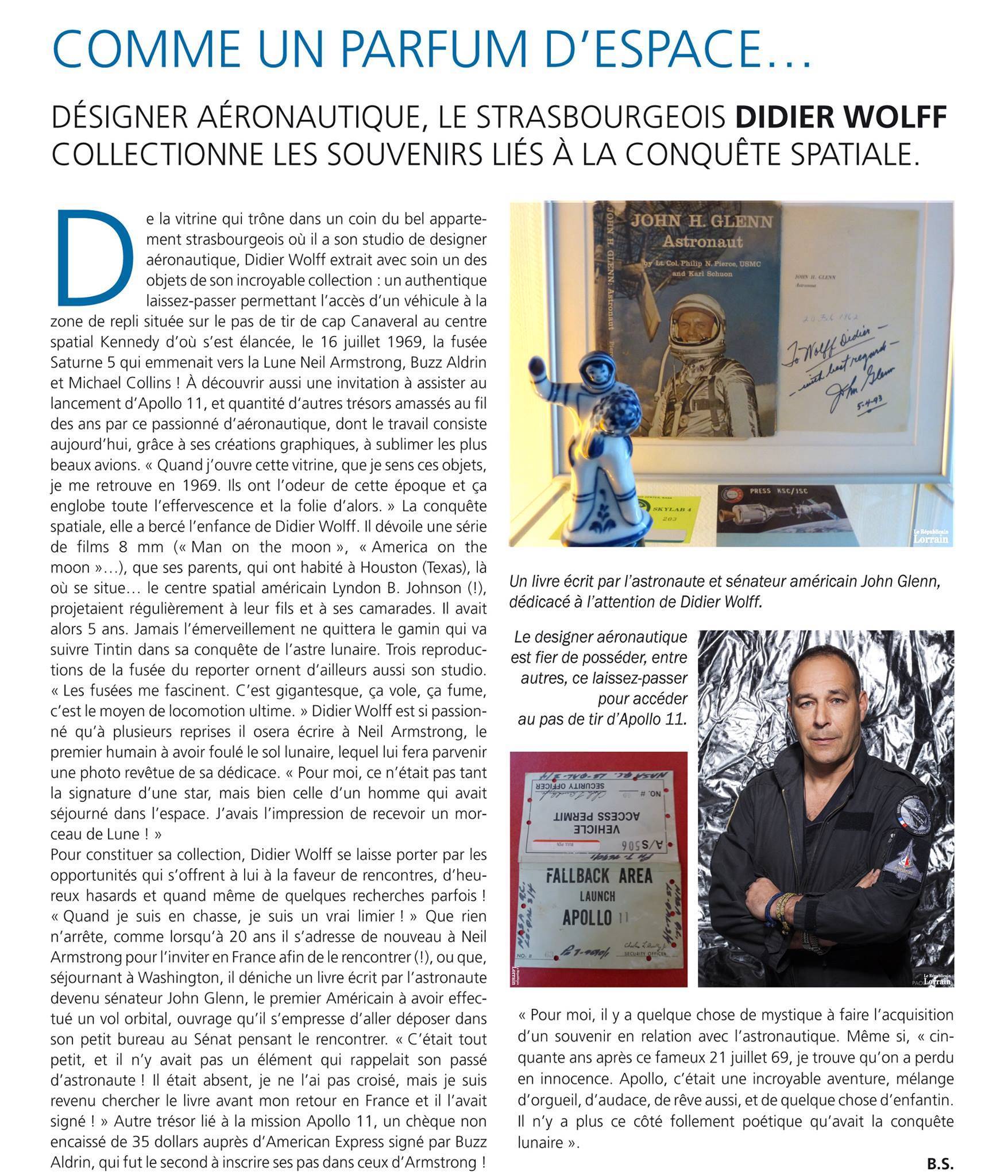
Read full article (text version) Source :L’EST REPUBLICAIN / This article is reproduced for archival purposes. COMME UN PARFUM D’ESPACE… DÉSIGNER AÉRONAUTIQUE, LE STRASBOURGEOIS DIDIER WOLFF COLLECTIONNE LES SOUVENIRS LIÉS À LA CONQUTE SPATIALE. De la vitrine qui trône dans un coin du bel appartement strasbourgeois où il a son studio de designer aéronautique, Didier Wolff extrait avec soin un des objets de son incroyable collection : un authentique laissez-passer permettant l’accès d’un véhicule à la zone de repli située sur le pas de tir de cap Canaveral au centre spatial Kennedy d’où s’est élancée, le 16 juillet 1969, la fusée Saturne 5 qui emmenait vers la Lune Neil Armstrong, Buzz Aldrin et Michael Collins ! À découvrir aussi une invitation à assister au lancement d’Apollo 11, et quantité d’autres trésors amassés au fil des ans par ce passionné d’aéronautique, dont le travail consiste aujourd’hui, grâce à ses créations graphiques, à sublimer les plus beaux avions. « Quand j’ouvre cette vitrine, que je sens ces objets, je me retrouve en 1969. Ils ont l’odeur de cette époque et ça englobe toute l’effervescence et la folie d’alors. » La conquête spatiale, elle a bercé l’enfance de Didier Wolff. Il dévoile une série de films 8 mm (« Man on the moon », « America on the moon »…), que ses parents, qui ont habité à Houston (Texas), là où se situe… le centre spatial américain Lyndon B. Johnson (!), projetaient régulièrement à leur fils et à ses camarades. Il avait alors 5 ans. Jamais l’émerveillement ne quittera le gamin qui va suivre Tintin dans sa conquête de l’astre lunaire. Trois reproductions de la fusée du reporter ornent d’ailleurs aussi son studio. « Les fusées me fascinent. C’est gigantesque, ça vole, ça fume, c’est le moyen de locomotion ultime. » Didier Wolff est si passionné qu’à plusieurs reprises il osera écrire à Neil Armstrong, le premier humain à avoir foulé le sol lunaire, lequel lui fera parvenir une photo revêtue de sa dédicace. « Pour moi, ce n’était pas tant la signature d’une star, mais bien celle d’un homme qui avait séjourné dans l’espace. J’avais l’impression de recevoir un morceau de Lune ! » Pour constituer sa collection, Didier Wolff se laisse porter par les opportunités qui s’offrent à lui à la faveur de rencontres, d’heureux hasards et quand même de quelques recherches parfois ! « Quand je suis en chasse, je suis un vrai limier ! » Que rien n’arrête, comme lorsqu’à 20 ans il s’adresse de nouveau à Neil Armstrong pour l’inviter en France afin de le rencontrer (!), ou que, séjournant à Washington, il déniche un livre écrit par l’astronaute devenu sénateur John Glenn, le premier Américain à avoir effectué un vol orbital, ouvrage qu’il s’empresse d’aller déposer dans son petit bureau au Sénat pensant le rencontrer. « C’était tout petit, et il n’y avait pas un élément qui rappelait son passé d’astronaute ! Il était absent, je ne l’ai pas croisé, mais je suis revenu chercher le livre avant mon retour en France et il l’avait signé ! » Autre trésor lié à la mission Apollo 11, un chèque non encaissé de 35 dollars auprès d’American Express signé par Buzz Aldrin, qui fut le second à inscrire ses pas dans ceux d’Armstrong ! Un livre écrit par l’astronaute et sénateur américain John Glenn, dédicacé à l’attention de Didier Wolff. Le designer aéronautique est fier de posséder, entre autres, ce laissez-passer pour accéder au pas de tir d’Apollo 11. « Pour moi, il y a quelque chose de mystique à faire l’acquisition d’un souvenir en relation avec l’astronautique. Même si, cinquante ans après ce fameux 21 juillet 69, je trouve qu’on a perdu en innocence. Apollo, c’était une incroyable aventure, mélange d’orgueil, d’audace, de rêve aussi, et de quelque chose d’enfantin. Il n’y a plus ce côté follement poétique qu’avait la conquête lunaire ».

ARTICLE N°270 / L’EST REPUBLICAIN

 JANUARY 2019

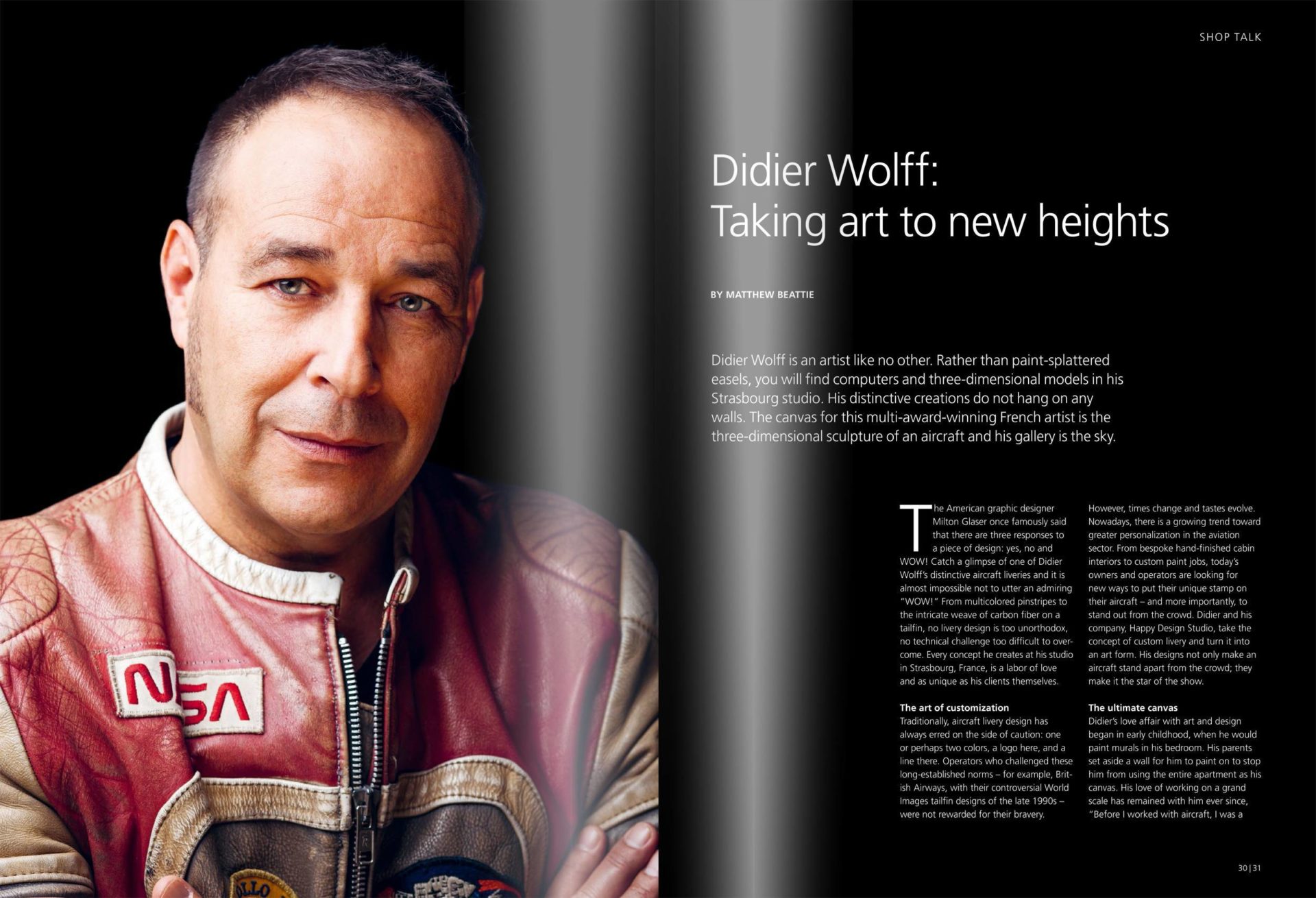
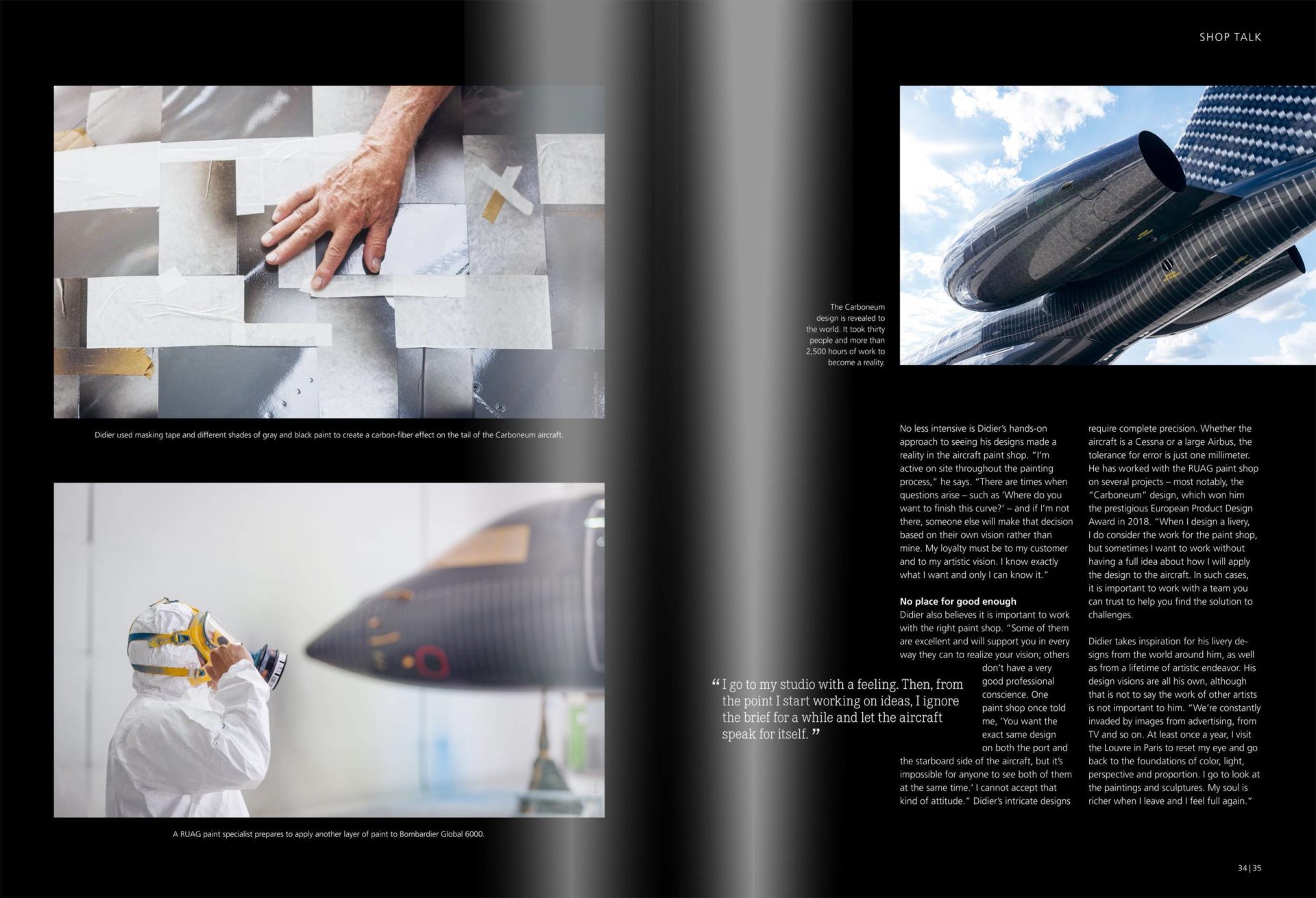
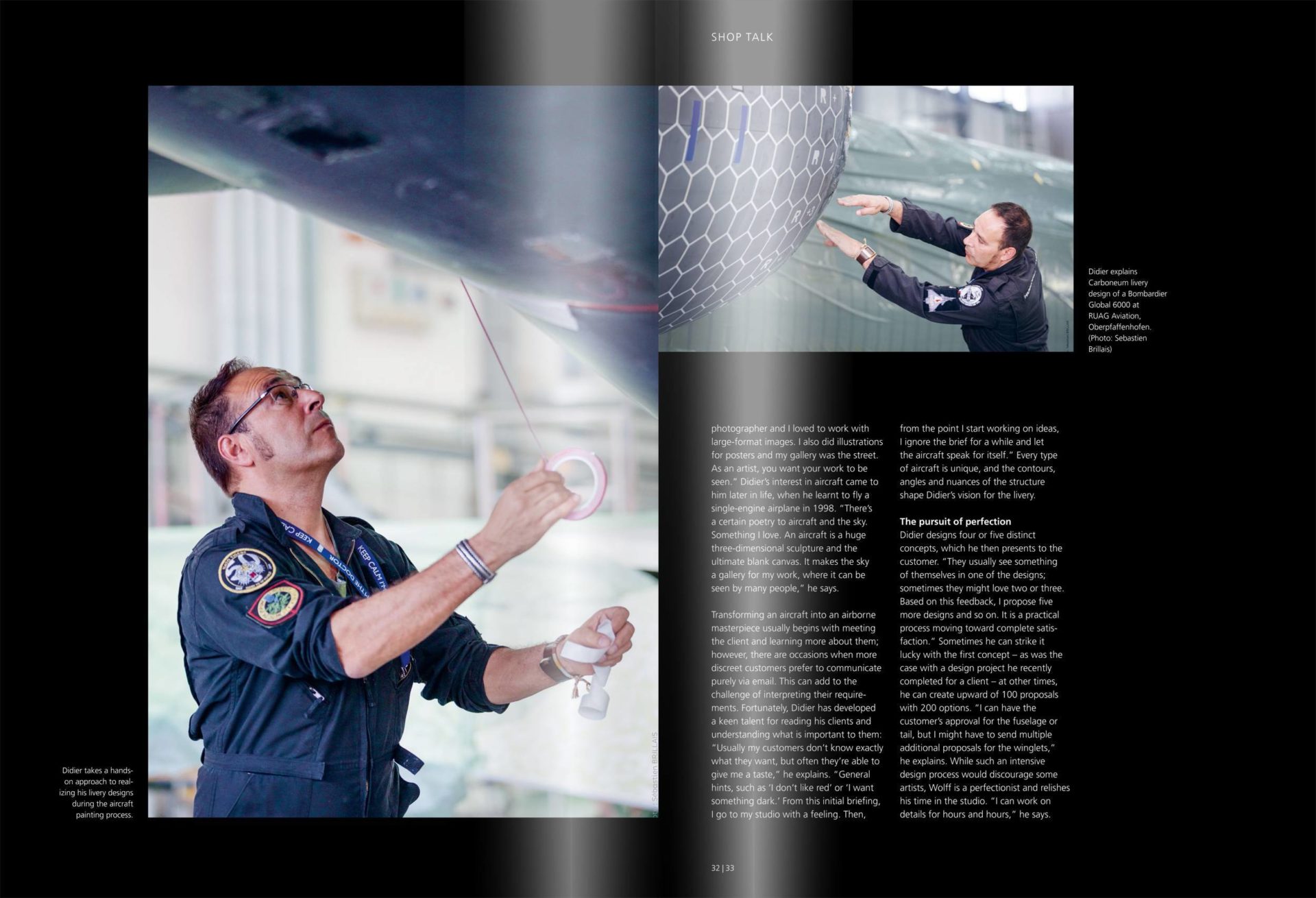
Read full article (text version) Source :LOVE MY JET / This article is reproduced for archival purposes. SHOP TALK Didier Wolff: Taking art to new heights BY MATTHEW BEATTIE Didier Wolff is an artist like no other. Rather than paint-splattered easels, you will find computers and three-dimensional models in his Strasbourg studio. His distinctive creations do not hang on any walls. The canvas for this multi-award-winning French artist is the three-dimensional sculpture of an aircraft and his gallery is the sky. The American graphic designer Milton Glaser once famously said that there are three responses to a piece of design: yes, no and WOW! Catch a glimpse of one of Didier Wolff’s distinctive aircraft liveries and it is almost impossible not to utter an admiring “WOW!” From multicolored pinstripes to the intricate weave of carbon fiber on a tailfin, no livery design is too unorthodox, no technical challenge too difficult to overcome. Every concept he creates at his studio in Strasbourg, France, is a labor of love and as unique as his clients themselves. The art of customization Traditionally, aircraft livery design has always erred on the side of caution: one or perhaps two colors, a logo here, and a line there. Operators who challenged these long-established norms – for example, British Airways, with their controversial World Images tailfin designs of the late 1990s – were not rewarded for their bravery. However, times change and tastes evolve. Nowadays, there is a growing trend toward greater personalization in the aviation sector. From bespoke hand-finished cabin interiors to custom paint jobs, today’s owners and operators are looking for new ways to put their unique stamp on their aircraft – and more importantly, to stand out from the crowd. Didier and his company, Happy Design Studio, take the concept of custom livery and turn it into an art form. His designs not only make an aircraft stand apart from the crowd; they make it the star of the show. The ultimate canvas Didier’s love affair with art and design began in early childhood, when he would paint murals in his bedroom. His parents set aside a wall for him to paint on to stop him from using the rest of the apartment as his canvas. His love of working on a grand scale has remained with him ever since. “Before I worked with aircraft, I was a Didier used masking tape and different shades of gray and black paint to create a carbon-fiber effect on the tail of the Carboneum aircraft. A RUAG paint specialist prepares to apply another layer of paint to Bombardier Global 6000. The Carboneum design is revealed to the world. It took thirty people and more than 2,500 hours of work to become a reality. No less intensive is Didier’s hands-on approach to seeing his designs made a reality in the aircraft paint shop. “I’m active on site throughout the painting process,” he says. “There are times when questions arise – such as ‘Where do you want to finish this curve?’ – and if I’m not there, someone else will make that decision based on their own vision rather than mine. My loyalty must be to my customer and to my artistic vision. I know exactly what I want and only I can know it.” No place for good enough Didier also believes it is important to work with the right paint shop. “Some of them are excellent and will support you in every way they can to realize your vision; others don’t have a very good professional conscience. One paint shop once told me, ‘You want the exact same design on both the port and the starboard side of the aircraft, but it’s impossible for anyone to see both of them at the same time. I cannot accept that kind of attitude.’ Didier’s intricate designs require complete precision. Whether the aircraft is a Cessna or a large Airbus, the tolerance for errors is just one millimeter. He has worked with the RUAG paint shop on several projects – most notably, the “Carboneum” design, which won the prestigious European Product Design Award in 2018. “When I design a livery, I do consider the work for the paint shop, but sometimes I want to work without having a full idea about how I will apply the design to the aircraft. In such cases, it is important to work with a team you can trust to help you find the solution to challenges.” Didier takes inspiration for his livery designs from the world around him, as well as from a lifetime of artistic endeavour. His design visions are all his own, although that is not to say the work of other artists is not important to him. “We’re constantly invaded by images from advertising, from TV and so on. At least once a year, I visit the Louvre in Paris to reset my eye and go back to the foundations of color, light, perspective and proportions. I go look at the paintings and sculptures. My soul is richer when I leave and I feel full again.” “I go to my studio with a feeling. Then, from the point I start working on ideas, I ignore the brief for a while and let the aircraft speak for itself.” SHOP TALK Didier takes a hands-on approach to realizing his livery designs during the aircraft painting process. Didier explains Carboneum livery design to Bombardier Global 6000 at RUAG Aviation, Oberpfaffenhofen. (Photo: Sebastien Brillais) photographer and I loved to work with strong images. I also did illustrations for posters and my gallery was the street. As an artist, you want your work to be seen.” Didier’s interest in aircraft took off later in life, when he flew to fly a single-engine airplane in 1998. “There’s a certain poetry about aircraft in the sky. Something I love. An aircraft is a huge three-dimensional sculpture and the ultimate blank canvas. It makes the sky a gallery for my work, where it can be seen by many people,” he says. Transforming an aircraft into an airborne masterpiece usually begins with meeting the client and learning more about their vision. However, there are occasions when more discreet customers choose to communicate purely via email. This can add to the challenge of interpreting their requirements. Fortunately, Didier has developed a keen talent for reading his clients and understanding what is important to them: “Usually my customers don’t know exactly what they want, but often they’re able to give me a taste,” he explains. “General hints, such as ‘I don’t like red’ or ‘I want something dark.’ From this initial briefing, I go to my studio with a feeling. Then, from the point I start working on ideas, I ignore the brief for a while and let the aircraft speak for itself.” Every type of aircraft is unique, and the contours, angles and nuances of the structure shape Didier’s vision for the livery. The pursuit of perfection Didier designs four or five distinct concepts, which he then presents to the customer. “They usually see something of themselves in one of the designs; sometimes they might love two or three. Based on this feedback, I propose five more designs and so on. It is a practical process moving toward complete satisfaction.” Sometimes he can strike it lucky with the first concept – as was the case with a design project he recently completed for a client – at other times, he can create upward of 100 proposals with 200 options. “I can have the customer’s approval for the fuselage or tail, but I might have to send multiple additional proposals for the winglets,” he explains. While such an intensive design process would discourage some artists, Wolff is a perfectionist and relishes his time in the studio. “I can work on details for hours and hours,” he says.

ARTICLE N°269 / LOVE MY JET

Press

2025
2024
2023
2022
2020-2021
2019
2018
2017
2016
2015
2014
2013
2012
2011
2010
2009