Press
NOVEMBRE 2017
Read full article (text version)
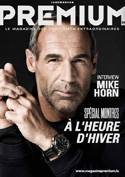
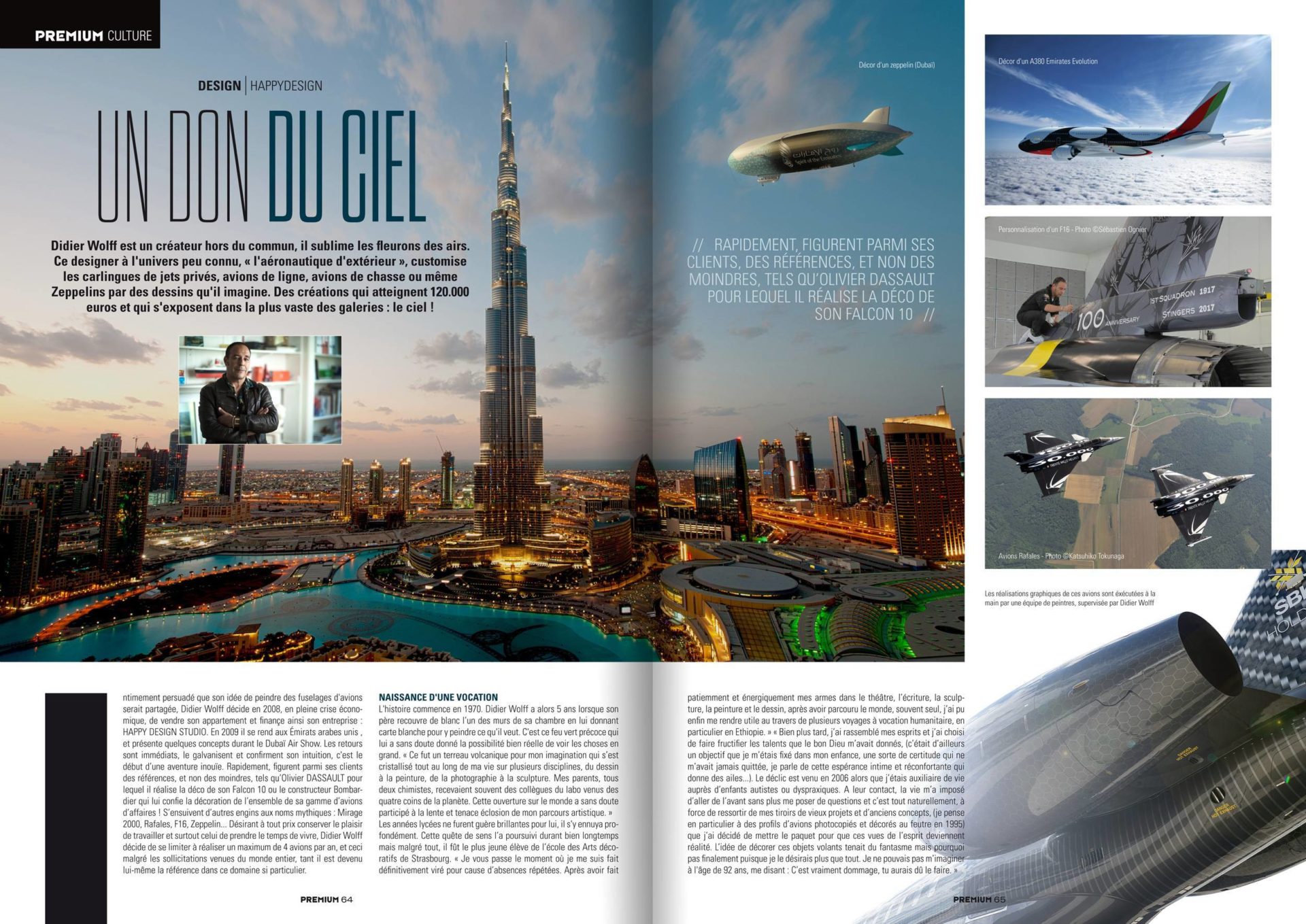
Source :PREMIUM MAGAZINE / This article is reproduced for archival purposes. PREMIUM CULTURE DESIGN | HAPPYDESIGN UN DON DU CIEL Didier Wolff est un créateur hors du commun, il sublime les fleurons des airs. Ce designer à l’univers peu connu, « l’aéronautique d’extérieur », customise les carlingues de jets privés, avions de ligne, avions de chasse ou même Zeppelins par des dessins qu’il imagine. Des créations qui atteignent 120.000 euros et qui s’exposent dans la plus vaste des galeries : le ciel ! // RAPIDEMENT, FIGURENT PARMI SES CLIENTS, DES RÉFÉRENCES, ET NON DES MOINDRES, TELS QU’OLIVIER DASSAULT POUR LEQUEL IL RÉALISE LA DÉCO DE SON FALCON 10 // NAISSANCE D’UNE VOCATION L’histoire commence en 1970. Didier Wolff a alors 5 ans lorsqu’on lui recouvre de blanc l’un des murs de sa chambre en lui donnant carte blanche pour y peindre ce qu’il veut. C’est ce feutre précoce qui lui a sans doute donné la possibilité bien réelle de voir les choses en grand. Ce fut un terreau volcanique pour mon imagination qui s’est cristallisé tout au long de ma vie sur plusieurs disciplines, du dessin à la peinture, de la photographie à la sculpture. Mes parents, tous deux chimistes, recevaient souvent des collègues du labo venus discuter autour de la planète. Cette ouverture sur le monde a sans doute participé à la lente et tenace éclosion de mon parcours artistique. Les années lycée ne furent guère brillantes pour lui, il s’y ennuya profondément. Cette quête de sens l’a poussé à évoluer longuement malgré tout, il fut le plus jeune élève de l’école des Arts décoratifs de Strasbourg, où il y passa le moment de sa vie fait définitivement virer pour cause d’absences répétées. Après avoir fait patiemment et énergiquement mes armes dans le théâtre, l’écriture, la sculpture, la peinture et le dessin, après avoir parcouru le monde, souvent seul, j’ai pu enfin me rendre utile au travers de voyages à vocation humanitaire, en particulier en Éthiopie. « Bien plus tard, j’ai rassemblé mes esprits et j’ai choisi de faire fructifier le don que Dieu m’avait donné, (c’était d’ailleurs un objectif que je m’étais fixé dans mon enfance, une sorte de certitude que je n’avais jamais quittée), de parler de cette expérience intime et réconfortante qui donne des ailes. Je le décide en 2006 alors que j’étais auxiliaire de vie auprès d’enfants autistes ou dyspraxiques. À leur contact, la vie m’a imposé d’aller de l’avant sans plus perdre de secondes et c’est tout naturellement, à force de ressortir de mes tiroirs de vieux projets et d’anciens concepts, (je pense en particulier à des profils d’avions photoshopés et décorés en 1995) que j’ai décidé de mettre le paquet pour que ces vues de l’esprit deviennent réalité. L’idée de décorer ces objets volants tenait du fantasme mais pourquoi attendre si longtemps puisque je désirais plus que tout. Je ne pouvais pas m’imaginer à l’âge de 92 ans, en me disant : “C’est vraiment dommage, tu aurais dû le faire.” »ARTICLE N° 256 / PREMIUM MAGAZINE


NOVEMBRE 2017
Read full article (text version)
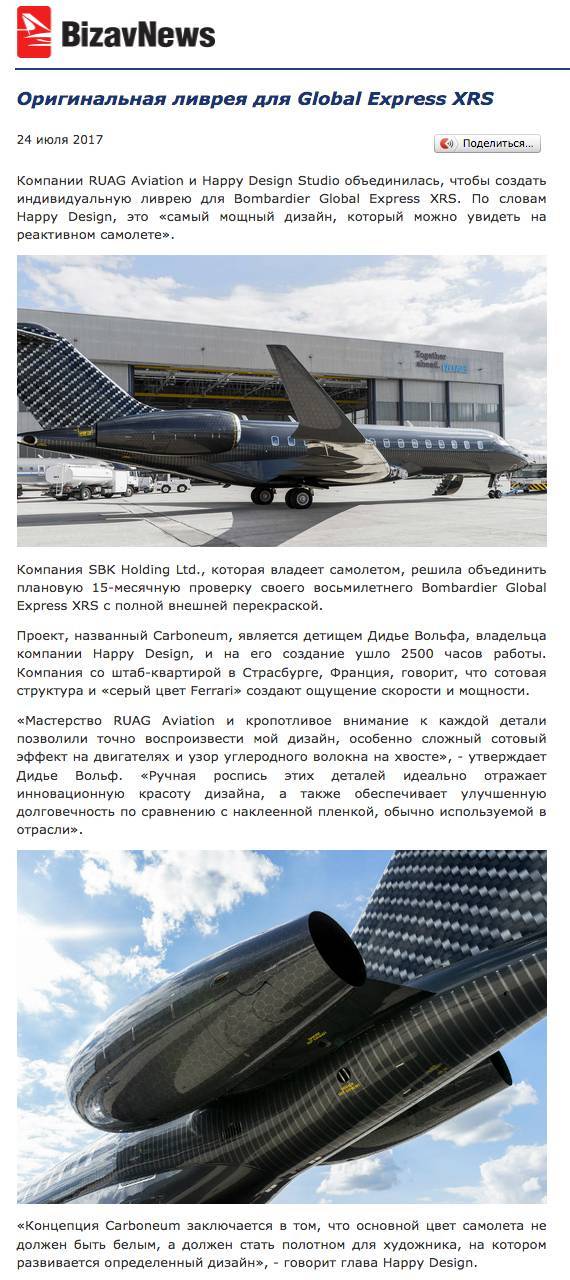
Source :BIZAVNEWS / This article is reproduced for archival purposes. BizavNews Оригинальная ливрея для Global Express XRS 24 июля 2017 Компании RUAG Aviation и Happy Design Studio объединились, чтобы создать индивидуальную ливрею для Bombardier Global Express XRS. По словам Happy Design, это «самый мощный дизайн, который можно увидеть на реактивном самолете». Компания SBK Holding Ltd., которая владеет самолетом, решила объединить плановую 15-месячную проверку своего восьмилетнего Bombardier Global Express XRS с полной внешней перекраской. Проект, названный Carboneum, является детищем Дидье Вольфа, владельца компании Happy Design, и на его создание ушло 2500 часов работы. Компания со штаб-квартирой в Страсбурге, Франция, говорит, что сотовая структура и «серый цвет Ferrari» создают ощущение скорости и мощности. «Мастерство RUAG Aviation и кропотливое внимание к каждой детали позволили точно воспроизвести мой дизайн, особенно сложный сотовый эффект на двигателях из углеродного волокна на хвосте», — утверждает Дидье Вольф. «Ручная роспись этих деталей идеально отражает инновационную красоту дизайна, а также обеспечивает улучшенную долговечность по сравнению с наклеенной пленкой, обычно используемой в отрасли». «Концепция Carboneum заключается в том, что основной цвет самолета не должен быть белым, а должен стать полотном для художника, на котором развивается определенный дизайн», — говорит глава Happy Design.ARTICLE N° 255 / BIZAVNEWS

NOVEMBRE 2017
Read full article (text version)
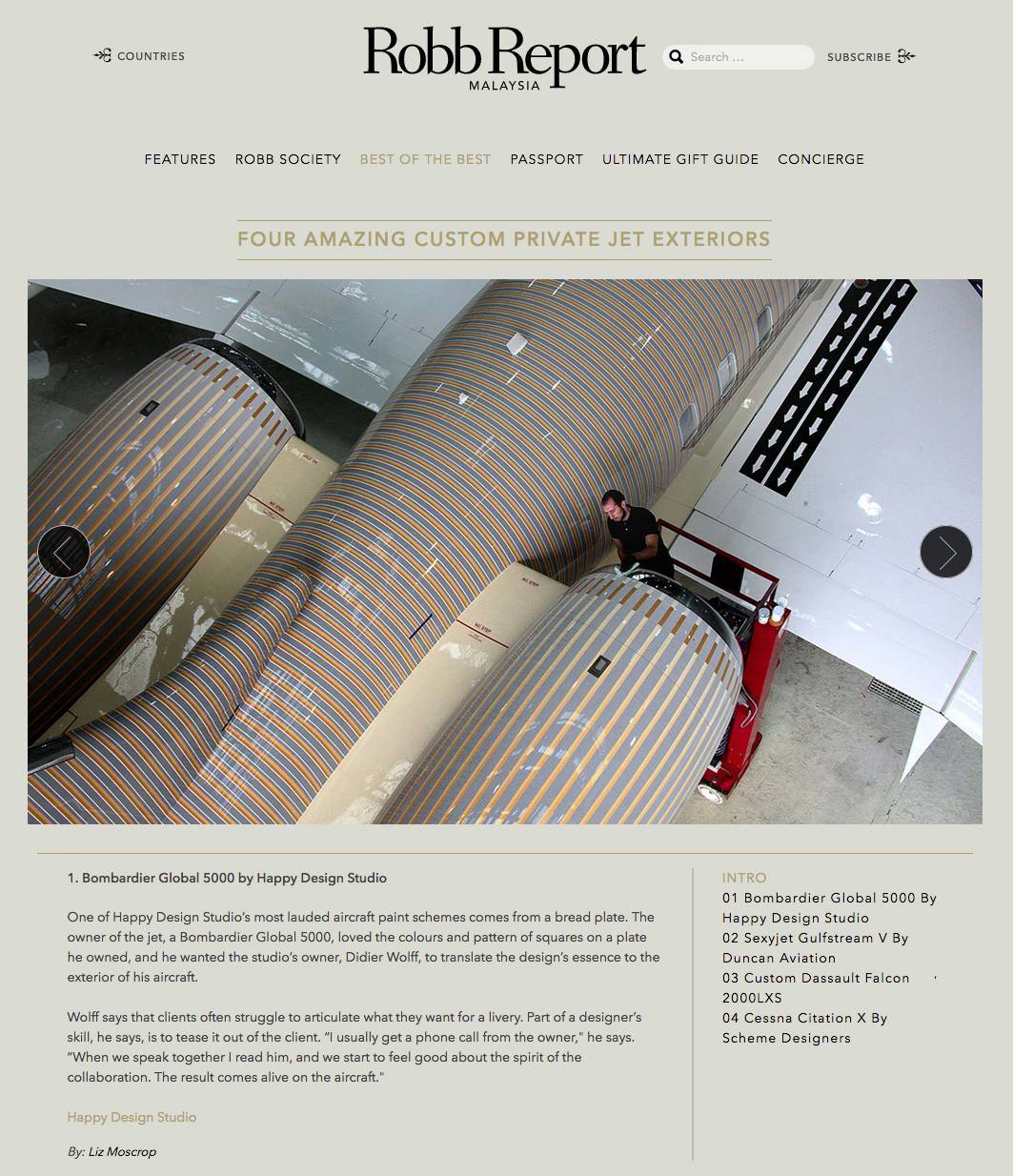
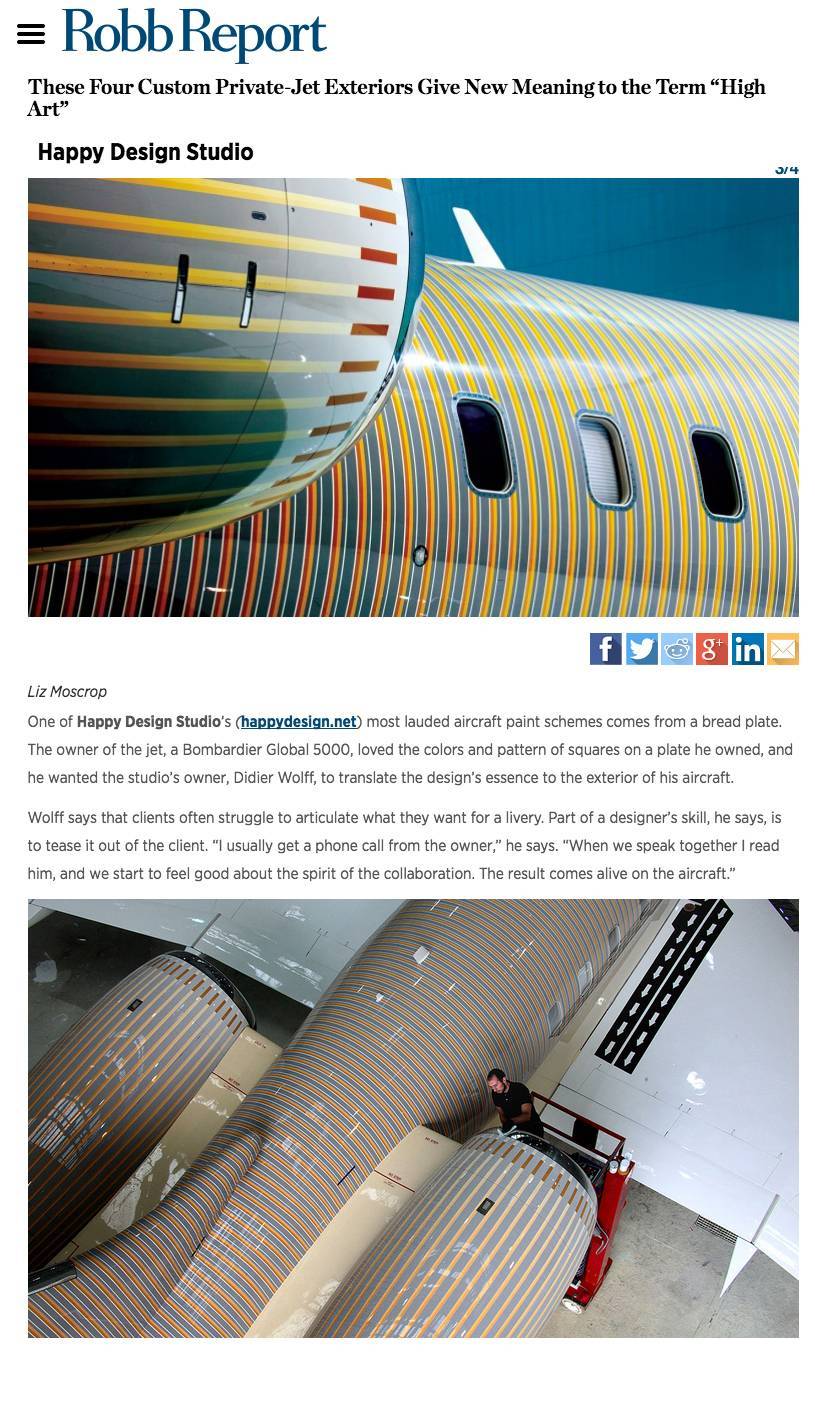
Source :ROB REPORT MALAYSIA / This article is reproduced for archival purposes. FEATURES ROBB SOCIETY BEST OF THE BEST ULTIMATE GIFT GUIDE CONCIERGE FOUR AMAZING CUSTOM PRIVATE JET EXTERIORS 1. Bombardier Global 5000 by Happy Design Studio One of Happy Design Studio’s most lauded aircraft paint schemes comes from a bread plate. The owner of the jet, a Bombardier Global 5000, loved the colours and pattern of squares on a plate he owned, and he wanted the studio’s owner, Didier Wolff, to translate the design’s essence to the exterior of his aircraft. Wolff says that clients often struggle to articulate what they want for a livery. Part of a designer’s skill, he says, is to tease it out of the client. “I usually get a phone call from the owner,” he says. “When we speak together I read him, and we start to feel good about the spirit of the collaboration. The result comes alive on the aircraft.” Happy Design Studio By: Liz MoscropARTICLE N° 254 / ROB REPORT MALAYSIA

NOVEMBRE 2017
Read full article (text version)
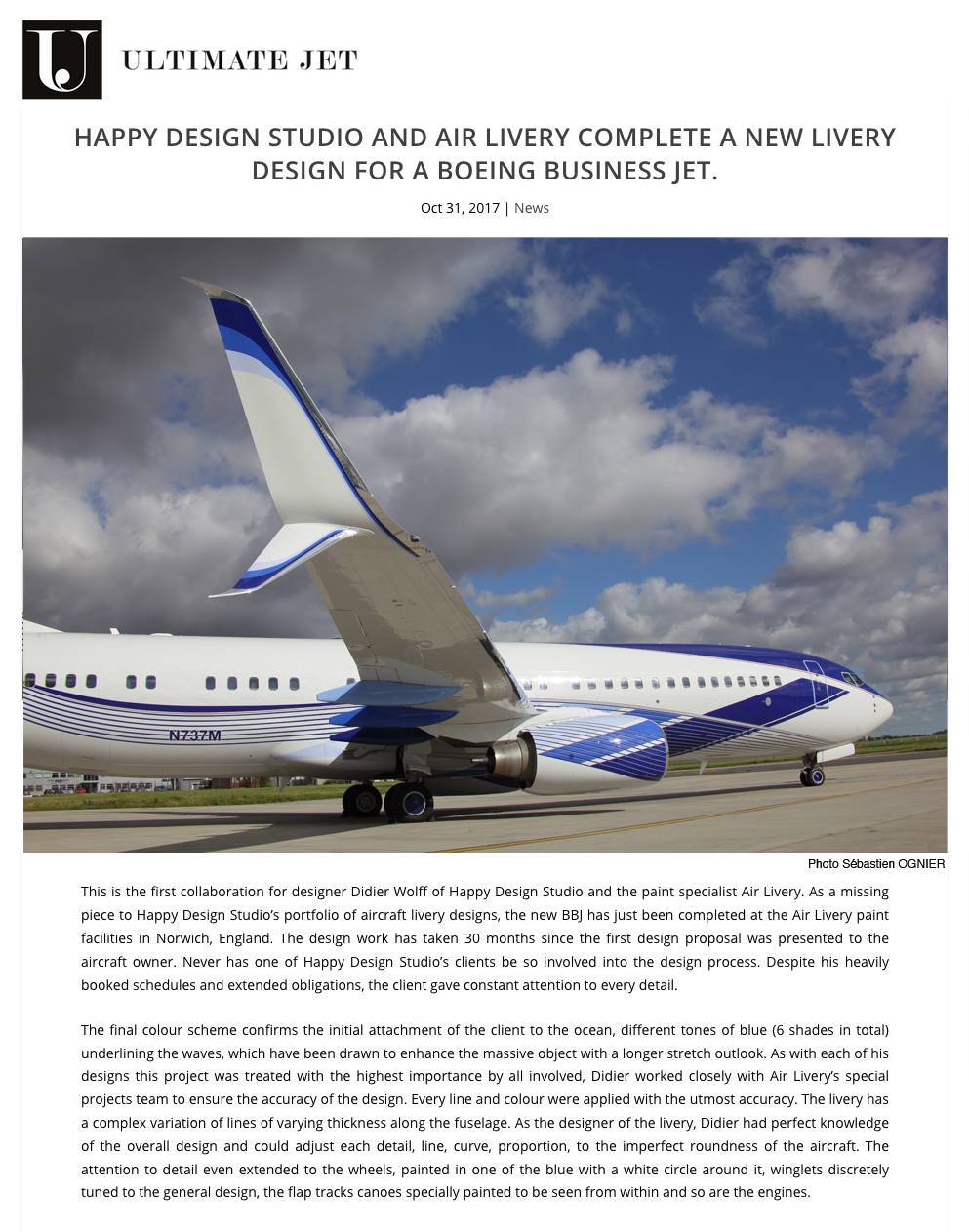
Source :ULTIMATE JET MAGAZINE / This article is reproduced for archival purposes. ULTIMATE JET HAPPY DESIGN STUDIO AND AIR LIVERY COMPLETE A NEW LIVERY DESIGN FOR A BOEING BUSINESS JET. Oct 31, 2017 | News Photo Sébastien OGNIER This is the first collaboration for designer Didier Wolff of Happy Design Studio and the paint specialist Air Livery. As a missing piece to Happy Design Studio’s portfolio of aircraft livery designs, the new BBJ has just been completed at the Air Livery paint facilities in Norwich, England. The design work has taken 30 months since the first design proposal was presented to the aircraft owner. Never has one of Happy Design Studio’s clients be so involved into the design process. Despite his heavily booked schedules and extended obligations, the client gave constant attention to every detail. The final colour scheme confirms the initial attachment of the client to the ocean, different tones of blue (6 shades in total) underlining the waves, which have been drawn to enhance the massive object with a longer stretch outlook. As with each of his designs this project was treated with the highest importance by all involved, Didier worked closely with Air Livery’s special projects team to ensure the accuracy of the design. Every line and colour were applied with the utmost accuracy. The livery has a complex variation of lines of varying thickness along the fuselage. As the designer of the livery, Didier had perfect knowledge of the overall design and could adjust each detail, line, curve, proportion, to the imperfect roundness of the aircraft. The attention to detail even extended to the wheels, painted in one of the blue with a white circle around it, winglets discreetly tuned to the general design, the flap tracks canoes specially painted to be seen from within and so are the engines.ARTICLE N° 253 / ULTIMATE JET MAGAZINE

OCTOBRE 2017
Read full article (text version)
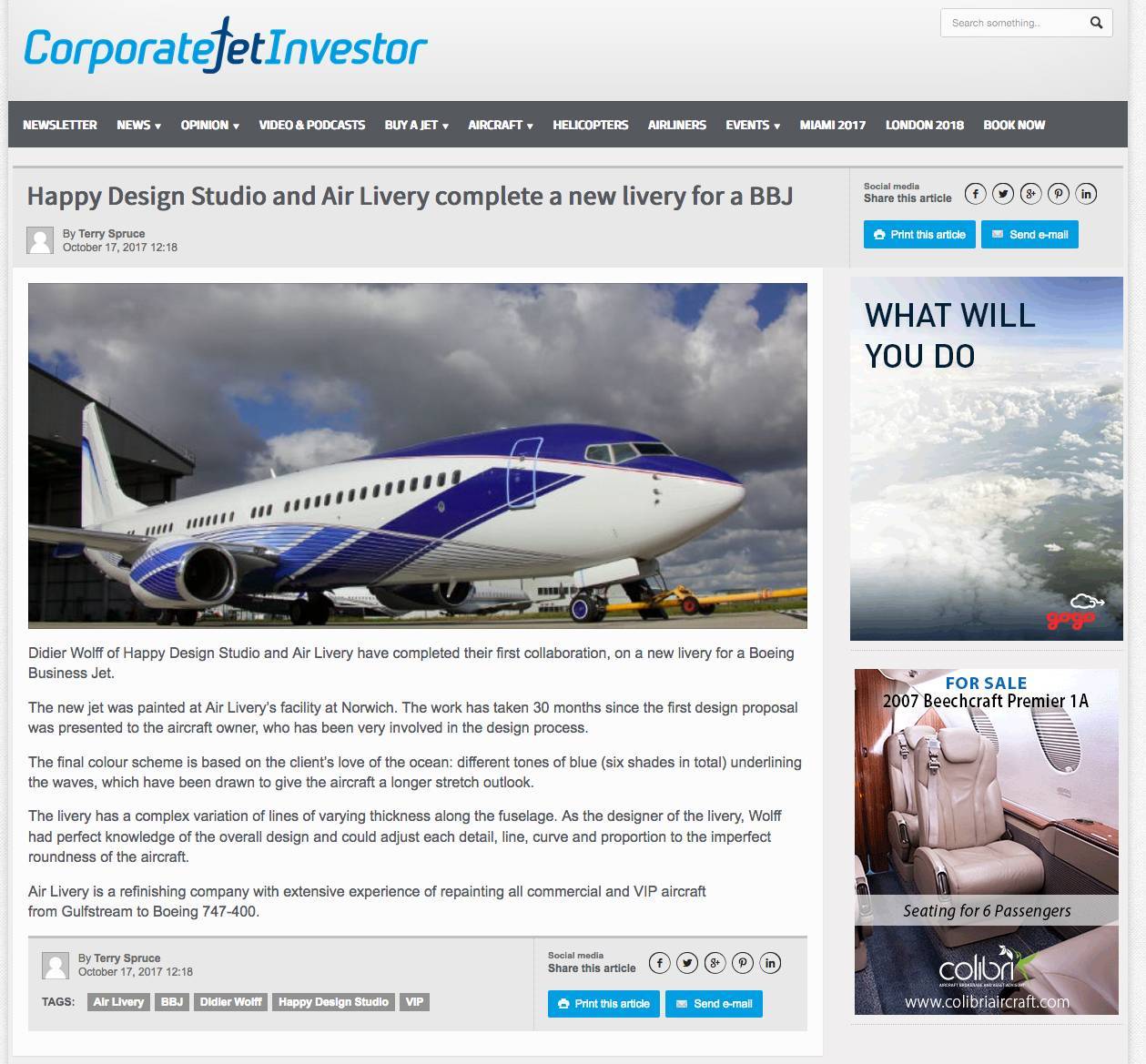
Source :CORPORATE JET INVESTOR / This article is reproduced for archival purposes. Happy Design Studio and Air Livery complete a new livery for a BBJ By Terry Spruce October 17, 2017 12:18 Didier Wolff of Happy Design Studio and Air Livery have completed their first collaboration, on a new livery for a Boeing Business Jet. The new jet was painted at Air Livery’s facility at Norwich. The work has taken 30 months since the first design proposal was presented to the aircraft owner, who has been very involved in the design process. The final colour scheme is based on the client’s love of the ocean: different tones of blue (six shades in total) underlining the waves, which have been drawn to give the aircraft a longer stretch outlook. The livery has a complex variation of lines of varying thickness along the fuselage. As the designer of the livery, Wolff had perfect knowledge of the overall design and could adjust each detail, line, curve and proportion to the imperfect roundness of the aircraft. Air Livery is a refinishing company with extensive experience of repainting all commercial and VIP aircraft from Gulfstream to Boeing 747-400. By Terry Spruce October 17, 2017 12:18ARTICLE N° 252 / CORPORATE JET INVESTOR
OCTOBRE 2017
Read full article (text version)
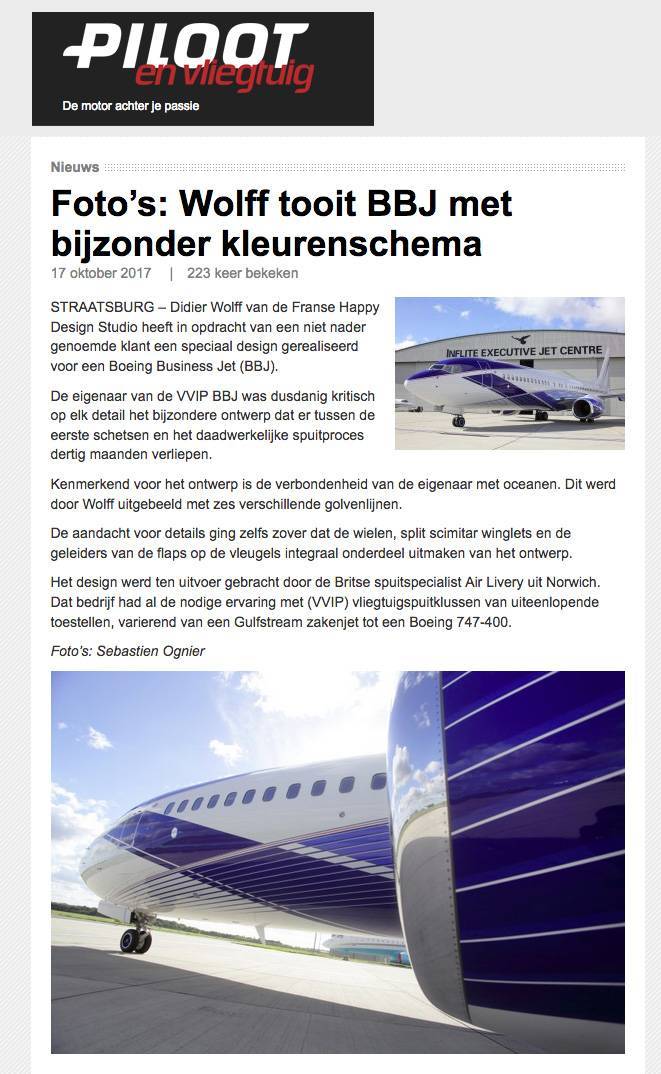
Source :PILOOT EN VLIEGTUIG / This article is reproduced for archival purposes. De motor achter je passie Nieuws Foto’s: Wolff tooit BBJ met bijzonder kleurenschema 17 oktober 2017 | 223 keer bekeken STRAATSBURG – Didier Wolff van de Franse Happy Design Studio heeft in opdracht van een niet nader genoemde klant een speciaal design gerealiseerd voor een Boeing Business Jet (BBJ). De eigenaar van de VVIP BBJ was dusdanig kritisch op elk detail van het bijzondere ontwerp dat er tussen de eerste schetsen en het daadwerkelijke spuitproces dertig maanden verliepen. Kenmerkend voor het ontwerp is de verbondenheid van de eigenaar met oceanen. Dit werd door Wolff uitgebeeld met zes verschillende golvenlijnen. De aandacht voor details ging zelfs zo ver dat de wielen, split scimitar winglets en de geleiders van de flaps op de vleugels integraal onderdeel uitmaken van het ontwerp. Het design werd ten uitvoer gebracht door de Britse spuitspecialist Air Livery uit Norwich. Dat bedrijf had al de nodige ervaring met (V)VIP vliegtuigspuiten van uiteenlopende toestellen, variërend van een Gulfstream zakenjet tot een Boeing 747-400. Foto’s: Sébastien OgnierARTICLE N° 251 / PILOOT EN VLIEGTUIG

SEPTEMBRE 2017
Read full article (text version)
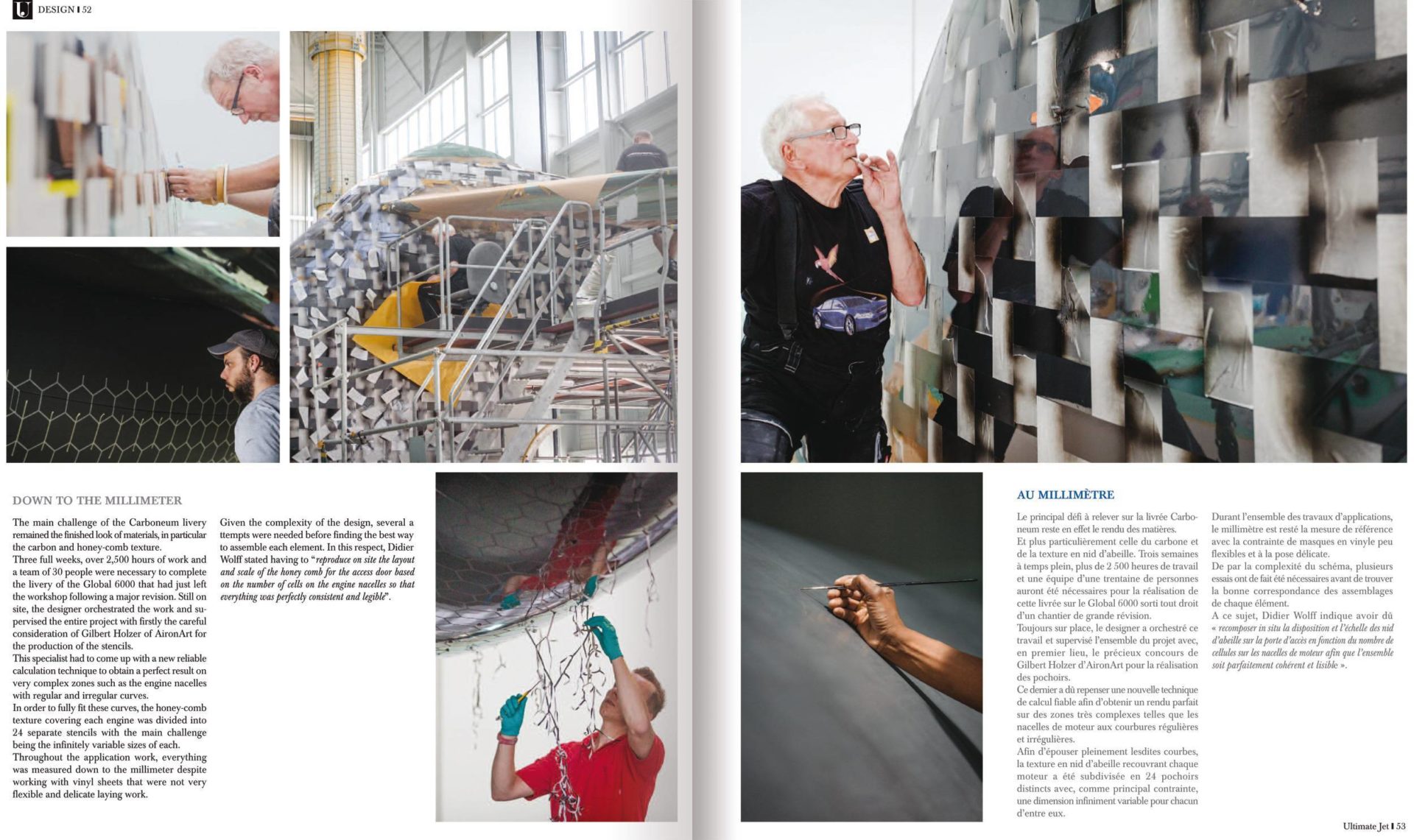
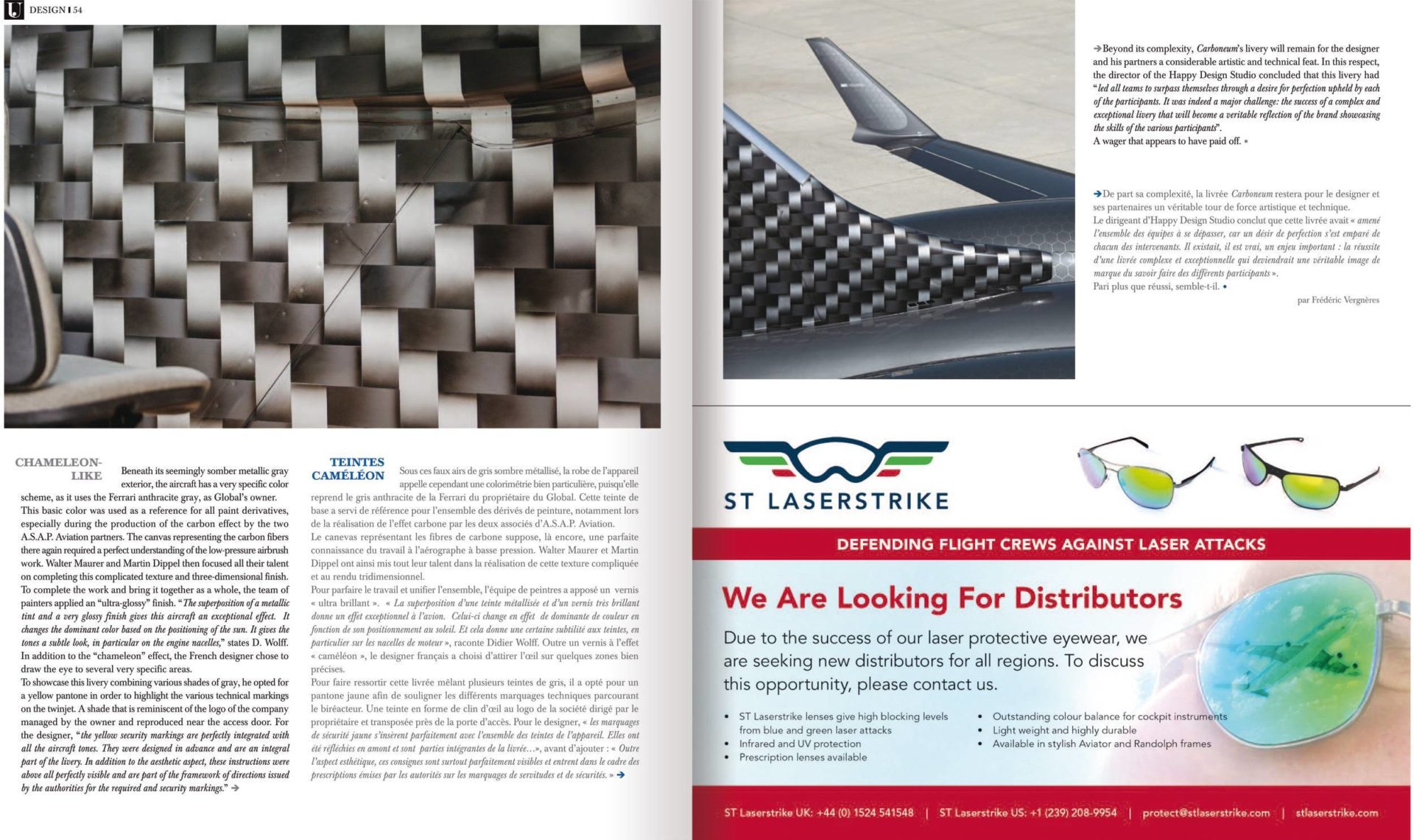
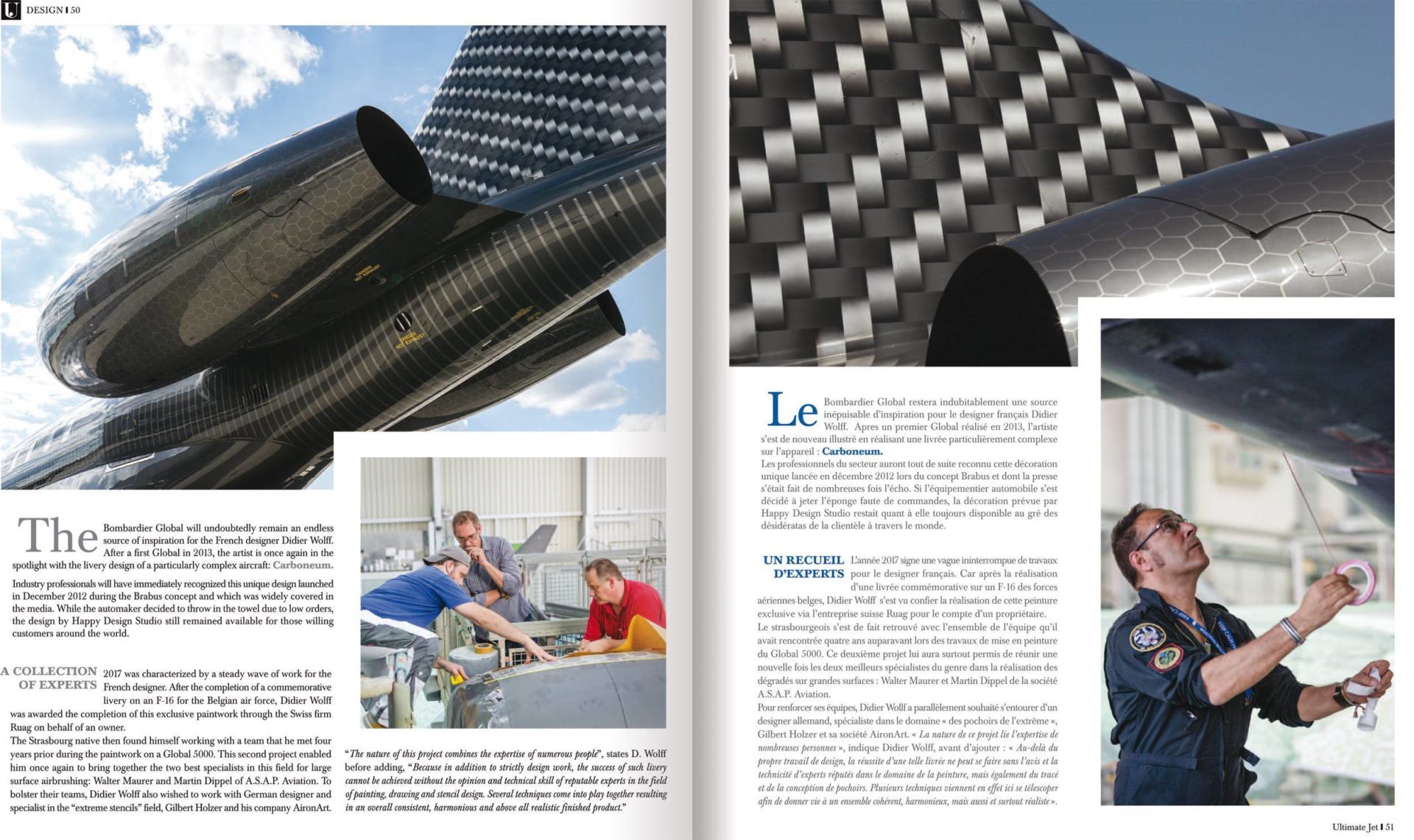
Source :ULTIMATE JET MAGAZINE / This article is reproduced for archival purposes. The Bombardier Global will undoubtedly remain an endless source of inspiration for the French designer Didier Wolff. After a first Global in 2013, the artist is once again in the spotlight with the livery design of a particularly complex aircraft: Carboneum. Industry professionals have immediately recognized this unique design launched in December 2012 during the Brabus concept which was widely covered in the media. While the automaker decided to throw in the towel due to low orders, the design by Happy Design Studio still remained available for those willing customers around the world. A COLLECTION OF EXPERTS 2017 was characterized by a steady wave of work for the French designer. After the completion of a commemorative livery on an F-16 for the Belgian air force, Didier Wolff was awarded the completion of this exclusive paintwork through the Swiss firm RUAG on behalf of an owner. The Strasbourg native then found himself working with a team that he met four years prior during the painting work on a Global 5000. This second project enabled him once again to bring together the two best specialists in this field for large surface airbrushing: Walter Maurer and Martin Dippel of A.S.A.P. Aviation. To reinforce their teams, Didier Wolff also showed interest in German designer and specialist in the “extreme stencils” field, Gilbert Holzer and his company AironArt. “The nature of this project combines the expertise of numerous people,” states D. Wolff before adding, “Because in addition to strictly design work, the success of such livery cannot be achieved without the opinion and technical skill of reputable experts in the field of painting, drawing and stencil design. Several techniques come into play together resulting in an overall consistent, harmonious and above all realistic finished product.” (page de droite) Le Bombardier Global restera indubitablement une source intarissable d’inspiration pour le designer français Didier Wolff. Après un premier Global réalisé en 2013, l’artiste s’est de nouveau illustré en réalisant une livrée particulièrement complexe sur l’appareil : Carboneum. Les professionnels du secteur auront tout de suite reconnu cette décoration unique lancée en décembre 2012 lors du concept Brabus et dont la presse s’était fait de nombreuses fois l’écho. Si l’équipementier automobile a décidé de jeter l’éponge faute de commandes, la décoration prévue par Happy Design Studio restait quant à elle toujours disponible au gré des désirs de la clientèle à travers le monde. UN RECUEIL D’EXPERTS L’année 2017 signe une vague ininterrompue de travaux pour le designer français. Car après la réalisation d’une livrée commémorative sur un F-16 des forces aériennes belges, Didier Wolff s’est vu confier la réalisation de cette peinture exclusive via l’entreprise suisse Ruag pour le compte d’un propriétaire. Le strasbourgeois s’est de fait retrouvé avec l’ensemble de l’équipe qu’il avait rencontrée quatre ans auparavant lors des travaux de mise en peinture du Global 5000. Ce deuxième projet lui aura surtout permis de réunir une nouvelle fois les deux meilleurs spécialistes du genre dans la réalisation des dégradés sur grandes surfaces : Walter Maurer et Martin Dippel de la société A.S.A.P. Aviation. Pour renforcer ses équipes, Didier Wolff a parallèlement souhaité s’entourer d’un designer allemand, spécialiste dans le domaine des « pochoirs de l’extrême », Gilbert Holzer de la société AironArt. « La nature de ce projet combine l’expertise de nombreuses personnes », indique Didier Wolff, avant d’ajouter : « Au-delà de la nature du design, la réussite d’une telle livrée ne tient pas seulement à l’expertise technique de spécialistes réputés dans le domaine de la peinture, mais également du tracé et de la conception des pochoirs. Plusieurs techniques entrent en jeu et se télescopent afin de donner vie à un ensemble cohérent, harmonieux, mais aussi et surtout réaliste. » DOWN TO THE MILLIMETER The main challenge of the Carboneum livery remained the finished look of materials, in particular the carbon and honey-comb texture. Three full weeks, over 2,500 hours of work and a team of 30 people were necessary to complete the livery of the Global 6000 that had just left the workshop following a major revision. Still on site, the designer orchestrated the work and supervised the entire project with the careful consideration of Gilbert Holzer of AironArt for the production of stencils. This specialist had to come up with a new reliable calculation technique to obtain a perfect result on very complex zones such as the engine nacelles with regular and irregular curves. In order to fully fit these curves, the honey-comb texture covering each engine was divided into 24 separate stencils with the main challenge being the infinitely variable sizes of each. Throughout the application work, everything was measured down to the millimeter despite working with vinyl sheets that were not very flexible and delicate laying work. Given the complexity of the design, several attempts were needed before finding the best way to assemble each element. In this respect, Didier Wolff stated having to “reproduce on site the layout and scale of the honey comb for the access door based on the number of cells on the engine nacelles so that everything was perfectly consistent and legible.” AU MILLIMETRE Le principal défi à relever sur la livrée Carboneum reste le rendu des matières. Et plus particulièrement celui du carbone et de la texture en nid d’abeille. Trois semaines à temps plein, plus de 2 500 heures de travail et une équipe d’une trentaine de personnes auront été nécessaires pour la réalisation de cette livrée sur le Global 6000 sorti tout droit d’un chantier de grande révision. Toujours sur place, le designer a orchestré ce travail et supervisé l’ensemble du projet avec le précieux concours de Gilbert Holzer d’AironArt pour la réalisation des pochoirs. Ce dernier a dû repenser une nouvelle technique de calcul fiable afin d’obtenir un rendu parfait sur des zones très complexes telles que les nacelles de moteur aux courbures régulières et irrégulières. Afin d’épouser pleinement lesdites courbes, la texture en nid d’abeille recouvrant chaque moteur a été subdivisée en 24 pochoirs distincts, avec comme principale contrainte une dimension infiniment variable pour chacun d’entre eux. Durant l’ensemble des travaux d’applications, le millimètre est resté la mesure de référence avec la contrainte de masques en vinyle peu flexibles et à la pose délicate. De par la complexité du schéma, plusieurs essais ont de fait été nécessaires avant de trouver la bonne correspondance des assemblages de chaque élément. À ce sujet, Didier Wolff indique avoir dû reproduire sur site la disposition et l’échelle des alvéoles sur la porte d’accès en fonction du nombre de cellules sur les nacelles de moteur afin que l’ensemble soit parfait visuellement et lisible. CHAMELEON-LIKE Beneath its seemingly somber metallic gray exterior, the aircraft has a very specific color scheme, as it uses the Ferrari anthracite gray, as Global’s owner. This base color was used as a reference for all paint derivatives, especially during the production of the carbon effect by the two A.S.A.P. Aviation partners. The canvas representing the carbon fibers then again required a perfect understanding of the low-pressure airbrush work. Walter Maurer and Martin Dippel then focused all their talent on completing this complicated texture and three-dimensional finish. To complete the work and bring it together as a whole, the team of painters applied an “ultra-glossy” finish . “The superposition of a metallic tint and a very glossy finish gives this aircraft exceptional effect. It changes the dominant color based on the positioning of the sun. It gives the tones a subtle look, in particular on the engine nacelles,” states Wolff. To accentuate the “chameleon” effect, the French designer chose to draw the eye to several very specific areas. To showcase this livery combining various shades of gray, he opted for a yellow pantone in order to highlight the various technical markings on the twinjet. A shade that is reminiscent of the logo of the company owned by the aircraft owner and reproduced on the access door. For the designer, “the yellow security markings are perfectly integrated with all the aircraft lines. They were designed in advance and are an integral part of the livery. In addition to the aesthetic aspect, these instructions ensure they are perfectly visible and are part of the framework of directions issued by the authorities for the required and security markings.” TEINTES CAMÉLÉON Sous ces faux airs de gris sombre métallisé, la robe de l’appareil appelle cependant une colorimétrie bien particulière, puisqu’elle reprend le gris anthracite de la Ferrari du propriétaire du Global. Cette teinte de base a servi de référence pour l’ensemble des dérivés de peinture, notamment lors de la réalisation de l’effet carbone par les deux associés d’A.S.A.P. Aviation. Le canvas représentant les fibres de carbone suppose, là encore, une parfaite connaissance du travail à l’aérographe à basse pression. Walter Maurer et Martin Dippel ont ainsi mis tout leur talent dans la réalisation de cette texture compliquée et au rendu tridimensionnel. Pour parfaire le travail et unifier l’ensemble, l’équipe de peintres a apposé un vernis « ultra brillant ». « La superposition d’une teinte métallisée et d’un vernis très brillant donne un effet exceptionnel à l’avion. Celui-ci change en effet de dominante de couleur en fonction de sa position au soleil. Et cela donne une certaine subtilité aux teintes, en particulier sur les nacelles moteur », raconte Didier Wolff. Outre un vernis à l’effet « caméléon », le designer français a choisi d’attirer l’il sur quelques zones bien précises. Pour faire ressortir cette livrée mêlant plusieurs teintes de gris, il a opté pour un pantone jaune afin de souligner les différents marquages techniques parcourant le biréacteur. Une teinte en forme de clin d’il au logo de la société dirigée par le propriétaire et transposée près de la porte d’accès. Pour le designer, « les marquages de sécurité jaunes s’insèrent parfaitement avec l’ensemble des lignes de l’avion. Ils ont été dessinés en amont et sont parties intégrantes de la livrée ». Il ajoute : « Outre l’aspect esthétique, ces consignes sont surtout parfaitement visibles et entrent dans le cadre des prescriptions émises par les autorités sur les marquages de servitudes et de sécurité. » Beyond its complexity, Carboneum’s livery will remain for the designer and his partners a considerable artistic and technical feat. In this respect, the director of the Happy Design Studio concluded the interview by “led all teams to surpass themselves through a desire for perfection applied by each of the participants. It was a major challenge: the success of such a complex and exceptional livery that will become a veritable reflection of the brand showcasing the skills of the various participants. A wager that appears to have paid off.” De par sa complexité, la livrée Carboneum restera pour le designer et ses partenaires un véritable tour de force artistique et technique. Le dirigeant d’Happy Design Studio conclut que cette livrée avait « amené l’ensemble des équipes à se dépasser, car un désir de perfection s’est emparé de chacun des intervenants. Il existait, il est vrai, un enjeu important : la réussite d’une livrée complexe et exceptionnelle qui deviendrait une véritable image de marque que sauront faire vivre les différents participants. Un pari plus que réussi, semble-t-il. » par Frédéric VergnèresARTICLE N° 250 / ULTIMATE JET MAGAZINE


SEPTEMBRE 2017
M6 TV / HAPPY DESIGN STUDIO
JUILLET 2017
ARTICLE N° 249 / PARIS MATCH / DOCUMENT
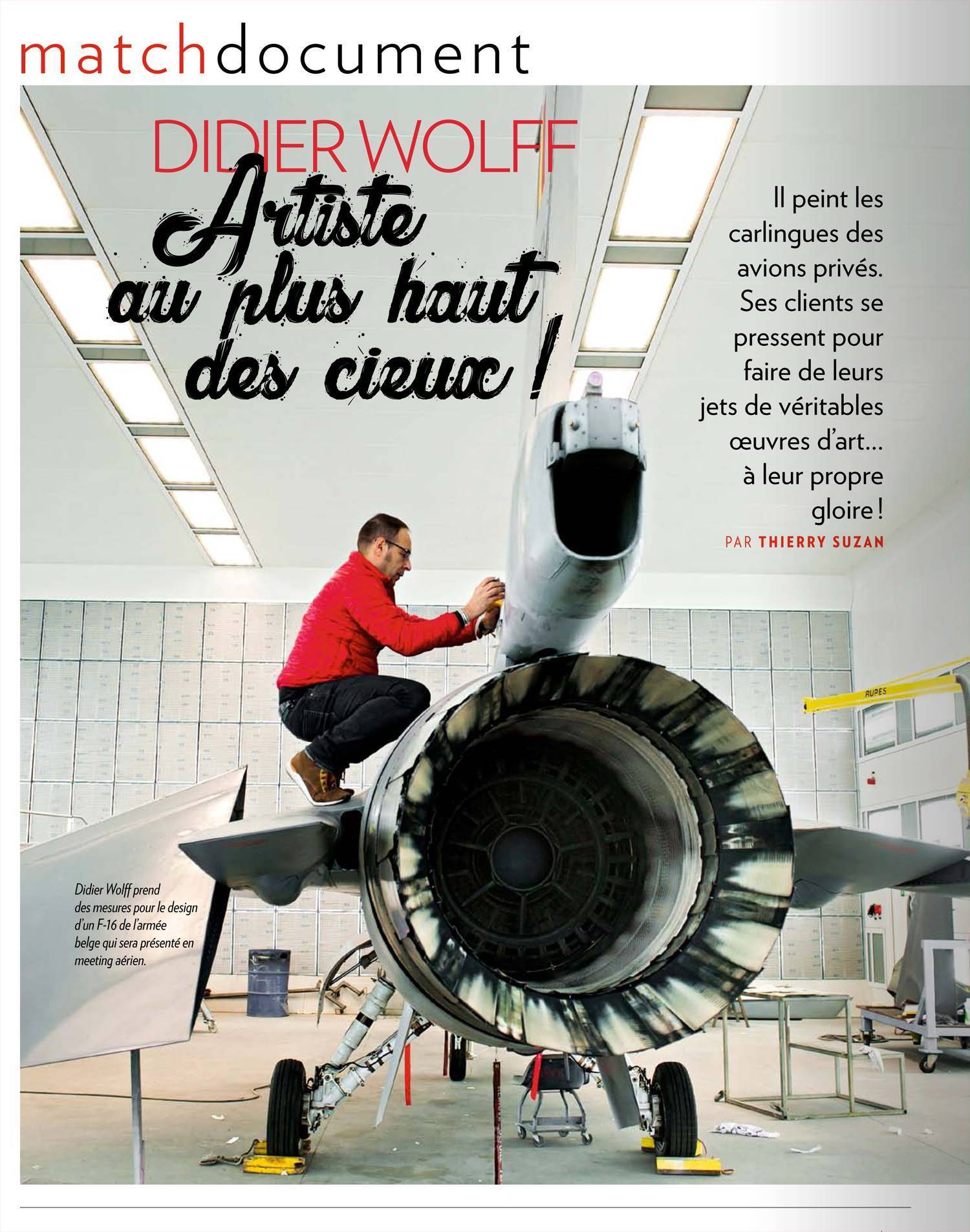
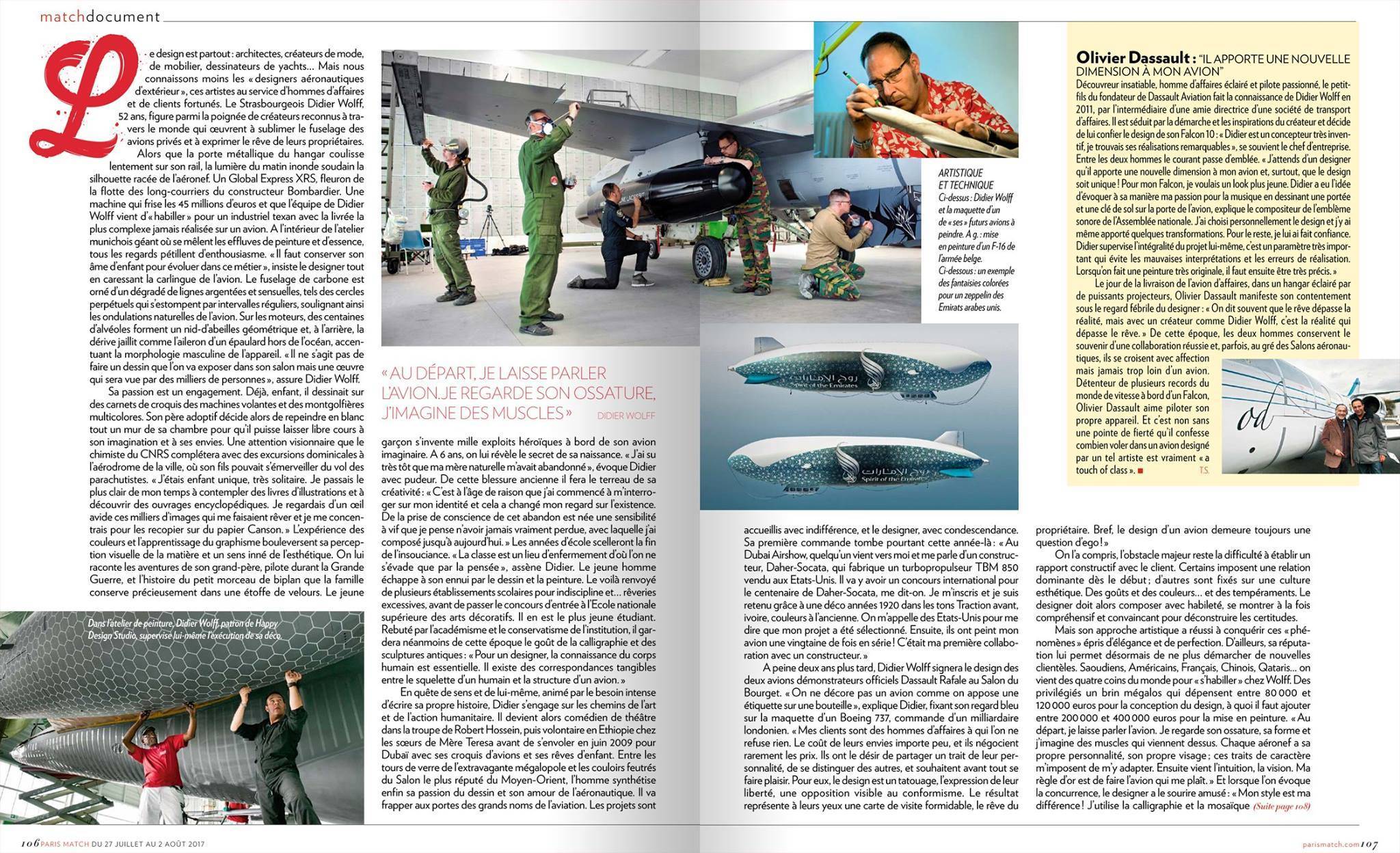
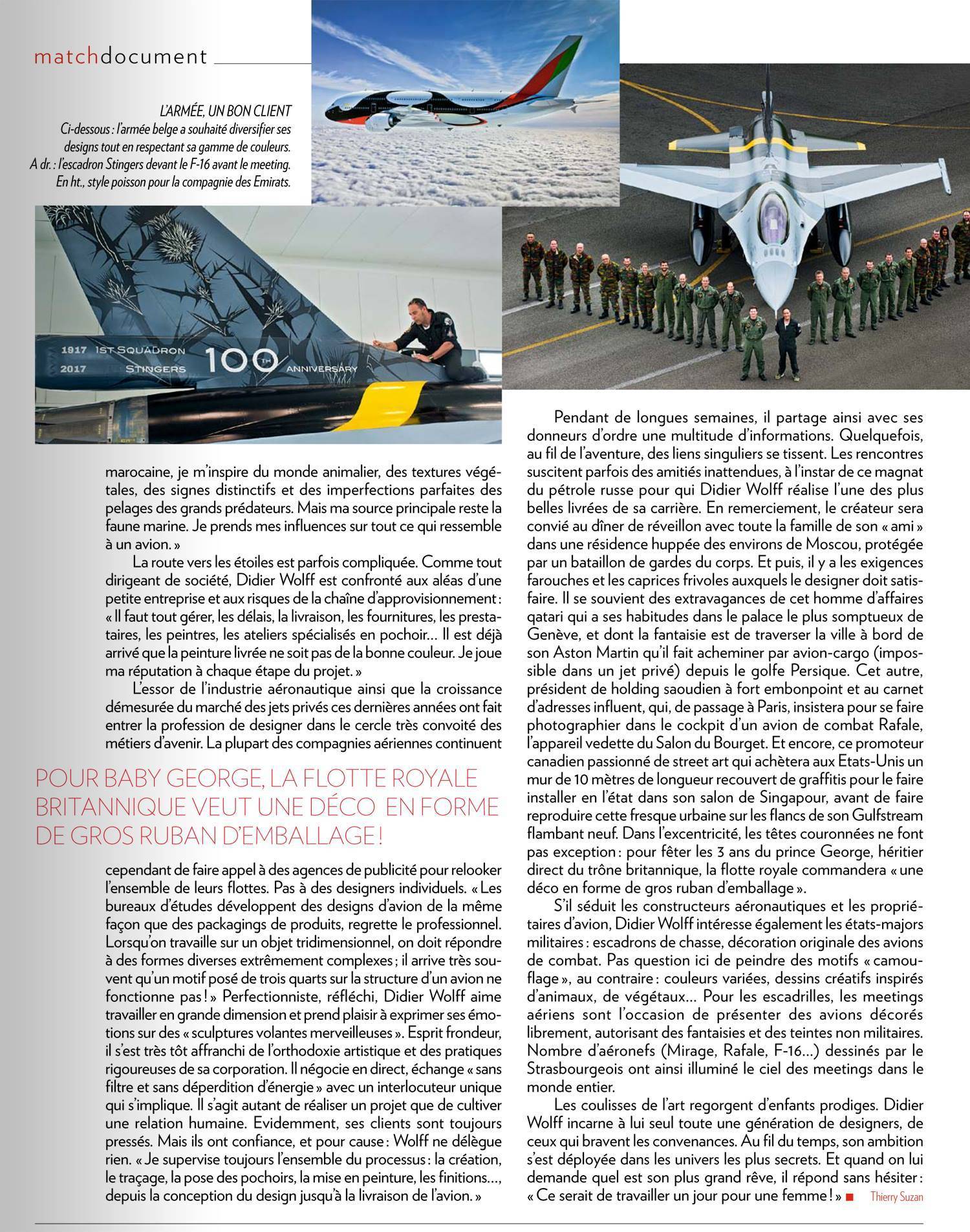
JUILLET 2017
ARTICLE N° 248 / AVIAPORT RUSSIA

Read full article (text version)
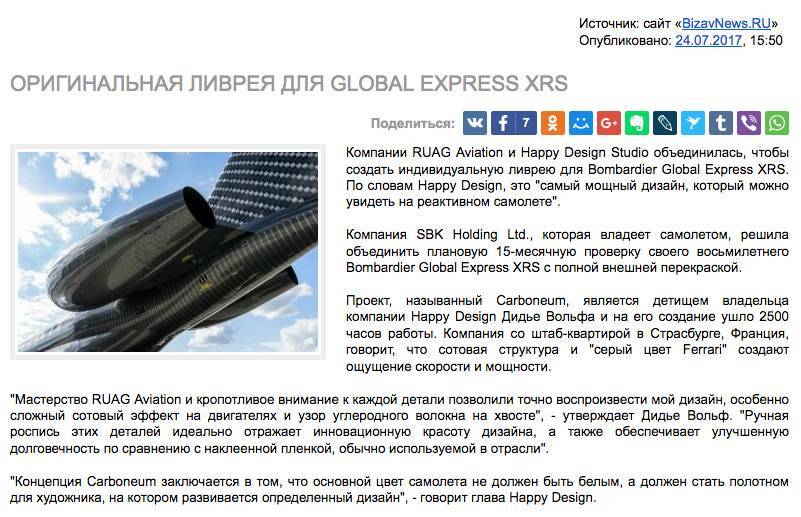
Источник: сайт «BizavNews.RU» Опубликовано: 24.07.2017, 15:50 Source AVIAPORT RUSSIA / This article is reproduced for archival purposes. ОРИГИНАЛЬНАЯ ЛИВРЕЯ ДЛЯ GLOBAL EXPRESS XRS Поделиться: Компании RUAG Aviation и Happy Design Studio объединились, чтобы создать индивидуальную ливрею для Bombardier Global Express XRS. По словам Happy Design, это «самый мощный дизайн, который можно увидеть на реактивном самолете». Компания SBK Holding Ltd., которая владеет самолетом, решила объединить плановую 15-месячную проверку своего восьмилетнего Bombardier Global Express XRS с полной внешней перекраской. Проект, названный Carboneum, является детищем владельца компании Happy Design Дидье Вольфа и на его создание ушло 2500 часов работы. Компания со штаб-квартирой в Страсбурге, Франция, говорит, что сотовая структура и «серый цвет Ferrari» создают ощущение скорости и мощности. «Мастерство RUAG Aviation и кропотливое внимание к каждой детали позволили точно воспроизвести мой дизайн, особенно сложный сотовый эффект на двигателях из углеродного волокна на хвосте», — утверждает Дидье Вольф. «Ручная роспись этих деталей идеально отражает инновационную красоту дизайна, а также обеспечивает улучшенную долговечность по сравнению с наклеенной пленкой, обычно используемой в отрасли». «Концепция Carboneum заключается в том, что основной цвет самолета не должен быть белым, а должен стать полотном для художника, на котором развивается определенный дизайн», — говорит глава Happy Design.

JUILLET 2017
Read full article (text version)
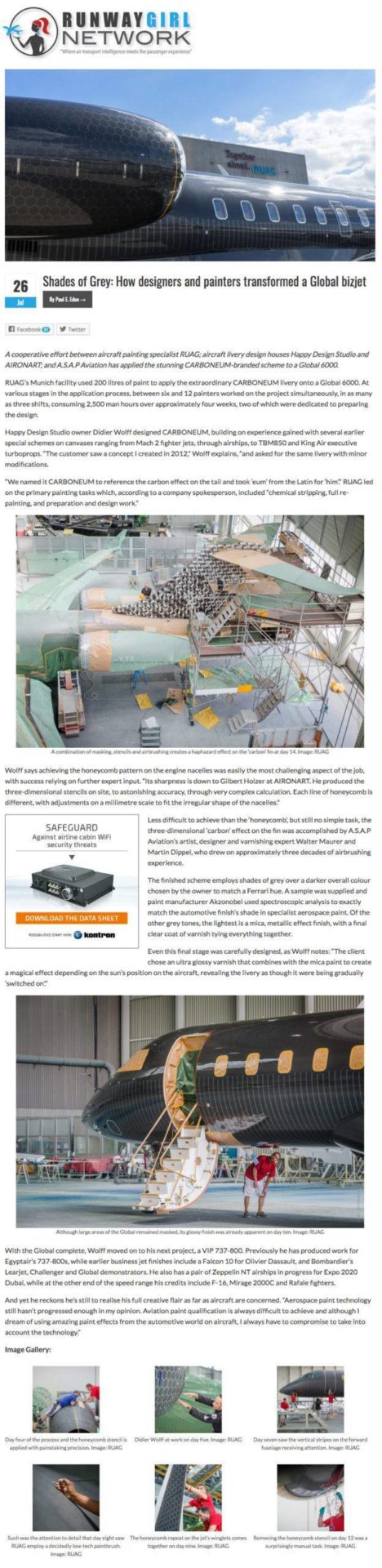
Source :RUNWAY GIRL NETWORK / This article is reproduced for archival purposes. Shades of Grey: How designers and painters transformed a Global bizjet A cooperative effort between aircraft painting specialist RUAG; aircraft livery design houses Happy Design Studio and AIRONART; and A.S.A.P Aviation has applied the stunning CARBONEUM-branded scheme to a Global 6000. RUAG’s Munich facility used 200 litres of paint to apply the extraordinary CARBONEUM livery onto a Global 6000. At various stages in the application process, between six and 12 painters worked on the project simultaneously, in as many as three shifts, consuming 2,500 man hours over approximately four weeks, two of which were dedicated to preparing the design. Happy Design Studio owner Didier Wolff designed CARBONEUM, building on experience gained with several earlier special schemes on canvases ranging from Mach 2 fighter jets, through airships, to TBM850 and King Air executive turboprops. “The customer saw a concept I created in 2012,” Wolff explains, “and asked for the same livery with minor modifications. “We named it CARBONEUM to reference the carbon effect on the tail and took ‘eum’ from the Latin for ‘him’.” RUAG led on the primary painting tasks which, according to a company spokesperson, included “chemical stripping, full re-painting, and preparation and design work.” A combination of masking, stencils and airbrushing creates a haphazard effect on the ‘carbon’ fin at day 14. Image: RUAG Wolff says achieving the honeycomb pattern on the engine nacelles was easily the most challenging aspect of the job, with success relying on further expert input. “Its sharpness is down to Gilbert Holzer at AIRONART. He produced the three-dimensional stencils on site, to astonishing accuracy, through very complex calculation. Each line of honeycomb is different, with adjustments on a millimetre scale to fit the irregular shape of the nacelles.” Less difficult to achieve than the ‘honeycomb’, but still no simple task, the three-dimensional ‘carbon’ effect on the fin was accomplished by A.S.A.P Aviation’s artist, designer and varnishing expert Walter Maurer and Martin Dippel, who drew on approximately three decades of airbrushing experience. The finished scheme employs shades of grey over a darker overall colour chosen by the owner to match a Ferrari hue. A sample was supplied and paint manufacturer Akzonobel used spectroscopic analysis to exactly match the automotive finish’s shade in specialist aerospace paint. Of the other grey tones, the lightest is a mica, metallic effect finish, with a final clear coat of varnish tying everything together. Even this final stage was carefully designed, as Wolff notes: “The client chose an ultra glossy varnish that combines with the mica paint to create a magical effect depending on the sun’s position on the aircraft, revealing the livery as though it were being gradually ‘switched on’.” Although large areas of the Global remained masked, its glossy finish was already apparent on day ten. Image: RUAG With the Global complete, Wolff moved on to his next project, a VIP 737-800. Previously he has produced work for Egyptair’s 737-800s, while earlier business jet finishes include a Falcon 10 for Olivier Dassault, and Bombardier’s Learjet, Challenger and Global demonstrators. He also has a pair of Zeppelin NT airships in progress for Expo 2020 Dubai, while at the other end of the speed range his credits include F-16, Mirage 2000C and Rafale fighters. And yet he reckons he’s still to realise his full creative flair as far as aircraft are concerned. “Aerospace paint technology still hasn’t progressed enough in my opinion. Aviation paint qualification is always difficult to achieve and although I dream of using amazing paint effects from the automotive world on aircraft, I always have to compromise to take into account the technology.”ARTICLE N° 247 / RUNWAY GIRL NETWORK

JUILLET 2017
Read full article (text version)
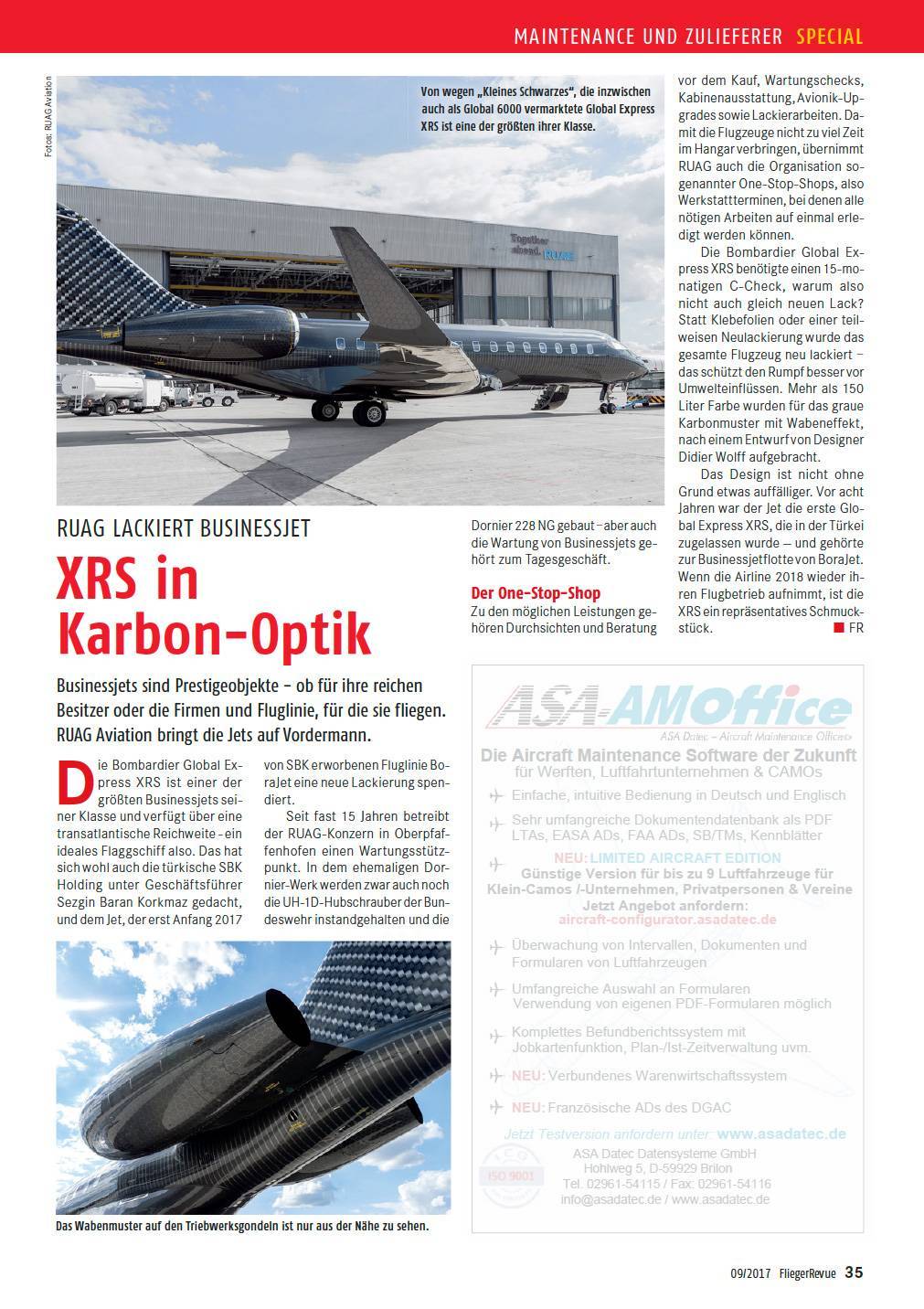
Source :FLIEGER REVUE / This article is reproduced for archival purposes. MAINTENANCE UND ZULIEFERER — SPECIAL Fotos: RUAG Aviation Von wegen Kleines Schwarzes“, die inzwischen auch als Global 6000 vermarktete Global Express XRS ist eine der größten ihrer Klasse. RUAG LACKIERT BUSINESSJET XRS in Karbon-Optik Businessjets sind Prestigeobjekte – ob für ihre reichen Besitzer oder die Firmen und Fluglinien, für die sie fliegen. RUAG Aviation bringt die Jets auf Vordermann. Die Bombardier Global Express XRS ist einer der größten Businessjets seiner Klasse und verfügt über eine transatlantische Reichweite – ein ideales Flaggschiff also. Das hat sich wohl auch die türkische SBK Holding unter Geschäftsführer Sezgin Baran Korkmaz gedacht, die den Jet, der erst Anfang 2017 von SBK erworbenen Fluglinie Borajet eine neue Lackierung spendiert. Seit fast 15 Jahren betreibt der RUAG-Konzern in Oberpfaffenhofen einen Wartungsstützpunkt. In dem ehemaligen Dornier-Werk werden zwar auch noch die UH-1D-Hubschrauber der Bundeswehr instand gehalten und die Dornier 228 NG gebaut – aber auch die Wartung von Businessjets gehört zum Tagesgeschäft. Der One-Stop-Shop Zu den möglichen Leistungen gehören Durchsichten und Beratung vor dem Kauf, Wartungschecks, Kabinenausstattung, Avionik-Upgrades sowie Lackierarbeiten. Damit die Flugzeuge nicht zu viel Zeit im Hangar verbringen, übernimmt RUAG auch die Organisation sogenannter One-Stop-Shops , also Werkstattterminen, bei denen alle nötigen Arbeiten auf einmal erledigt werden können. Die Bombardier Global Express XRS benötigte einen 15-monatigen C-Check , warum also nicht auch gleich neuen Lack? Statt Klebefolien oder einer teilweisen Neulackierung wurde das gesamte Flugzeug neu lackiert – das schützt den Rumpf besser vor Umwelteinflüssen. Mehr als 150 Liter Farbe wurden für das graue Karbonmuster mit Wabeneffekt nach einem Entwurf von Designer Didier Wolff aufgebracht. Das Design ist nicht ohne Grund etwas auffälliger. Vor acht Jahren war der Jet der erste Global Express XRS, der in der Türkei zugelassen wurde – und gehörte zur Businessjetflotte von Borajet. Wenn die Airline 2018 wieder ihren Flugbetrieb aufnimmt , ist die XRS ein repräsentatives Schmuckstück. Bildunterschrift: Das Wabenmuster auf den Triebwerksgondeln ist nur aus der Nähe zu sehen.ARTICLE N° 246 / FLIEGER REVUE

JUILLET 2017
ARTICLE N° 245 / AIN ONLINE
Read full article (text version)
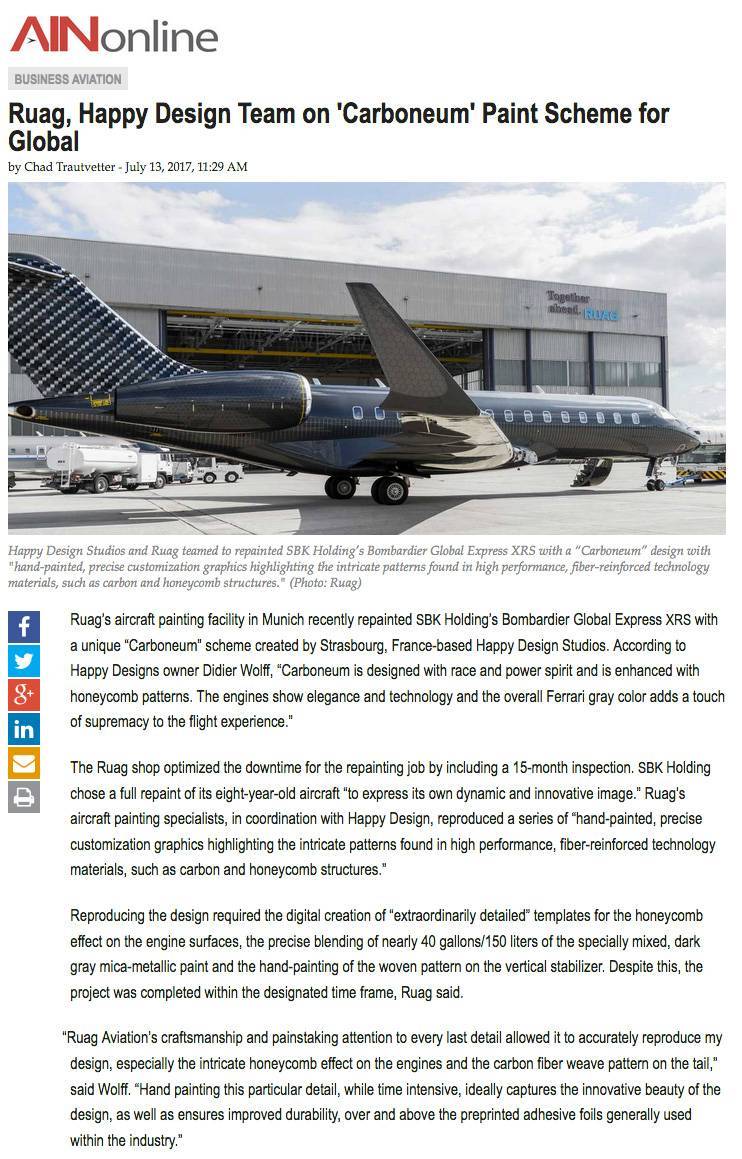
Source :AINonline / This article is reproduced for archival purposes. BUSINESS AVIATION Ruag, Happy Design Team on ‘Carboneum’ Paint Scheme for Global by Chad Trautvetter – July 13, 2017, 11:29 AM Happy Design Studios and Ruag teamed to repainted SBK Holding’s Bombardier Global Express XRS with a “Carboneum” design with hand-painted, precise customization graphics highlighting the intricate patterns found in high performance, fiber-reinforced technology materials, such as carbon and honeycomb structures. (Photo: Ruag) Ruag’s aircraft painting facility in Munich recently repainted SBK Holding’s Bombardier Global Express XRS with a unique “Carboneum” scheme created by Strasbourg, France-based Happy Design Studios. According to Happy Designs owner Didier Wolff, Carboneum is designed with race and power spirit and is enhanced with honeycomb patterns. The engines show elegance and technology and the overall Ferrari gray color adds a touch of supremacy to the flight experience.” The Ruag shop optimized the downtime for the repainting job by including a 15-month inspection. SBK Holding chose afull repaint of its eight-year-old aircraft“ to express its own dynamic and innovative image.” Ruag’s aircraft painting specialists, in coordination with Happy Design, reproduced a series of hand-painted, precise customization graphics highlighting the intricate patterns found in high performance, fiber-reinforced technology materials, such as carbon and honeycomb structures. Reproducing the design required the digital creation of “extraordinarily detailed” templates for the honeycomb effect on the engine surfaces, the precise blending of nearly 40 gallons / 150 liters of specially mixed dark gray mica-metallic paint , and the hand-painting of the woven pattern on the vertical stabilizer. Despite this, the project was completed within the designated time frame, Ruag said. “Ruag Aviation’s craftsmanship and painstaking attention to every last detail allowed it to accurately reproduce my design, especially the intricate honeycomb effect on the engines and the carbon fiber weave pattern on the tail,” said Wolff.“ Hand painting this particular detail, while time intensive, ideally captures the innovative beauty of the design, as well as ensures improved durability, over and above the preprinted adhesive foils generally used within the industry.
JUILLET 2017
Read full article (text version)
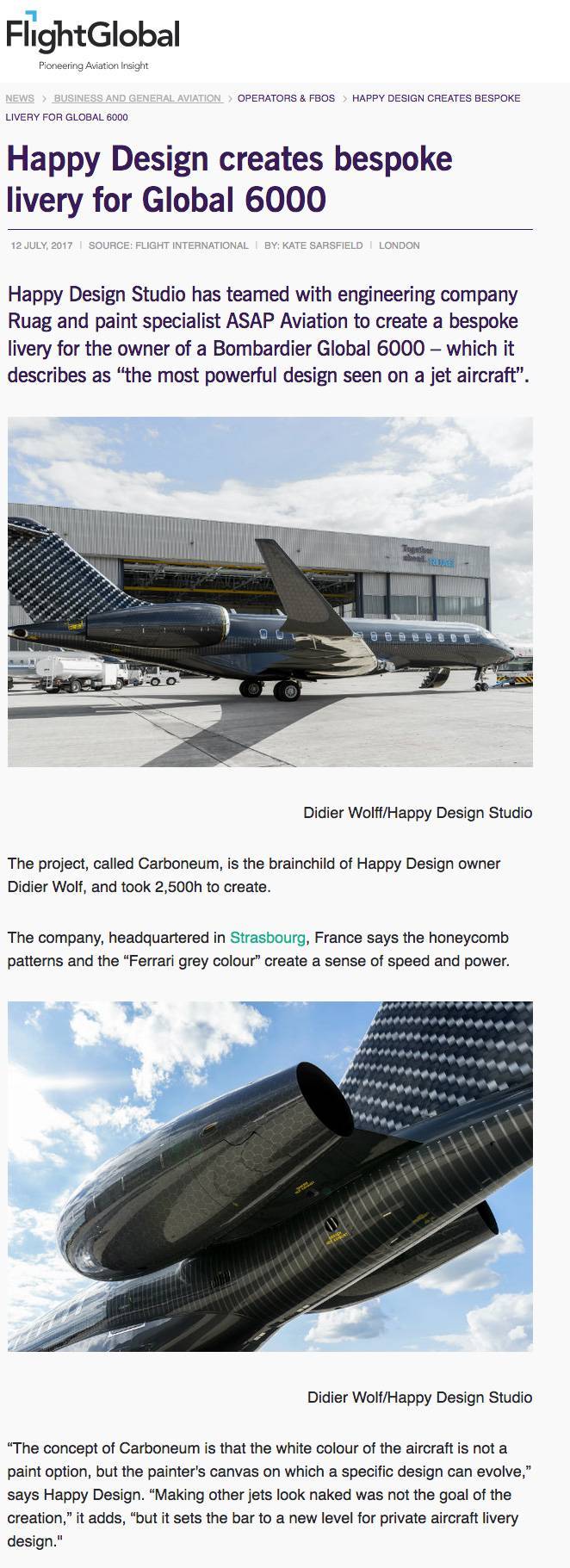
Source :FLIGHT GLOBAL / This article is reproduced for archival purposes. Pioneering Aviation Insight NEWS BUSINESS AND GENERAL AVIATION OPERATORS & FBOS HAPPY DESIGN CREATES BESPOKE LIVERY FOR GLOBAL 6000 12 JULY, 2017 | SOURCE: FLIGHT INTERNATIONAL | BY: KATE SARSFIELD | LONDON Happy Design Studio has teamed with engineering company Ruag and paint specialist ASAP Aviation to create a bespoke livery for the owner of a Bombardier Global 6000, which it describes as “the most powerful design seen on a jet aircraft”. (Didier Wolff / Happy Design Studio) The project, called Carboneum, is the brainchild of Happy Design owner Didier Wolff, and took 2,500h to create. The company, headquartered in Strasbourg, France says the honeycomb patterns and the “Ferrari grey colour” create a sense of speed and power. (Didier Wolff / Happy Design Studio) “The concept of Carboneum is that the white colour of the aircraft is not a paint option, but the painter’s canvas on which a specific design can evolve,” says Happy Design. “Making other jets look naked was not the goal of the creation,” it adds, “but it sets the bar to a new level for private aircraft livery design.”ARTICLE N° 244 / FLIGHT GLOBAL

JUILLET 2017
Read full article (text version)
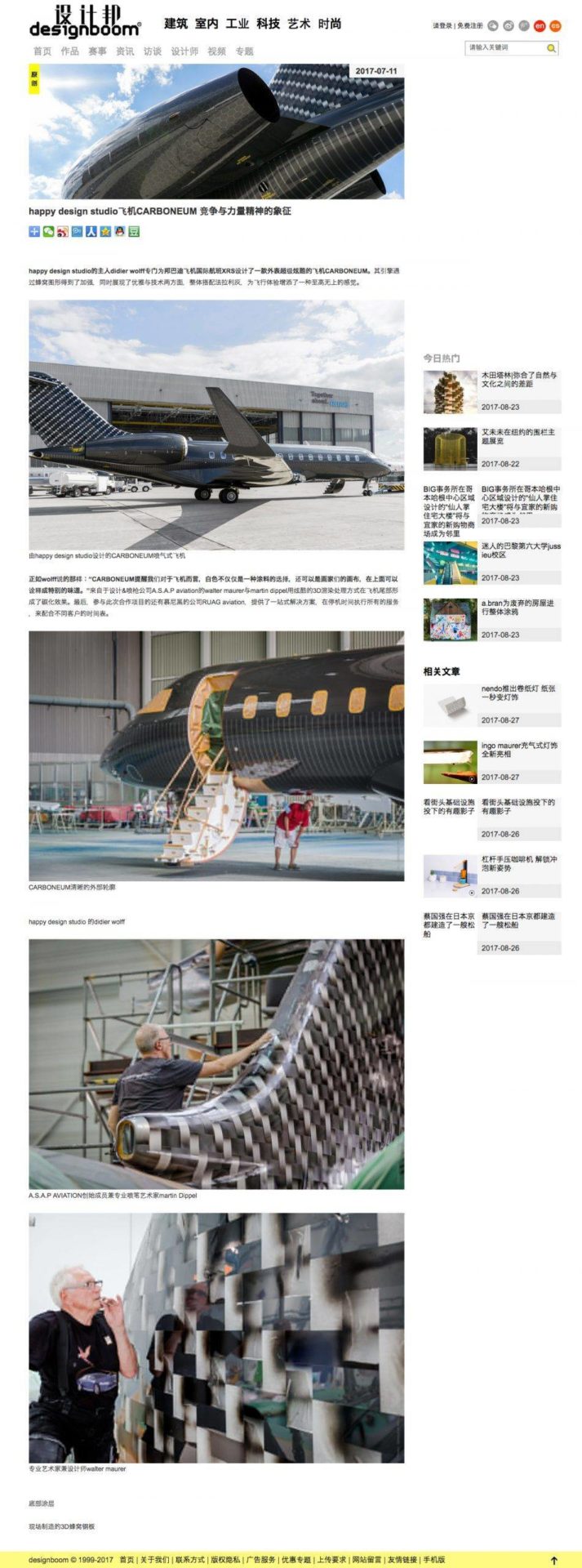
Source :DESIGNBOOM CHINA / This article is reproduced for archival purposes. designboom 建筑 室内 工业 科技 艺术 时尚 2017-07-11 happy design studio 飞机CARBONEUM 竞争与力量精神的象征 happy design studio的创始人didier wolff专门为阿联酋航空租赁公司的一架私人飞机设计了一款外观极其独特的飞机CARBONEUM,其灵感来源于碳纤维材料的结构。通过复杂的设计过程以及艺术家的精细技术加持,这架飞机整体呈现出极具力量感的视觉效果,同时也象征着竞争精神。 由happy design studio设计的CARBONEUM喷气飞机 正如wolff所说的那样:“CARBONEUM最重要的设计元素在于其机身。颜色不仅仅是一种装饰,更可以成为艺术家的画布,在上面可以演绎出不同的视觉语言。”该飞机在瑞士RUAG aviation完成喷漆,并由艺术家A.S.A.P aviation的walter maurer与martin dippel团队合作完成。整个飞机喷涂过程耗费了约30个工作日。 CARBONEUM飞机外观细节 happy design studio 创始人 didier wolff A.S.A.P AVIATION创始成员艺术家 martin dippel 艺术家 walter maurer 底部涂装 碳纤维纹理的3D蜂窝结构ARTICLE N° 243 / DESIGNBOOM CHINA

JUILLET 2017
Read full article (text version)
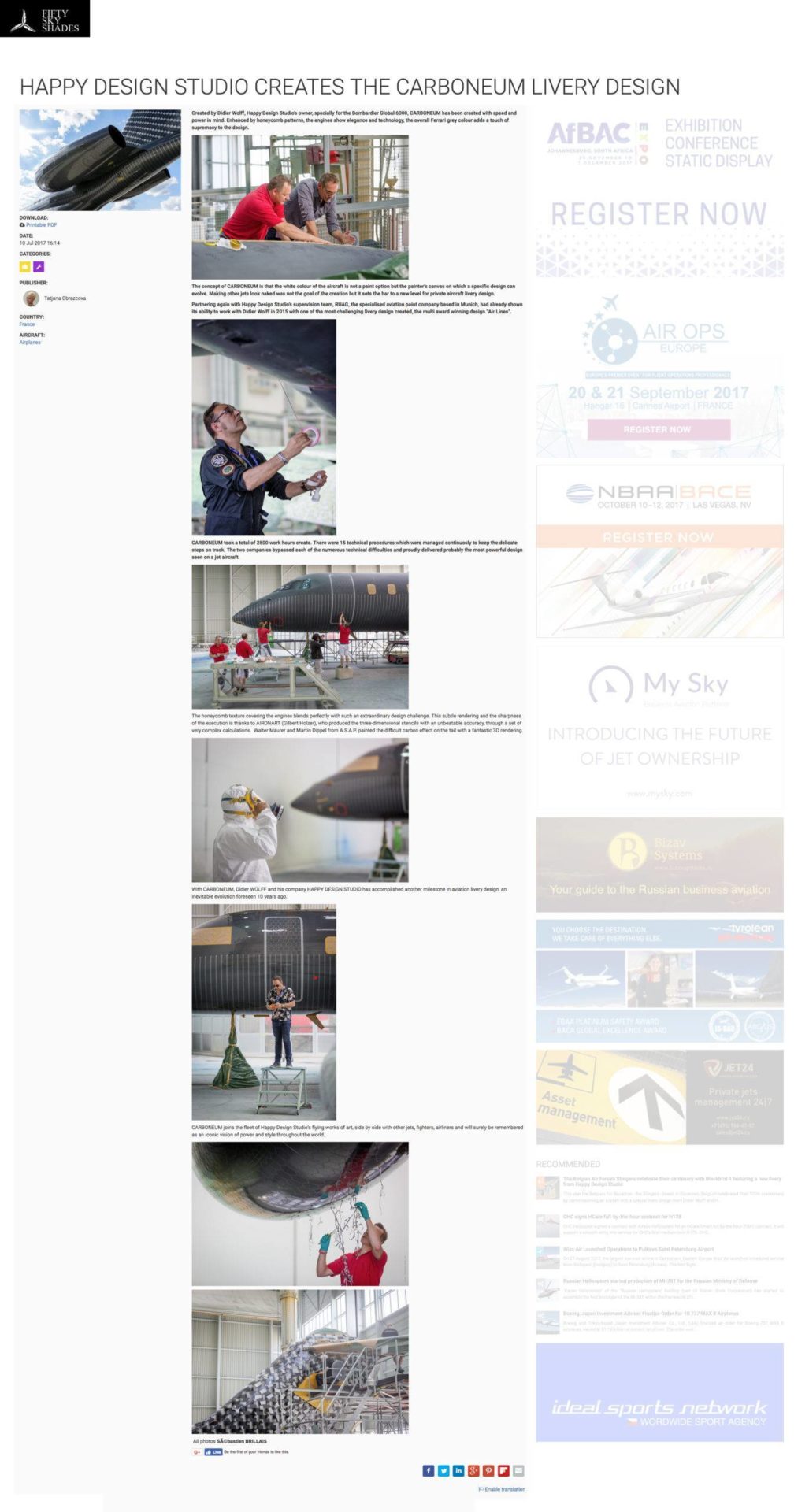
Source :FIFTY SKYSHADES / This article is reproduced for archival purposes. HAPPY DESIGN STUDIO CREATES THE CARBONEUM LIVERY DESIGN Created by Didier Wolff, Happy Design Studio’s owner, specially for the Bombardier Global 6000, CARBONEUM has been created with speed and power in mind. Enhanced by honeycomb patterns, the engines show elegance and technology, the overall Ferrari grey colour adds a touch of supremacy to the design. The concept of CARBONEUM is that the white colour of the aircraft is not a paint option but the painter’s canvas on which a specific design can evolve. Making other jets look naked was not the goal of the creation but it sets the bar to a new level for private aircraft livery design. Partnering again with Happy Design Studio supervision team, RUAG , the specialised aviation paint company based in Munich, had already shown its ability to work with Didier Wolff in 2015 with one of the most challenging livery designs ever created, the multi award winning design “Air Lines”. CARBONEUM took a total of 2500 work hours create. There were 15 technical procedures were managed continuously to keep the delicate shapes on track. The companies surpassed each of the numerous technical difficulties and proudly delivered probably the most powerful design seen on a jet aircraft. The honeycomb texture covering the engines blends perfectly with such an extraordinary design challenge. This subtle rendering and the sharpness of the execution is thanks to AIRONART (Gilbert Holzer) who produced the three-dimensional stencils with an ultra-precise accuracy, through a set of very complex calculations. Walter Maurer and Martin Dippel from A.S.A.P. Aviation perfected the airbrush work for the woven pattern on the tail with a fantastic 3D rendering. With CARBONEUM , Didier Wolff and his company HAPPY DESIGN STUDIO has accomplished another milestone in aviation livery design, an inevitable evolution foreseen 10 years ago. CARBONEUM joins the fleet of Happy Design Studio’s flying works of art side by side with other jets, fighters, airliners and will surely be remembered as an iconic symbol of power and style throughout the world. All photos Sébastien BrillaisARTICLE N° 242 / FIFTY SKYSHADES

JUILLET 2017
Read full article (text version)
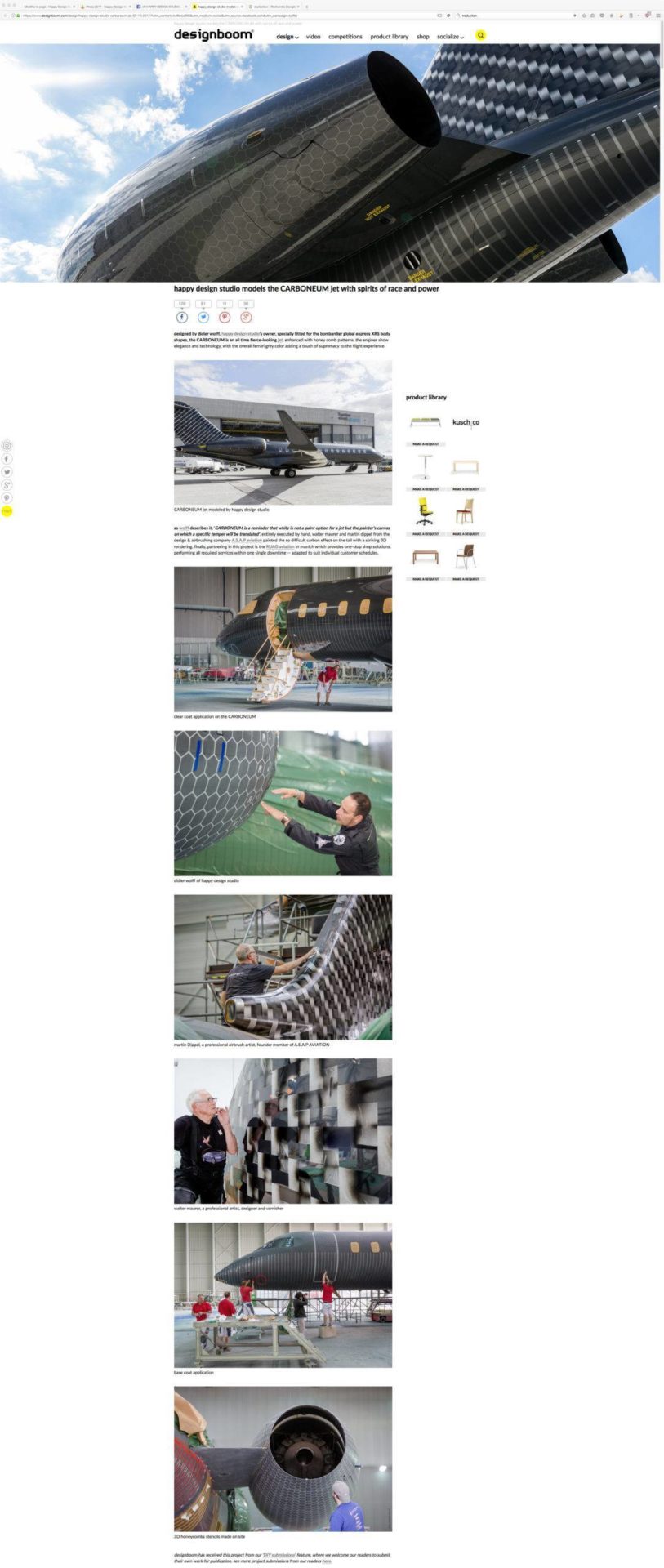
Source :DESIGNBOOM / This article is reproduced for archival purposes. happy design studio models the CARBONEUM jet with spirits of race and power designed by didier wolff, happy design studio’s owner, specially fitted for the bombardier global express xrs body shape, the CARBONEUM is an all time fine-looking jet, enhanced with honeycomb patterns. the engines show elegance and technology, while the overall ferrari grey colour adding a touch of supremacy to the flight experience. CARBONEUM jet modeled by happy design studio as wolff describes it, ‘CARBONEUM is a reminder that white is not a paint option for a jet but the painter’s canvas on which a specific design can evolve’. developed under wolff’s supervision but set to be a new level for private aircraft livery design. working again with A.S.A.P aviation and RUAG aviation, the design required precise execution with a full repaint, featuring more than 150 liters of paint. the honeycomb pattern was created using specially produced templates and precise hand painting. clear coat application on the CARBONEUM didier wolff at happy design studio martin dippel, a professional airbrush artist, founder member of A.S.A.P aviation walter maurer, a professional artist, designer and varnisher base coat application 3D honeycomb stencils made on siteARTICLE N° 241 / DESIGNBOOM


JUIN 2017
Read full article (text version)
Source :MAGNIFICIENT DESIGNERS / This article is reproduced for archival purposes. Didier Wolff-Air Lines Aircraft Livery Design DI: DESIGN INTERVIEWS At Design Interviews (Excerpt) Interview with DIDIER WOLFF : Frank Scott: What is the main principle, idea and inspiration behind your design? DIDIER WOLFF: To create the most complex design ever painted onto an aircraft. Frank Scott: What has been your main focus in designing this work? Especially what did you want to achieve? DIDIER WOLFF: Keep the client’s desire within the project along with making it a challenge to achieve. Frank Scott: What are your future plans for this award winning design? DIDIER WOLFF: Air to Air video and photo shoot. Frank Scott: How long did it take you to design this particular concept? DIDIER WOLFF: A little over 3 months. Frank Scott: Why did you design this particular concept? Was this design commissioned or did you decide to pursue an inspiration? DIDIER WOLFF: This design was commissioned by our client, based on a ceramic tile which only a certain rhythm and colors remain in the final realization. Frank Scott: Is your design being produced or used by another company, or do you plan to sell or lease the production rights or do you intend to produce your work yourself? DIDIER WOLFF: No, each of my creations are unique, original and for 1 aircraft only. Frank Scott: Were there any other designs and/or designers that helped to influence the design of your work? DIDIER WOLFF: None. Frank Scott: Who is the target customer for this design? DIDIER WOLFF: Private jet owners. Frank Scott: What sets this design apart from other similar or resembling concepts? DIDIER WOLFF: The complexity of its application onto the aircraft and the amount of details. Frank Scott: Which design tools did you use when working on this project? DIDIER WOLFF: The usual computer graphic softwares (Maya, Mental Ray, Photoshop & Illustrator). Frank Scott: What is the most unique aspect of your design? DIDIER WOLFF: Triple overlaying of a complete fading effect. Frank Scott: Who did you collaborate with for this design? Did you work with people with technical / specialized skills? DIDIER WOLFF: Once the design was created and validated, we have worked with the most skilled painters for each of the very technical painting challenges. Most particularly with Walter Maurer & Martin Dippel (Walter Maurer was also an artistic partner of Andy Warhol, Roy Lichtenstein and Frank Stella). Frank Scott: What is the role of technology in this particular design? DIDIER WOLFF: Essential, as its painting onto the aircraft has required a mixed of ancient and very modern tools to overcome each technical challenges that the design raised and most of all a lot of creativity. Frank Scott: What are some of the challenges you faced during the design/realization of your concept? DIDIER WOLFF: Main challenges were encountered in production phase, going from the 3D Design Livery Project to the scale 1 aircraft. Quadruple stripping from the front door to the last window adjusted with Lasers, masking, de-masking and re-masking for the application of the 5 colors. From the last window to the back cone, each stripe had to face the cylindric imperfections, adjusted one by one, cm by cm and correcting each imperfection to render the natural feeling of perfect alignment. Critical zones as the engine pylons and the last meter of the back cone took an entire team and days of adjustments to meet validation. The engine nacelles shape was the hardest technical challenges in order to render th. End of Excerpt | Read complete interview with DIDIER WOLFF on Air Lines Aircraft Livery Design at design-interviews.comARTICLE N° 240 / MAGNIFICIENT DESIGNERS
JUIN 2017
Read full article (text version)
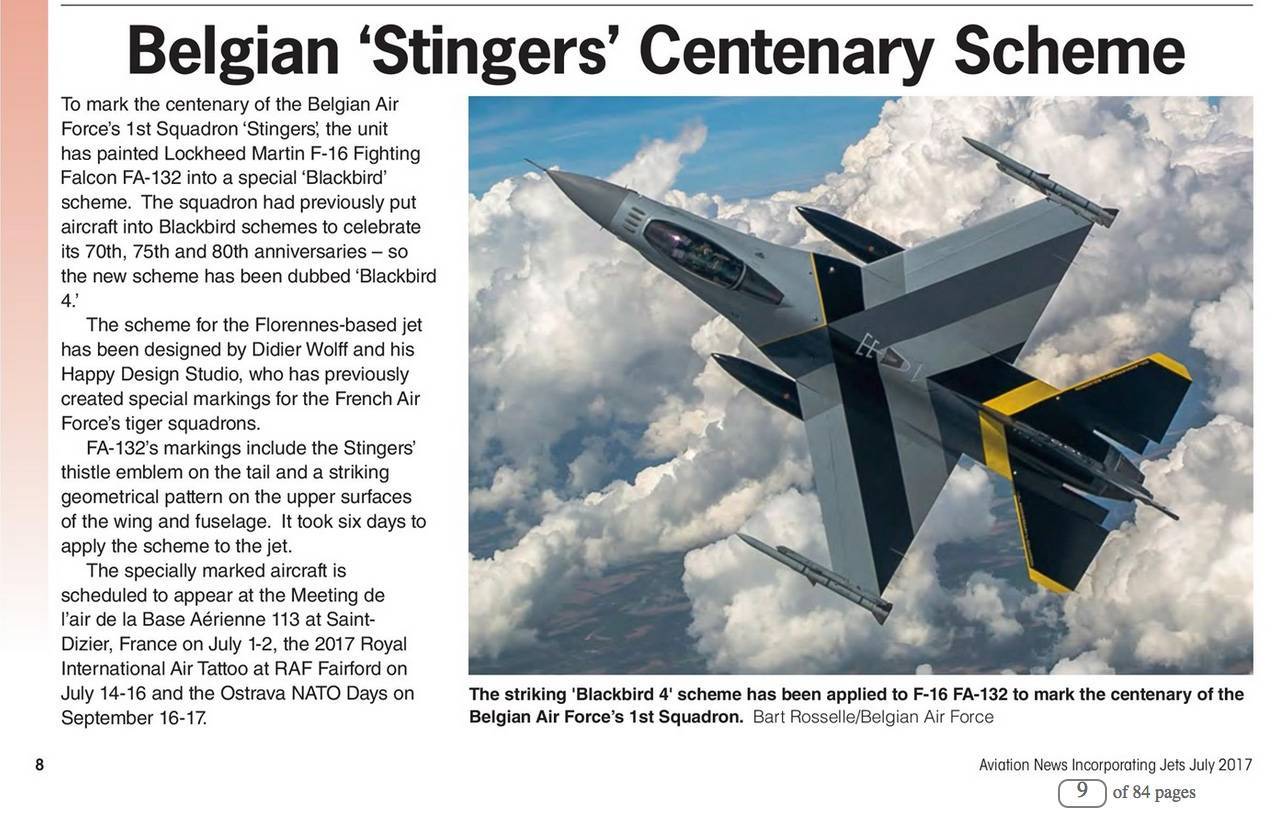
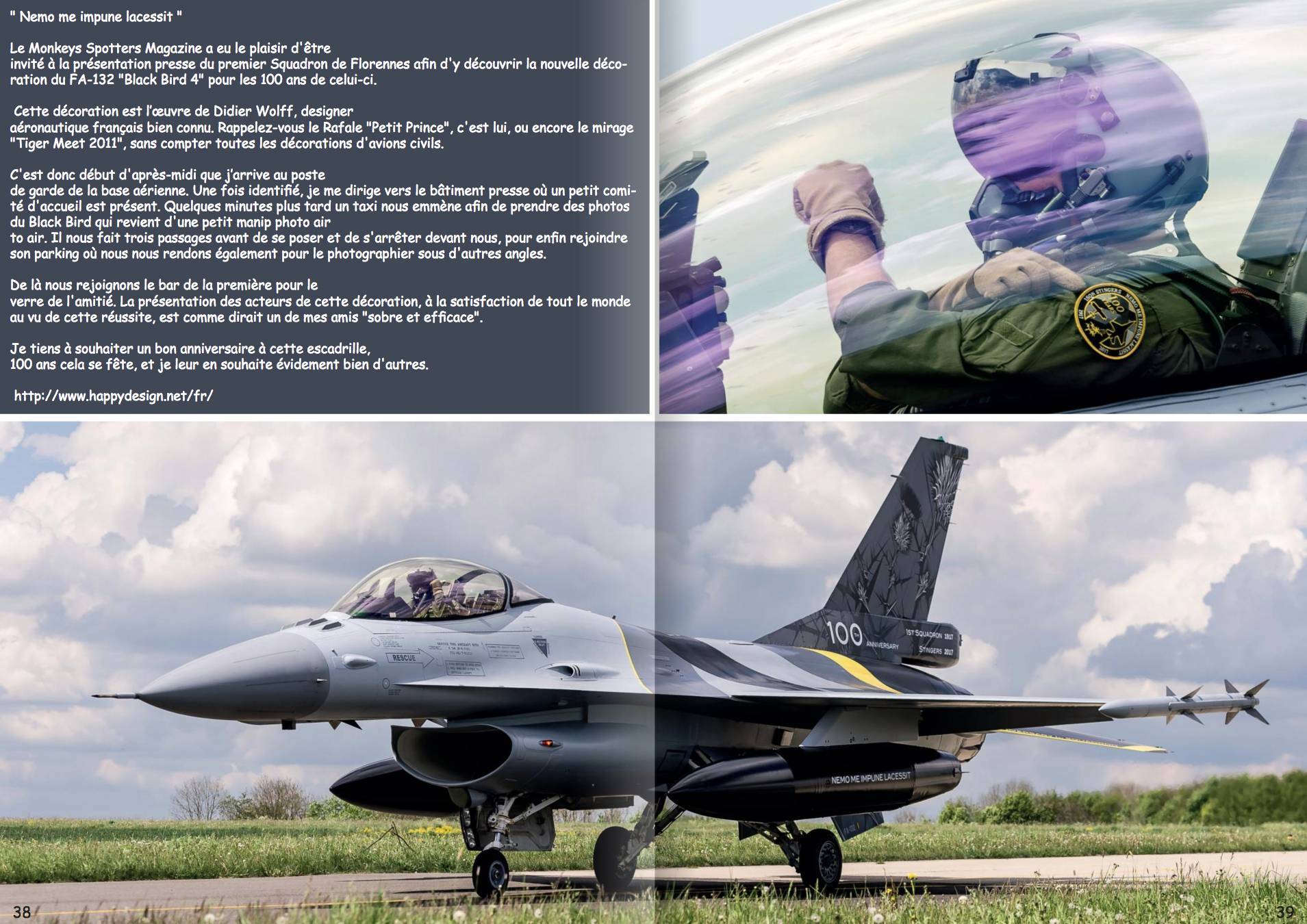
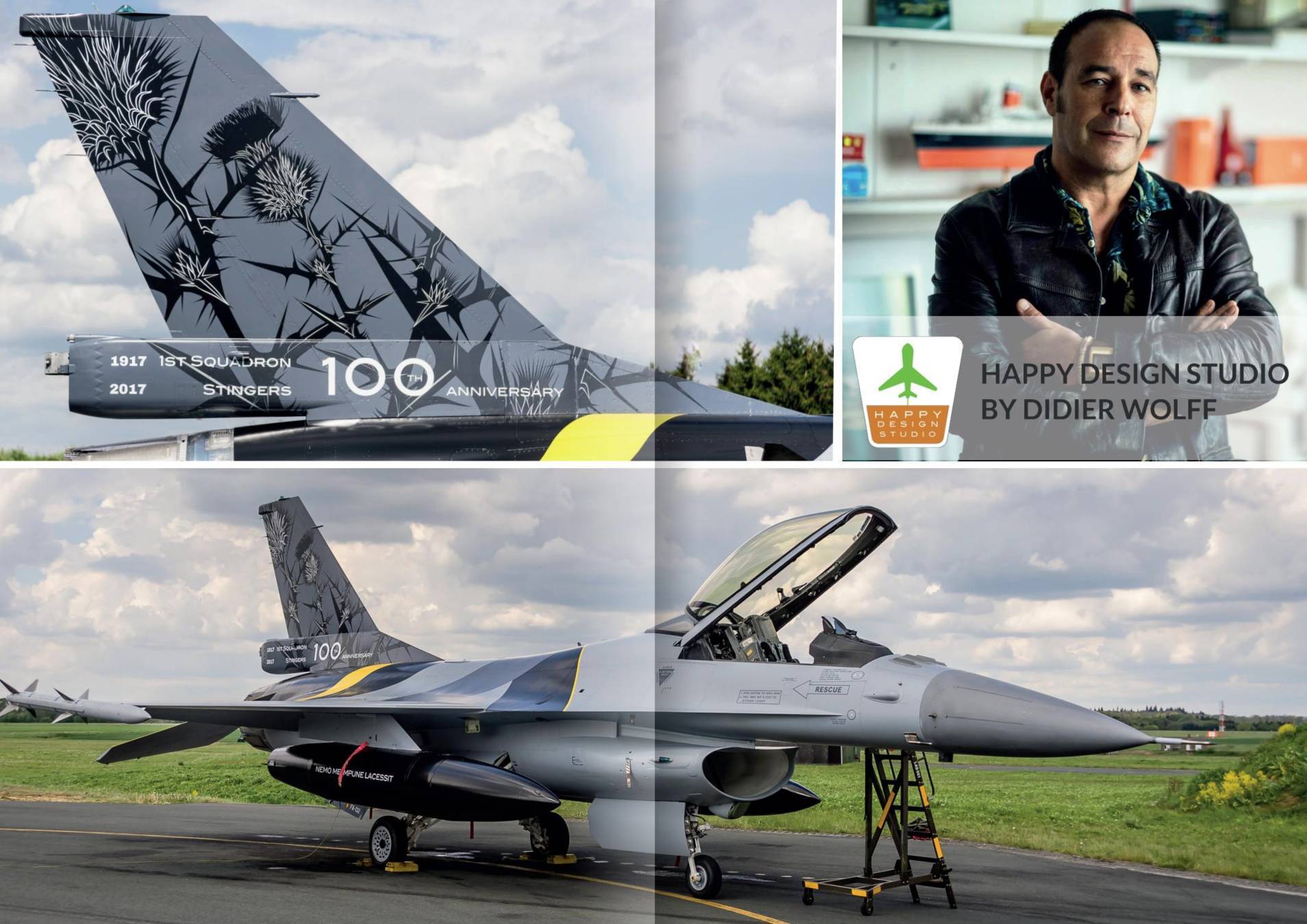
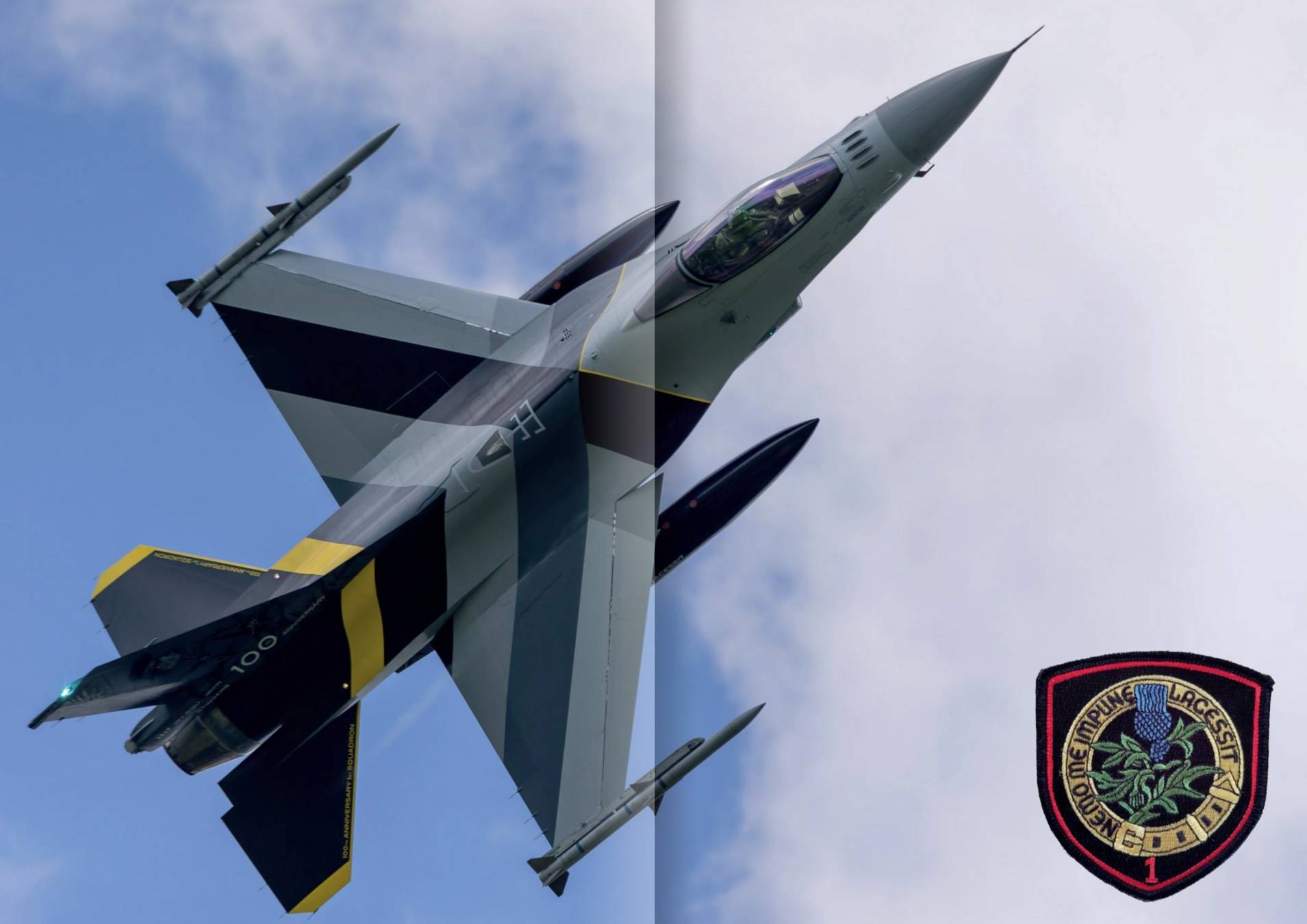
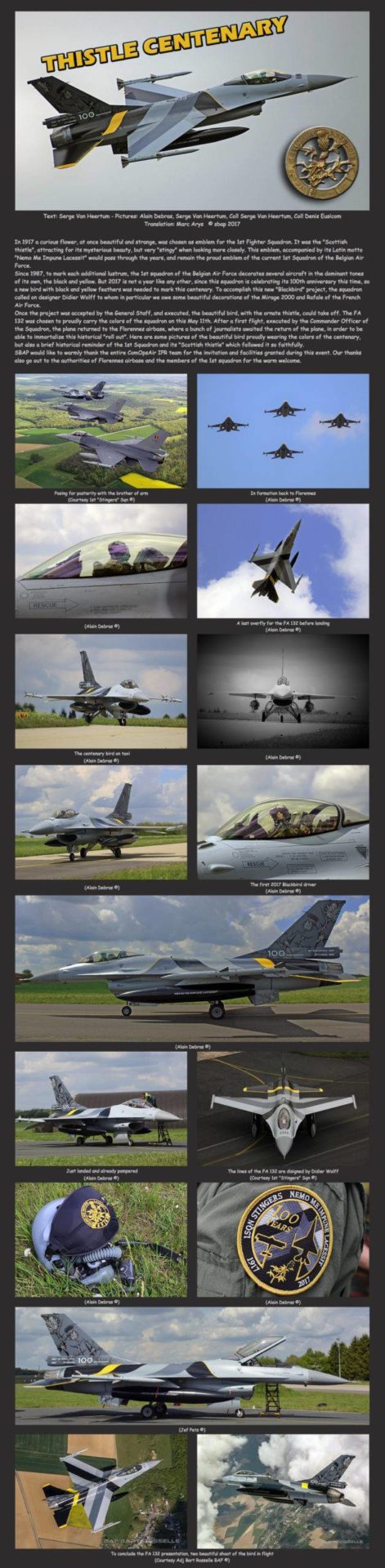
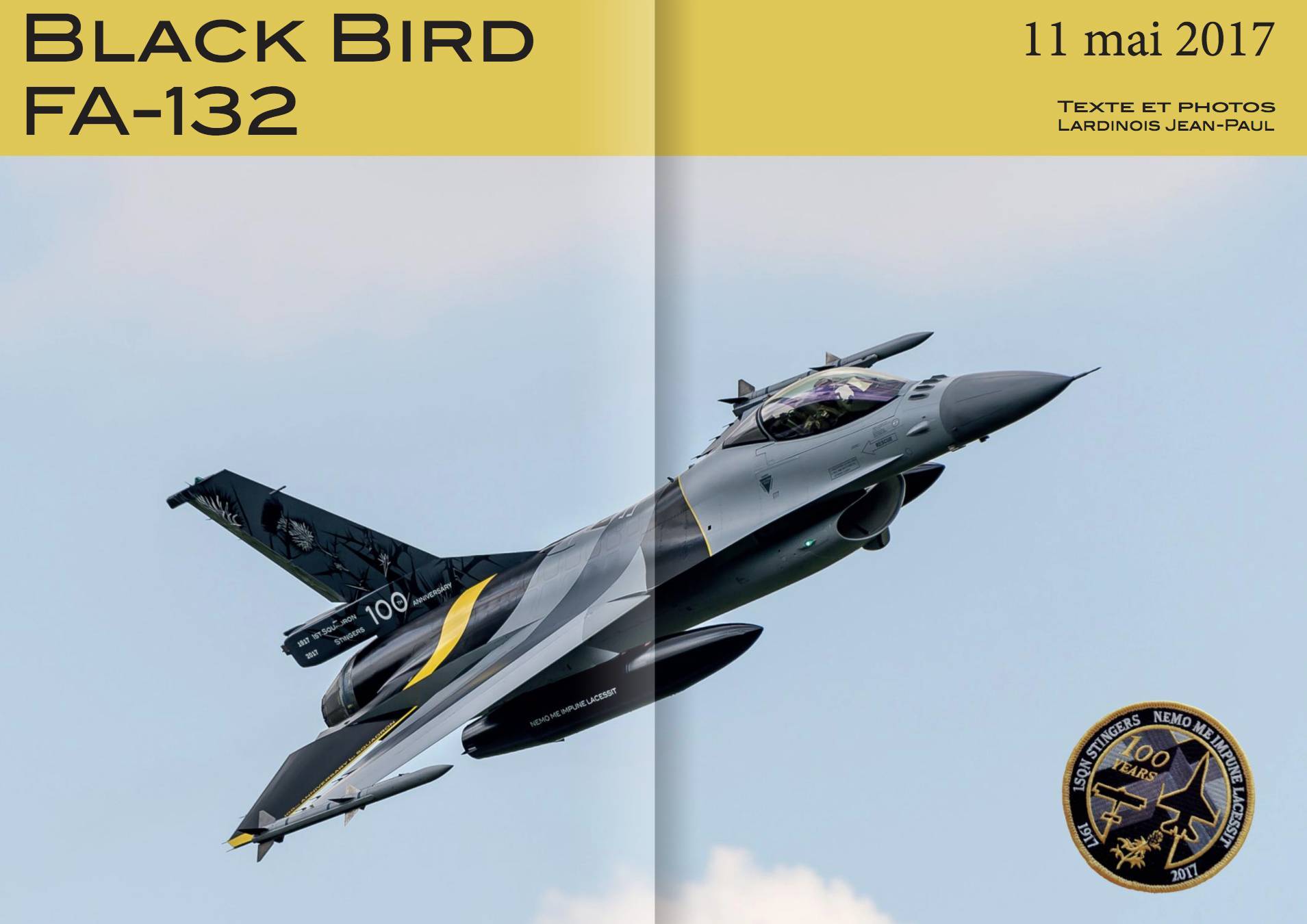
Source :AVIATION NEWS / This article is reproduced for archival purposes. Belgian ‘Stingers’ Centenary Scheme To mark the centenary of the Belgian Air Force’s 1st Squadron ‘Stingers’, the unit has painted Lockheed Martin F-16 Fighting Falcon FA-132 into a special ‘Blackbird’ scheme. The squadron had previously put aircraft into Blackbird schemes to celebrate its 70th, 75th and 80th anniversaries – so the new scheme has been dubbed ‘Blackbird 4’. The scheme for the Florennes-based jet has been designed by Didier Wolff and his Happy Design Studio, who has previously created special markings for the French Air Force’s tiger squadrons. FA-132’s markings include the Stingers’ thistle emblem on the tail and a striking geometrical pattern on the upper surfaces of the wing and fuselage. It took six days to apply the scheme to the jet. The specially marked aircraft is scheduled to appear at the Meeting de l’air de la Base Aérienne 113 at Saint-Dizier, France on July 1-2, the 2017 Royal International Air Tattoo at RAF Fairford on July 14-16 and the Ostrava NATO Days on September 16-17. Caption under the image The striking ‘Blackbird 4’ scheme has been applied to F-16 FA-132 to mark the centenary of the Belgian Air Force’s 1st Squadron. Bart Rosselle / Belgian Air Force.ARTICLE N° 239 / AVIATION NEWS


MAI 2017
Read full article (text version)
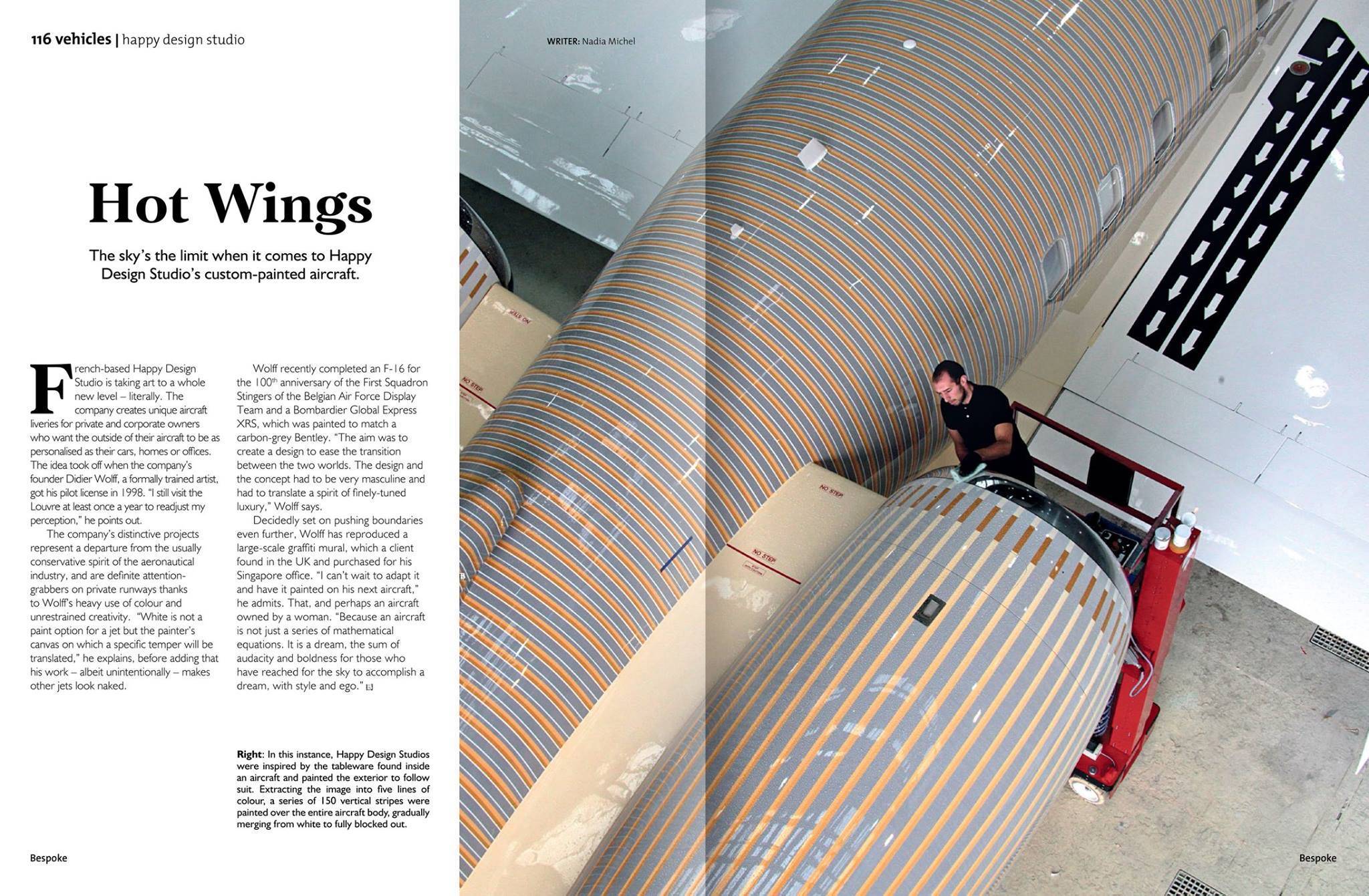
Source :BESPOKE MAGAZINE / This article is reproduced for archival purposes. 116 vehicles | happy design studio WRITER: Nadia Michel Hot Wings The sky’s the limit when it comes to Happy Design Studio’s custom-painted aircraft. French-based Happy Design Studio is taking art to a whole new level – literally. This company creates unique aircraft liveries for private and corporate owners who want the outside of their aircraft to be as personalised as their cars, homes or offices. The idea took off when the company’s founder Didier Wolff, a formally trained artist, got his pilot licence in 1998. “I still visit the Louvre at least once a year to readjust my perception,” he points out. The company’s distinctive projects represent a departure from the usually conservative spirit of the aeronautical industry, and are definite attention-grabbers on private runways thanks to Wolff’s heavy use of colour and unrestrained creativity. “White is not a paint option for a jet but the painter’s canvas on which a specific temper will be translated,” he explains, before adding that his work – albeit unintentionally – makes other jets look naked. Wolff recently completed an F-16 for the 100th anniversary of the First Squadron Stingers of the Belgian Air Force Display Team and a Bombardier Global Express XRS, which was painted to match a carbon-grey Bentley. “The aim was to create a design to ease the transition between the two worlds. The design and the concept had to be very masculine and had to translate a spirit of finely-tuned luxury,” Wolff says. Decidedly set on pushing boundaries even further, Wolff has reproduced a large-scale graffiti mural, which a client found in the UK and purchased for his Singapore office. “I can’t wait to adapt it and have it painted on his next aircraft,” he admits. That, and perhaps an aircraft owned by a woman. “Because an aircraft is not just a series of mathematical equations. It is a dream, the sum of audacity and boldness for those who have reached for the sky to accomplish a dream, with style and ego.” Right: In this instance, Happy Design Studios were inspired by the tableware found inside an aircraft and painted the exterior to follow suit. Extracting the image into five lines of colour, a series of 150 vertical stripes were painted over the entire aircraft body, gradually merging from white to fully blocked out.ARTICLE N° 238 / BESPOKE MAGAZINE


MAI 2017
Read full article (text version)
Source : MONKEY SPOTTERS MAGAZINE / This article is reproduced for archival purposes. BLACK BIRD FA-132 11 mai 2017 Texte et photos Lardinois Jean-Paul “Nemo me impune lacessit” Le Monkeys Spotters Magazine a eu le plaisir d’être invité à la présentation presse du premier Squadron de Florennes afin d’y découvrir la nouvelle décoration du FA-132 “Black Bird 4” pour les 100 ans de celui-ci. Cette décoration est l’œuvre de Didier Wolff, designer aéronautique français bien connu. Rappelez-vous le Rafale “Petit Prince”, c’est lui, ou encore le mirage “Tiger Meet 2011”, sans compter toutes les décorations d’avions civils. C’est donc début d’après-midi que j’arrive au poste de garde de la base aérienne. Une fois identifié, je me dirige vers le bâtiment presse où un petit comité d’accueil est présent. Quelques minutes plus tard un taxi nous emmène afin de prendre des photos du Black Bird qui revient d’une petite manip photo air to air. Il nous fait trois passages avant de se poser et de s’arrêter devant nous, pour enfin rejoindre son parking où nous nous rendons également pour le photographier sous d’autres angles. De là nous rejoignons le bar de la première pour le verre de l’amitié. La présentation des acteurs de cette décoration, à la satisfaction de tout le monde au vu de cette réussite, est comme dirait un de mes amis “sobre et efficace”. Je tiens à souhaiter un bon anniversaire à cette escadrille, 100 ans cela se fête, et je leur souhaite évidemment bien d’autres.ARTICLE N° 237 / MONKEY SPOTTERS MAGAZINE


MAI 2017
Read full article (text version)
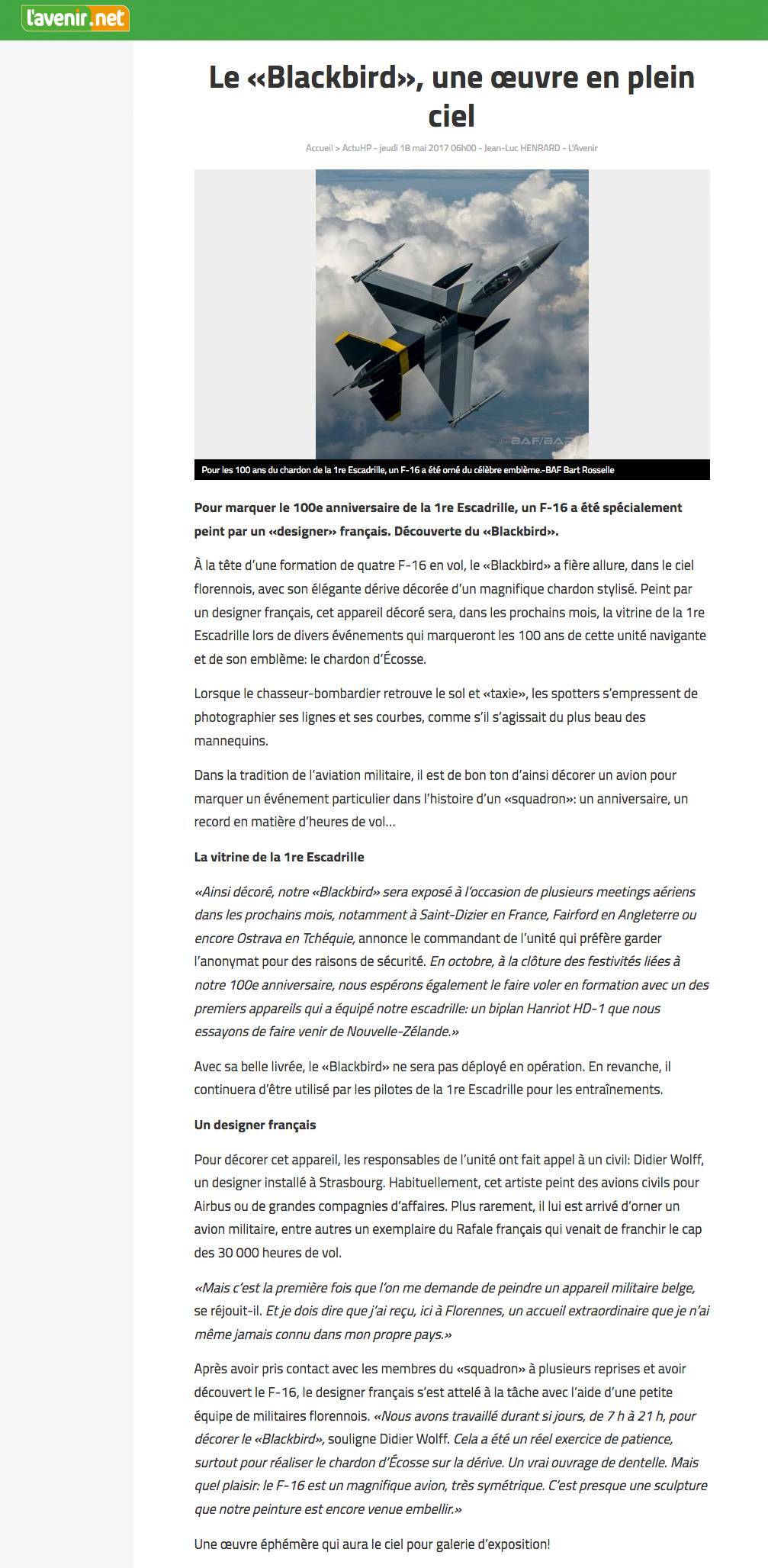
Source : L’AVENIR / This article is reproduced for archival purposes. Le «Blackbird», une uvre en plein ciel Accueil > ActuHP – jeudi 18 mai 2017 06h00 – Jean-Luc HENRARD Pour les 100 ans du chardon de la 1re Escadrille, un F-16 a été orné du célèbre emblème – BAF Bart Rosselle Pour marquer le 100e anniversaire de la 1re Escadrille, un F-16 a été spécialement peint par un «designer» français. Découverte du «Blackbird». À la tête d’une formation de quatre F-16 en vol, le «Blackbird» a fière allure, dans le ciel florennoys, avec son élégante dérive décorée d’un magnifique chardon stylisé. Peint par un designer français, cet appareil décoré sera, dans les prochains mois, la vitrine de la 1re Escadrille lors de divers événements qui marqueront les 100 ans de cette unité navigante et de son emblème: le chardon d’Écosse. Lorsque le chasseur-bombardier retrouve le sol et «taxie», les spotters s’empressent de photographier ses lignes et ses courbes, comme s’il s’agissait du plus beau des mannequins. Dans la tradition de l’aviation militaire, il est de bon ton d’ainsi décorer un avion pour marquer un événement particulier dans l’histoire d’un «squadron»: un anniversaire, un record en matière d’heures de vol… La vitrine de la 1re Escadrille «Ainsi décoré, notre «Blackbird» sera exposé à l’occasion de plusieurs meetings aériens dans les prochains mois, notamment à Saint-Dizier en France, Fairford en Angleterre ou encore Ostrava en Tchéquie, annonce le commandant de l’unité qui préfère garder l’anonymat pour des raisons de sécurité. En octobre, à la clôture des festivités liées à notre 100e anniversaire, nous espérons également le faire voler en formation avec un des premiers appareils qui a équipé notre escadrille: un biplan Hanriot HD-1 que nous essayons de faire venir de Nouvelle-Zélande.» Avec sa belle livrée, le «Blackbird» ne sera pas déployé en opération. En revanche, il continuera d’être utilisé par les pilotes de la 1re Escadrille pour les entraînements. Un designer français pour décorer cet appareil, les responsables de l’unité ont fait appel à un civil: Didier Wolff, un designer installé à Strasbourg. Habituellement, cet artiste peint des avions civils pour Airbus ou de grandes compagnies d’affaires. Plus rarement, il lui est arrivé d’orner un avion militaire, entre autres un exemplaire du Rafale français qui venait de franchir le cap des 30 000 heures de vol. «Mais c’est la première fois que l’on me demande de peindre un appareil militaire belge, se réjouit-il. Et je dois dire que j’ai reçu, ici à Florennes, un accueil extraordinaire que je n’ai même jamais connu dans mon propre pays.» Après avoir pris contact avec les membres du «squadron» à plusieurs reprises et avoir découvert le F-16 , le designer français s’est attelé à la tâche avec l’aide d’une petite équipe de militaires florennoys. «Nous avons travaillé durant six jours, de 7 h à 21 h, pour décorer le «Blackbird», souligne Didier Wolff. Cela a été un réel exercice de patience, surtout pour réaliser le chardon d’Écosse sur la dérive. Un vrai ouvrage de dentelle. Mais quel plaisir: le F-16 est un magnifique avion, très symétrique. C’est presque une sculpture que notre peinture est encore venue embellir.» Une œuvre éphémère qui aura le ciel pour galerie d’exposition!ARTICLE N° 236 / L’AVENIR

MAI 2017
Read full article (text version)
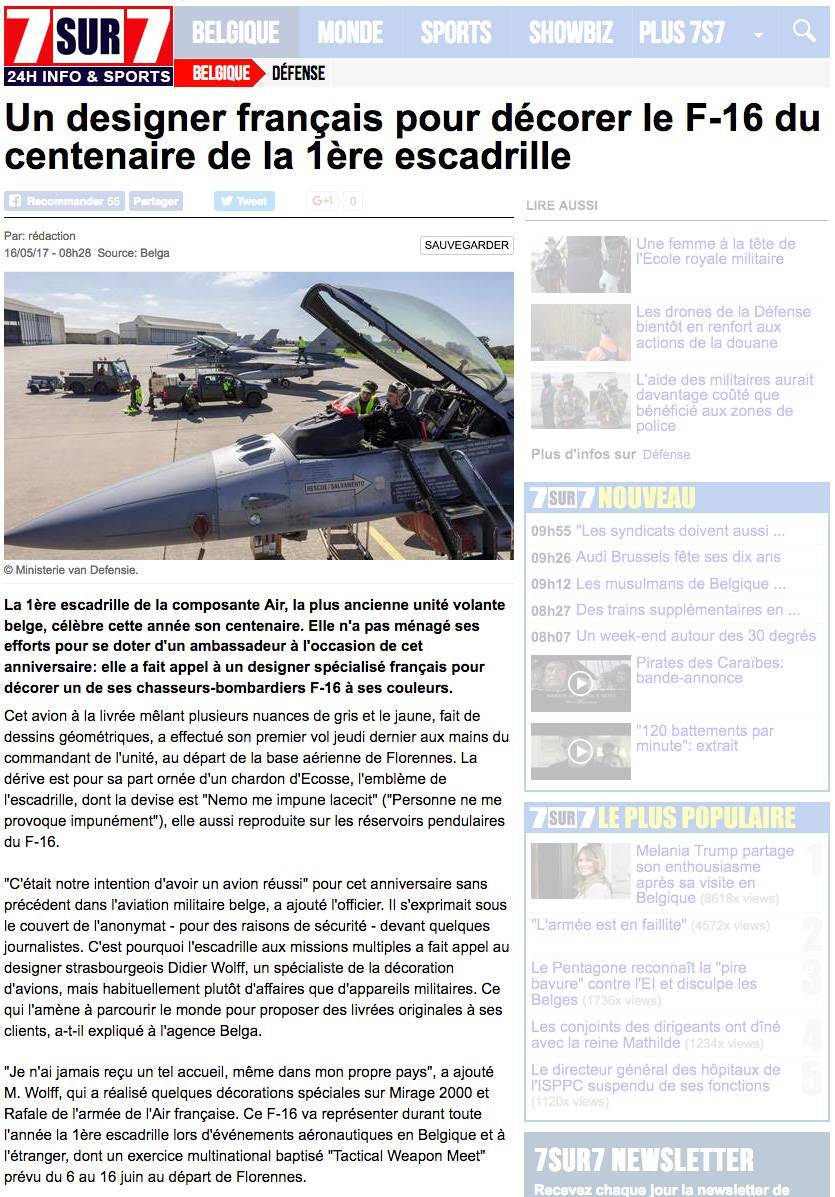
Source :7 SUR 7 / This article is reproduced for archival purposes. 24H INFO & SPORTS BELGIQUE – DÉFENSE Un designer français pour décorer le F-16 du centenaire de la 1ère escadrille Par: rédaction 16/05/17 – 08h28 Source: Belga © Ministerie van Defensie. La 1ère escadrille de la composante Air, la plus ancienne unité volante belge, célèbre cette année son centenaire. Elle n’a pas ménagé ses efforts pour se doter d’un ambassadeur à l’occasion de cet anniversaire: elle a fait appel à un designer spécialisé français pour décorer un de ses chasseurs-bombardiers F-16 ses couleurs. Cet avion à la livrée mêlant plusieurs nuances de gris et le jaune, fait de dessins géométriques, a effectué son premier vol jeudi dernier aux mains du commandant de l’unité, au départ de la base aérienne de Florennes. La dérive est pour sa part ornée d’un chardon d’Écosse, l’emblème de l’escadrille, dont la devise est “Nemo me impune lacessit”(“Personne ne me provoque impunément”), elle aussi reproduite sur les réservoirs pendulaires du F-16. “C’était notre intention d’avoir un avion réussi” pour cet anniversaire sans précédent dans l’aviation militaire belge, a ajouté l’officier. Il s’exprimait sous le couvert de l’anonymat – pour des raisons de sécurité – devant quelques journalistes. C’est pourquoi l’escadrille aux missions multiples a fait appel au designer strasbourgeois Didier Wolff, un spécialiste de la décoration d’avions, mais habituellement plutôt d’affaires que militaires. Ce qui l’amène à parcourir le monde pour proposer des livrées originales à ses clients, a-t-il expliqué à l’agence Belga. “Je n’ai jamais reçu un tel accueil, même dans mon propre pays”, a ajouté M. Wolff, qui a réalisé quelques décorations spéciales sur Mirage 2000 et Rafale de l’armée de l’Air française. Ce F-16 va représenter durant toute l’année la 1ère escadrille lors d’événements aéronautiques en Belgique et à l’étranger, dont un exercice multinational baptisé “Tactical Weapon Meet” prévu du 6 au 16 juin au départ de Florennes.ARTICLE N° 235 / 7 SUR 7

MAI 2017
Read full article (text version)
Source :SBAP / This article is reproduced for archival purposes. THISTLE CENTENARY Text: Serge Van Herturn Pictures: Alain Debrera, Serge Van Herturn, Col Serge Van Herturn, Coll Denis Eucom In 1917 a curious flower, at once beautiful and strange, was chosen as emblem for the 1st Fighter Squadron. It was the “Scottish thistle”, attracting for its mysterious beauty, but very “stingy” when looking more closely. This emblem, accompanied by its Latin motto “Nemo Me Impune Lacessit” would pass through the years, and remain the proud emblem of the current 1st Squadron of the Belgian Air Force. Since 1987, for each additional lustrum, the 1st squadron of the Belgian Air Force decorates several aircraft in the dominant tones of its own, the black and yellow. But 2017 is not a year like any other, since this squadron is celebrating its 100th anniversary this time, and it now has chosen to proudly celebrate this event by a design by designer Didier Wolff, with particular we owe some beautiful decorations of the Mirage 2000 and Rafale of the French Air Force. The project was accepted by the General Staff, and executed, the beautiful bird, with the matte metallic, cold face of the F-16 FA 132 was chosen to proudly carry the colors of the squadron on May 11th. After a first flight, executed by the Commander Officer of the Squadron, the plane returned to the Florennes airbase, where a bunch of journalists crowded the waiting of the plane, in order to be able to immortalize this historical “roll out”. There are some pictures of the beautiful bird posted very soon. The team of the 1st Squadron and its “Scottish thistle” which followed to satisfy fully. SABA would like to warmly thank the entire ComOpAir JPR team for the invitation and facilities granted during this event. Our thanks also go to the authorities of Florennes airbase and the members of the 1st squadron for the warm welcome.ARTICLE N° 234 / SBAP

JANVIER 2017
Read full article (text version)
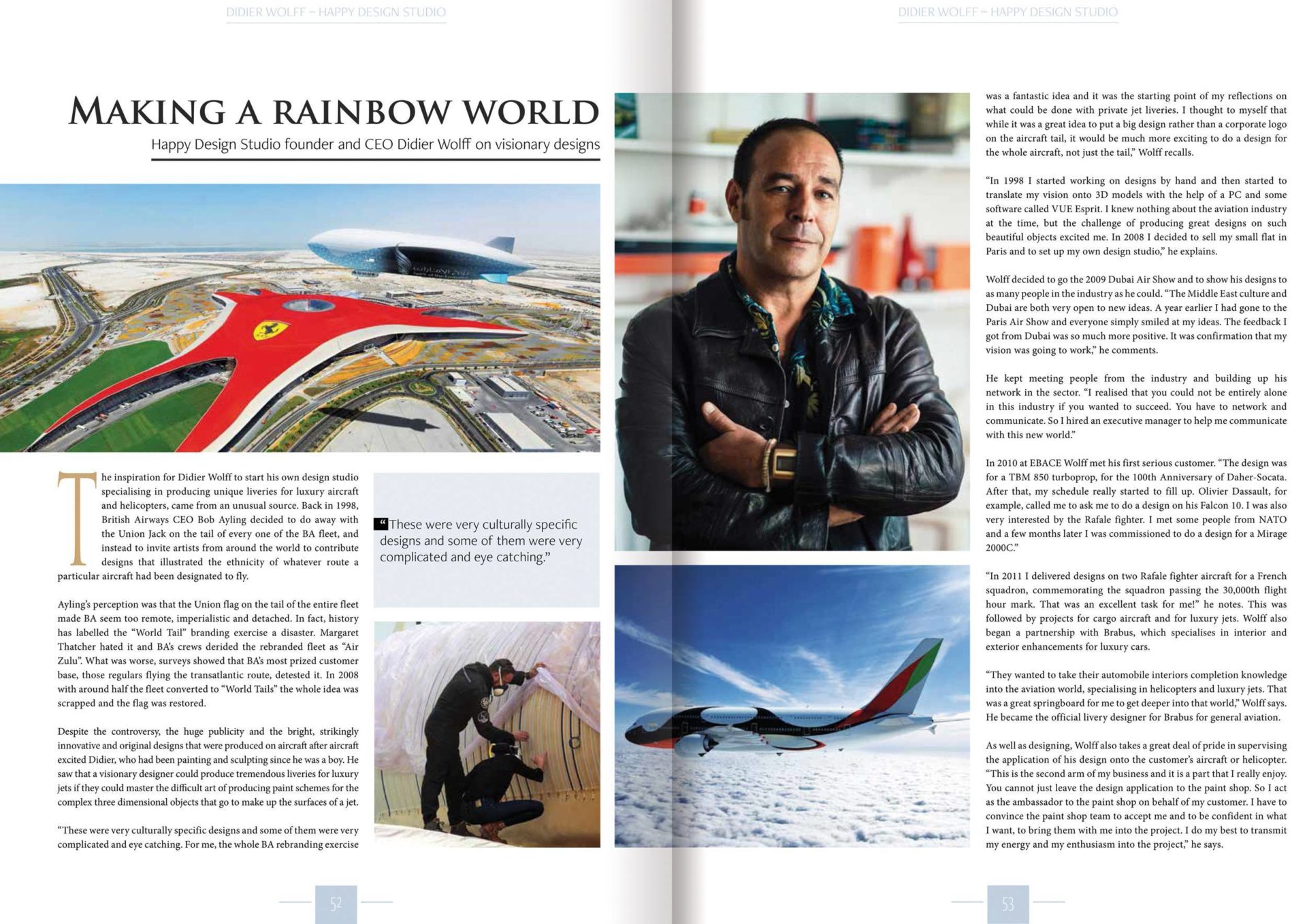
Source: BUSINESS AVIATION MAGAZINE / This article is reproduced for archival purposes. DIDIER WOLFF – HAPPY DESIGN STUDIO MAKING A RAINBOW WORLD Happy Design Studio founder and CEO Didier Wolff on visionary designs The inspiration for Didier Wolff to start his own design studio specialising in producing unique liveries for luxury aircraft and helicopters, came from an unusual source. Back in 1998, British Airways CEO Bob Ayling decided to do away with the Union Jack on the tail of every one of the BA fleet, and instead to invite artists from around the world to contribute designs that illustrated the ethnicity of whatever route a particular aircraft had been designated to fly. Ayling’s perception was that the Union flag on the tail of the entire fleet made BA seem too remote, imperialistic and detached. In fact, history has labelled the ‘World Tail’ branding exercise a disaster. Margaret Thatcher hated it and BA’s crews derided the rebranded fleet as ‘Air Zulu’. What was worse, surveys showed that BA’s most prized customer base, those regulars flying the transatlantic route, detested it. In 2008 with around half the fleet converted to ‘World Tails’ the whole idea was scrapped and the flag was restored. Despite the controversy, the huge publicity and the bright, strikingly innovative and original designs that were produced on aircraft after aircraft excited Didier, who had been painting and sculpting since he was a boy. He saw that a visionary designer could produce tremendous liveries for luxury jets if they could master the difficult art of producing paint schemes for jets that go three dimensional objects that go to make up the surfaces of a jet. “These were very culturally specific designs and some of them were very complicated and eye catching.” “These were very culturally specific designs and some of them were very complicated and eye catching.” …was a fantastic idea and it was the starting point of my reflections on what could be done with private jet liveries. I thought to myself that while it was a great idea to put a big design rather than a corporate logo on the aircraft tail, it would be much more exciting to do a design for the whole aircraft, not just the tail,” Wolff recalls. “In 1998 I started working on designs by hand and then started to translate my vision onto 3D models with the help of a PC and some software called VUE Esprit. I knew nothing about the aviation industry at the time, but the challenge of producing great designs on such beautiful objects excited me. In 2008 I decided to sell my small flat in Paris and to set up my own design studio,” he explains. Wolff decided to go to the 2009 Dubai Air Show to show his designs to as many people in the industry as he could. “The Middle East culture and Dubai are both very open to new ideas. A year earlier I had gone to the Paris Air Show and everyone simply smiled at my ideas. The feedback I got from Dubai was so much more positive. It was confirmation that my vision was going to work,” he comments. He kept meeting people from the industry and building up his network in the sector. “I realised that you could not do entirely alone in this industry if you wanted to succeed. You have to network and communicate. So I hired an executive manager to help me communicate with this new world.” In 2010 at EBACE Wolff met his first serious customer. “The design was for a TBM 850 turboprop, for the 100th Anniversary of Daher-Socata. After that, my schedule really started to fill up. Olivier Dassault, for example, called me to ask me to do a design on his Falcon 10. I was very interested by the Rafale fighter. I met some people from NATO and a few months later I was commissioned to do a design for a Mirage 2000C.” “In 2011 I delivered designs on two Rafale fighter aircraft for a French squadron, commemorating the squadron passing the 30,000th flight hour mark. That was an excellent task for me,” he notes. This was followed by projects for cargo aircraft and for luxury jets. Wolff also began a partnership with Brabus, which specialises in interior and exterior enhancements for luxury cars. “They wanted to take their automobile interiors completion knowledge into the aviation world, specialising in helicopters and luxury jets. That was a great springboard for me to get deeper into that world,” Wolff says. He became the official livery designer for Brabus for general aviation. As well as designing, Wolff also takes a great deal of pride in supervising the application of his design onto the customer’s aircraft or helicopter. “This is the second half of my business and it is a part that I really enjoy. You cannot just leave the design application to the paint shop. So I act as the ambassador to the paint shop on behalf of my customer. I have to convince the paint shop team to accept me and to be confident in what I want, to bring them with me into the project. I do my best to transmit my energy and my enthusiasm into the project,” he says.ARTICLE N° 233 / BUSINESS AVIATION MAGAZINE

JANVIER 2017
Read full article (text version)
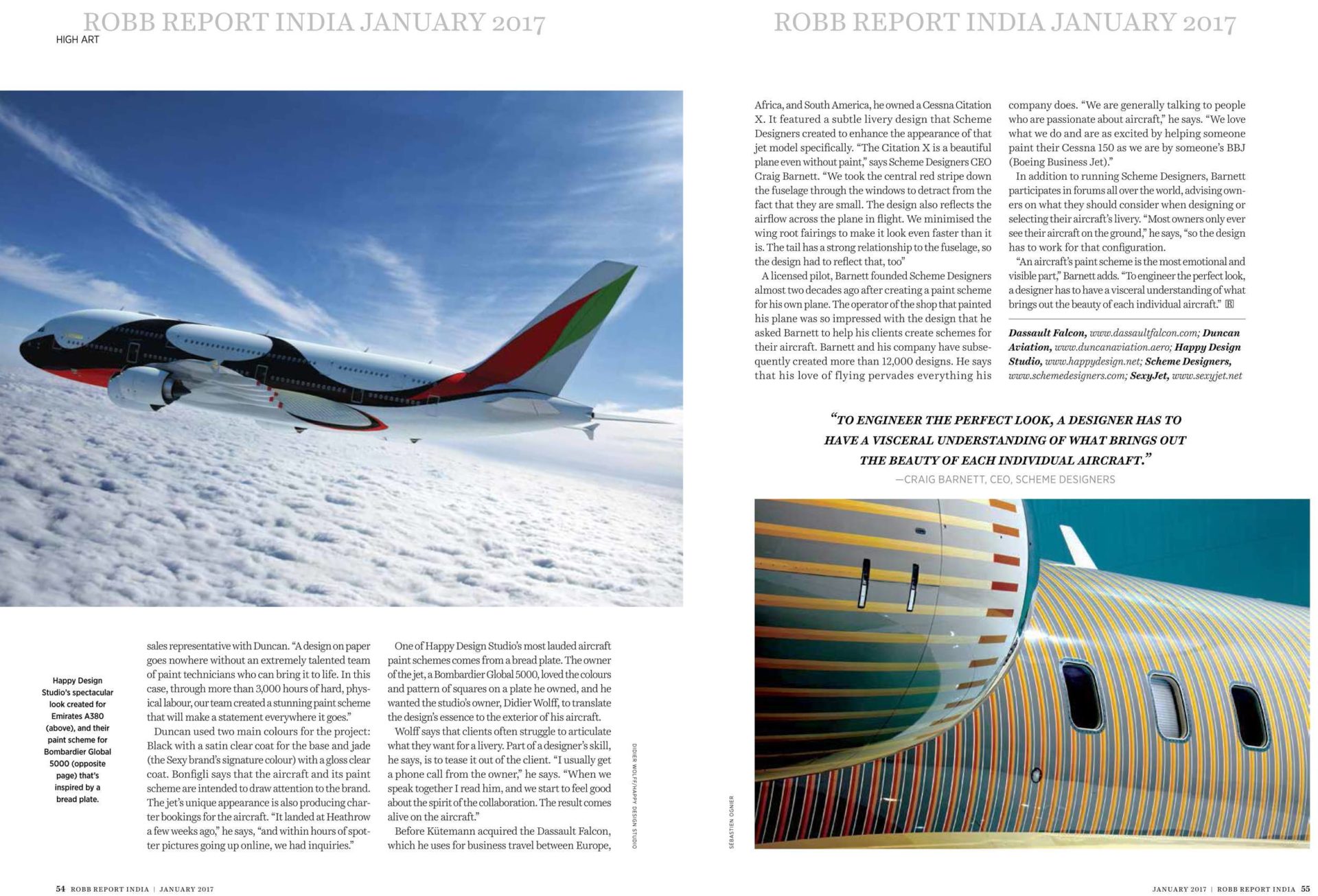
Source :ROBB REPORT INDIA / This article is reproduced for archival purposes. These Four Custom Private-Jet Exteriors Give New Meaning to the Term “High Art” Happy Design Studio Liz Moscrop One of Happy Design Studio’s (happydesign.net) most lauded aircraft paint schemes comes from a bread plate. The owner of the jet, a Bombardier Global 5000 , loved the colors and pattern of squares on a plate he owned, and he wanted the studio’s owner, Didier Wolff , to translate the design’s essence to the exterior of his aircraft. Wolff says that clients often struggle to articulate what they want for a livery. Part of a designer’s skill, he says, is to tease it out of the client. “I usually get a phone call from the owner,” he says. “When we speak together I read him, and we start to feel good about the spirit of the collaboration. The result comes alive on the aircraft.” HIGH ART Happy Design Studio’s spectacular look created for Emirates A380 (above), and their paint scheme for Bombardier Global 5000 (opposite page) that’s inspired by a bread plate. The jet’s unique appearance is also producing charter bookings for the aircraft. “It landed at Heathrow a few weeks ago,” he says, “and within hours of spotter pictures going up online, we had inquiries.” One of Happy Design Studio’s most lauded aircraft paint schemes comes from a bread plate. The owner of the jet, a Bombardier Global 5000, loved the colours and pattern of squares on a plate he owned, and he wanted the studio’s owner, Didier Wolff, to translate the design’s essence to the exterior of his aircraft. Wolff says that clients often struggle to articulate what they want for a livery. Part of a designer’s skill, he says, is to tease it out of the client. “I usually get a phone call from the owner,” he says. “When we speak together I read him, and we start to feel good about the spirit of the collaboration. The result comes alive on the aircraft.”ROBB REPORT INDIAARTICLE N° 232 / ROBB REPORT INDIA