Press

2025
2024
2023
2022
2020-2021
2019
2018
2017
2016
2015
2014
2013
2012
2011
2010
2009

 DECEMBRE 2014

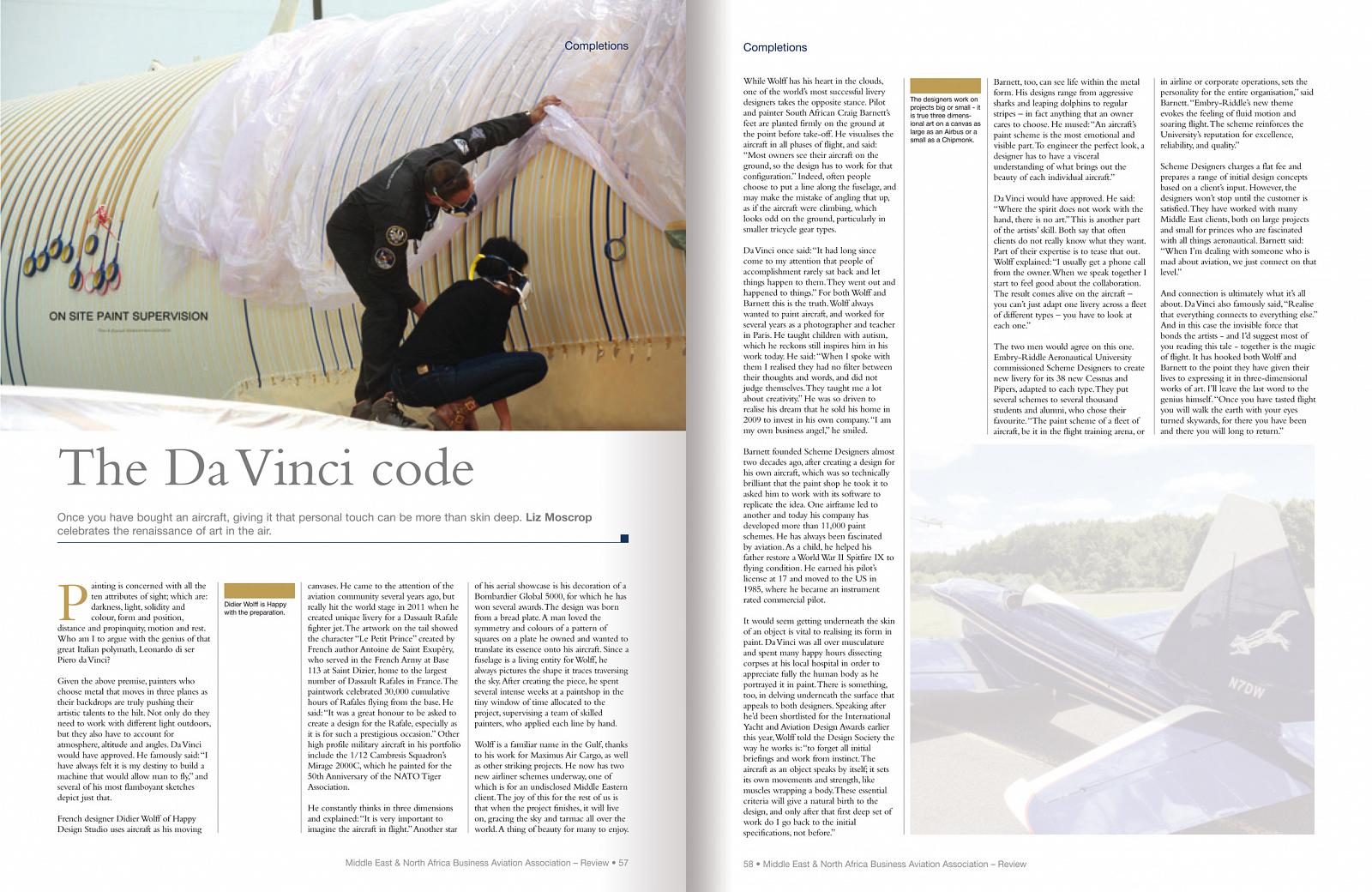
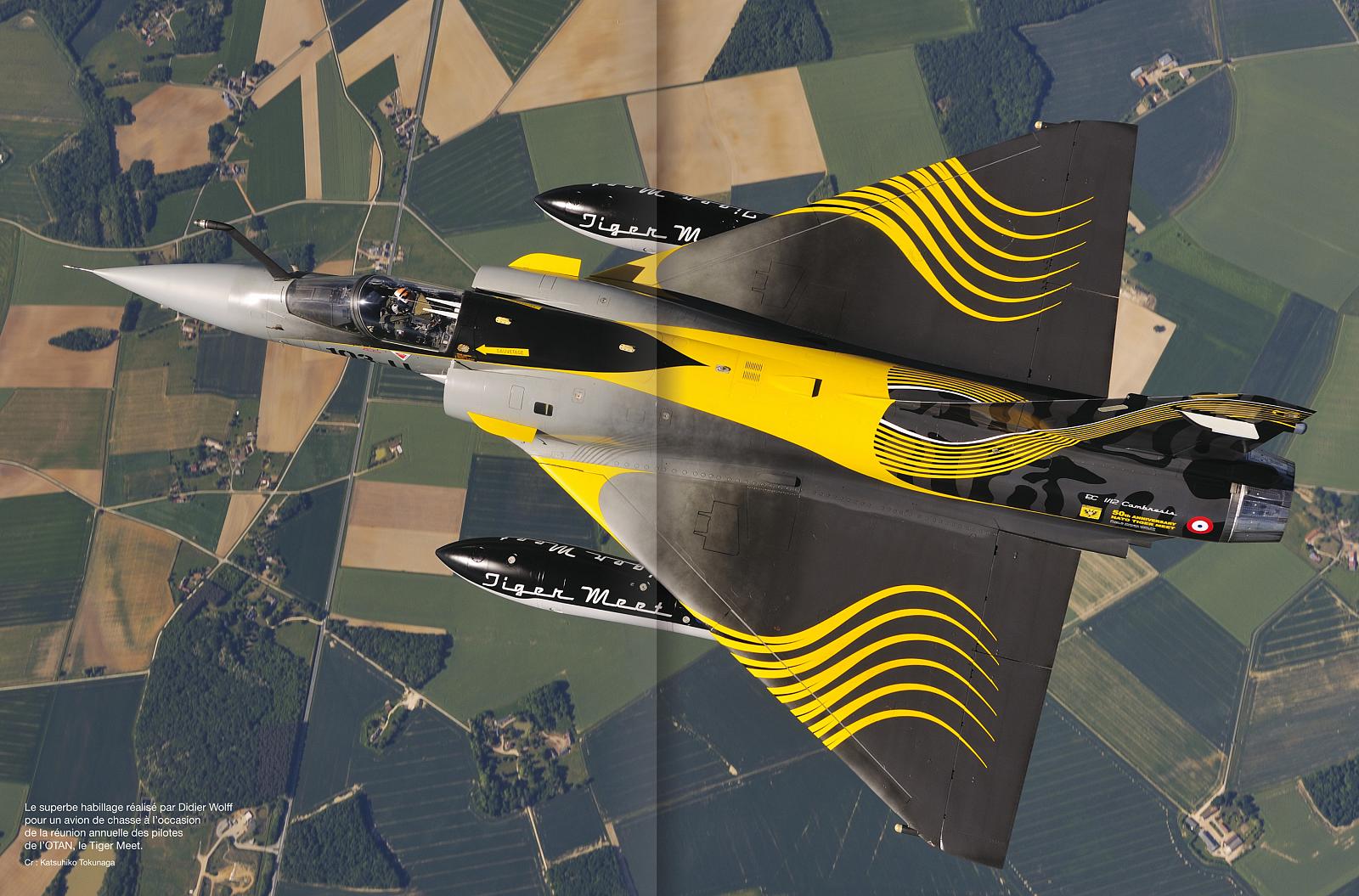
Read full article (text version) Source : Middle East & North Africa Business Aviation Association / This article is reproduced for archival purposes. Completions The DaVinci code Once you have bought an aircraft, giving it that personal touch can be more than skin deep. Liz Moscrop celebrates the renaissance of art in the air. Painting is concerned with all the ten attributes of sight, which are: darkness, light, solidity and colour, form and position, distance and propinquity, motion and rest. Who am I to argue with the genius of that great Italian polymath, Leonardo di ser Piero da Vinci? Given the above premise, painters who choose metal that moves in three planes as their backdrops are truly pushing their artistic talents to the hilt. Not only do they need to work with different light outdoors, but they also have to account for atmosphere, altitude and angles. Da Vinci would have approved. He famously said: “I have always felt it is my destiny to build a machine that would allow man to fly,” and several of his most flamboyant sketches depict just that. French designer Didier Wolff of Happy Design Studio uses aircraft as his moving Didier Wolff is Happy with the preparation. canvases. He came to the attention of the aviation community several years ago, but really hit the world stage in 2011 when he created unique livery for a Dassault Rafale fighter jet. The artwork on the tail showed the character “Le Petit Prince” created by French author Antoine de Saint Exupéry, who served in the French Army at Base 113 at Saint Dizier, home to the largest number of Dassault Rafales in France. The paintwork celebrated 30,000 cumulative hours of Rafales flying from the base. He said: “It was a great honour to be asked to create a design for the Rafale, especially as it is for such a prestigious occasion.” Other high profile military aircraft in his portfolio include the 1/12 Cambress Squadron’s Mirage 2000C, which he painted for the 50th Anniversary of the NATO Tiger Association. He constantly thinks in three dimensions and explained: “It is very important to imagine the aircraft in flight.” Another star of his aerial showcase is his decoration of a Bombardier Global 5000, for which he has won several awards. The design was born from a bread plate. A man loved the symmetry and colours of a pattern of squares on a plate he owned and wanted to translate its essence onto his aircraft. Since a fuselage is a living entity for Wolff, he always pictures the shape it traces traversing the sky. After creating the piece, he spent several intense weeks at a paintshop in the tiny window of time allocated to the project, supervising a team of skilled painters, who applied each line by hand. Wolff is a familiar name in the Gulf, thanks to his work for Maximus Air Cargo, as well as other striking projects. He now has two new airliner schemes underway, one of which is for an undisclosed Middle Eastern client. The joy of this for the rest of us is that when the project finishes, it will live on, gracing the sky and tarmac all over the world. A thing of beauty for many to enjoy. Completions While Wolff has his heart in the clouds, one of the world’s most successful livery designers takes the opposite stance. Pilot and painter South African Craig Barnett’s feet are planted firmly on the ground at the point before take-off. He visualises the aircraft in all phases of flight, and said: “Most owners see their aircraft on the ground, so the design has to work for that configuration.” Indeed, often people choose to put a line along the fuselage, and may make the mistake of angling that up, as if the aircraft were climbing, which looks odd on the ground, particularly in smaller tricycle gear types. Da Vinci once said: “It had long since come to my attention that people of accomplishment rarely sat back and let things happen to them. They went out and happened to things.” For both Wolff and Barnett this is the truth. Wolff always wanted to paint aircraft, and worked for several years as a photographer and teacher in Paris. He taught children with autism, which he reckons still inspires him in his work today. He said: “When I spoke with them I realised they had no filter between their thoughts and work, and did not judge themselves. They taught me a lot about creativity.” He was so driven to realise his dream that he sold his home in 2009 to invest in his own company. “I am my own business angel,” he smiled. Barnett founded Scheme Designers almost two decades ago, after creating a design for his own aircraft, which was so technically brilliant that the paint shop he took it to asked him to work with its software to replicate the idea. One airframe led to another and today his company has developed more than 11,000 paint schemes. He has always been fascinated by aviation. As a child, he helped his father restore a World War II Spitfire IX to flying condition. He earned his pilot’s license at 17 and moved to the US in 1985, where he became an instrument rated commercial pilot. It would seem getting underneath the skin of an object is vital to realising its form in paint. Da Vinci was all over musculature, and spent many happy hours dissecting corpses at his local hospital in order to appreciate fully the human body as he portrayed it in paint. There is something, too, in delving underneath the surface that appeals to both designers. Speaking after he’d been shortlisted for the International Yacht and Aviation Design Awards earlier this year, Wolff told the Design Society the way he works is: “to forget all initial briefings and work from instinct. The aircraft as an object speaks by itself; it sets its own movements and strength, like muscles wrapping a body. These essential criteria will give a natural birth to the design, and only after that first deep set of work do I go back to the initial specifications, not before.” The designers work on projects big or small – it is true three dimensional art on a canvas as large as an Airbus or a small as a Chipmunk. Barnett, too, can see life within the metal form. His designs range from aggressive sharks and leaping dolphins to regular stripes – in fact anything that an owner cares to choose. He mused: “An aircraft’s paint scheme is the most emotional and visible part. To engineer the perfect look, a designer has to have a visceral understanding of what brings out the beauty of each individual aircraft.” Da Vinci would have approved. He said: “Where the spirit does not work with the hand, there is no art.” This is another part of the artists’ skill. Both say that often clients do not really know what they want. Part of their expertise is to tease that out. Wolff explained: “I usually get a phone call from the owner. When we speak together I start to feel good about the collaboration. The result comes alive on the aircraft – you can’t just adapt one livery across a fleet of different types – you have to look at each one.” The two men would agree on this one. Embry-Riddle Aeronautical University commissioned Scheme Designers to create new livery for its 38 new Cessnas and Pipers, adapted to each type. They put several schemes to several thousand students and alumni, who chose their favourite: “The paint scheme of a fleet of aircraft, be it in the flight training arena, or in airline or corporate operations, sets the personality for the entire organisation,” said Barnett. “Embry-Riddle’s new theme evokes the feeling of fluid motion and soaring flight. The scheme reinforces the University’s reputation for excellence, reliability, and quality.” Scheme Designers charges a flat fee and prepares a range of initial design concepts based on a client’s input. However, the designers won’t stop until the customer is satisfied. They have worked with many Middle East clients, both on large projects and small for princes who are fascinated with all things aeronautical. Barnett said: “When I’m dealing with someone who is mad about aviation, we just connect on that level.” And connection is ultimately what it’s all about. Da Vinci also famously said, “Realise that everything connects to everything else.” And in this case the invisible force that bonds the artists – and I’d suggest most of you reading this tale – together is the magic of flight. It has hooked both Wolff and Barnett to the point they have given their lives to expressing it in three-dimensional works of art. I’ll leave the last word to the genius himself: “Once you have tasted flight you will walk the earth with your eyes turned skywards, for there you have been and there you will long to return.” Middle East & North Africa Business Aviation Association – Review • 57 58 – Middle East & North Africa Business Aviation Association – Review

ARTICLE N° 218 / Middle East & North Africa Business Aviation Association

 DECEMBRE 2014

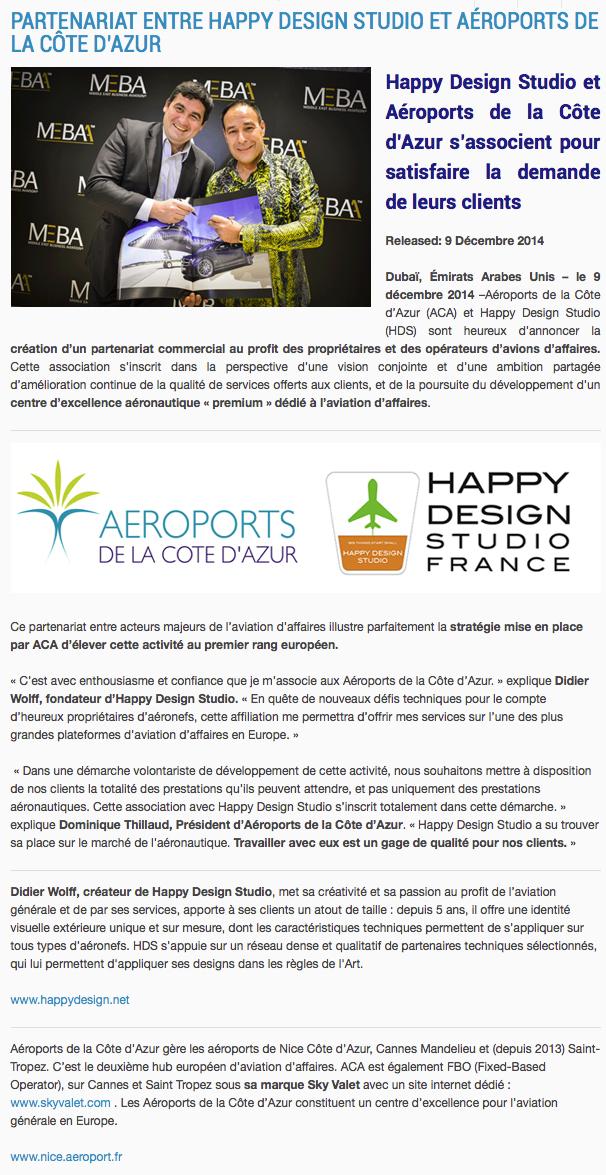
Read full article (text version) Source : NICE AEROPORT / This article is reproduced for archival purposes. Happy Design Studio et Aéroports de la Côte d’Azur s’associent pour satisfaire la demande de leurs clients Released: 9 Décembre 2014 Dubaï, Émirats Arabes Unis – le 9 décembre 2014 – Aéroports de la Côte d’Azur (ACA) et Happy Design Studio (HDS) sont heureux d’annoncer la création d’un partenariat commercial au profit des propriétaires et des opérateurs d’avions d’affaires. Cette association s’inscrit dans la perspective d’une vision conjointe et d’une ambition partagée d’amélioration continue de la qualité de services offerts aux clients, et de la poursuite du développement d’un centre d’excellence aéronautique « premium » dédié à l’aviation d’affaires. Ce partenariat entre acteurs majeurs de l’aviation d’affaires illustre parfaitement la stratégie mise en place par ACA d’élever cette activité au premier rang européen. « C’est avec enthousiasme et confiance que je m’associe aux Aéroports de la Côte d’Azur.» explique Didier Wolff, fondateur d’Happy Design Studio. « En quête de nouveaux défis techniques pour le compte d’heureux propriétaires d’aéronefs, cette affiliation me permettra d’offrir mes services sur l’une des plus grandes plateformes d’aviation d’affaires en Europe. «Dans une démarche volontariste de développement de cette activité, nous souhaitons mettre à disposition de nos clients la totalité des prestations qu’ils peuvent attendre, et pas uniquement des prestations aéronautiques. Cette association avec Happy Design Studio s’inscrit totalement dans cette démarche.» explique Dominique Thillaud, Président d’Aéroports de la Côte d’Azur. Happy Design Studio a su trouver sa place sur le marché de l’aéronautique. Travailler avec eux est un gage de qualité pour nos clients. Didier Wolff, créateur de Happy Design Studio, met sa créativité et sa passion au profit de l’aviation générale et de par ses services, apporte à ses clients un atout de taille : depuis 5 ans, il offre une identité visuelle extérieure unique et sur mesure, dont les caractéristiques techniques permettent de s’appliquer sur tous types d’aéronefs. HDS s’appuie sur un réseau dense et qualifié de partenaires techniques sélectionnés, qui lui permettent d’appliquer ses designs dans les règles de l’Art.

ARTICLE N° 217 / NICE AEROPORT

 DECEMBRE 2014

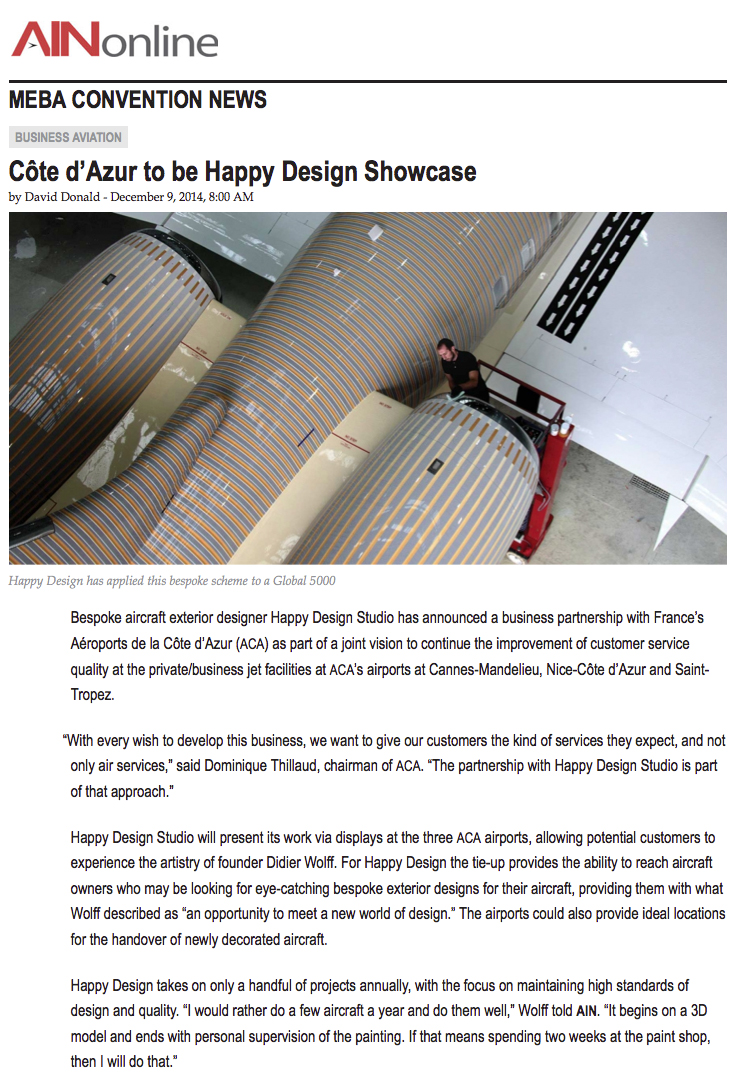
Read full article (text version) A INonline Source : MEBA CONVENTION NEWS / This article is reproduced for archival purposes. BUSINESS AVIATION Côte d’Azur to be Happy Design Showcase by David Donald – December 9, 2014, 8:00 AM Happy Design has applied this bespoke scheme to a Global 5000 Bespoke aircraft exterior designer Happy Design Studio has announced a business partnership with France’s Aéroports de la Côte d’Azur (ACA) as part of a joint vision to continue the improvement of customer service quality at the private/business jet facilities at ACA’s airports at Cannes-Mandelieu, Nice-Côte d’Azur and Saint-Tropez. “With every wish to develop this business, we want to give our customers the kind of services they expect, and not only air services,” said Dominique Thillaud, chairman of ACA. “The partnership with Happy Design Studio is part of that approach.”Happy Design Studio will present its work via displays at the three ACA airports, allowing potential customers to experience the artistry of founder Didier Wolff. For Happy Design the tie-up provides the ability to reach aircraft owners who may be looking for eye-catching bespoke exterior designs for their aircraft, providing them with what Wolff described as “an opportunity to meet a new world of design.” The airports could also provide ideal locations for the handover of newly decorated aircraft. Happy Design takes on only a handful of projects annually, with the focus on maintaining high standards of design and quality. “I would rather do a few aircraft a year and do them well,” Wolff told AIN. “It begins on a 3D model and ends with personal supervision of the painting. If that means spending two weeks at the paint shop, then I will do that.”

ARTICLE N° 216 / AIN ONLINE

 NOVEMBRE 2014

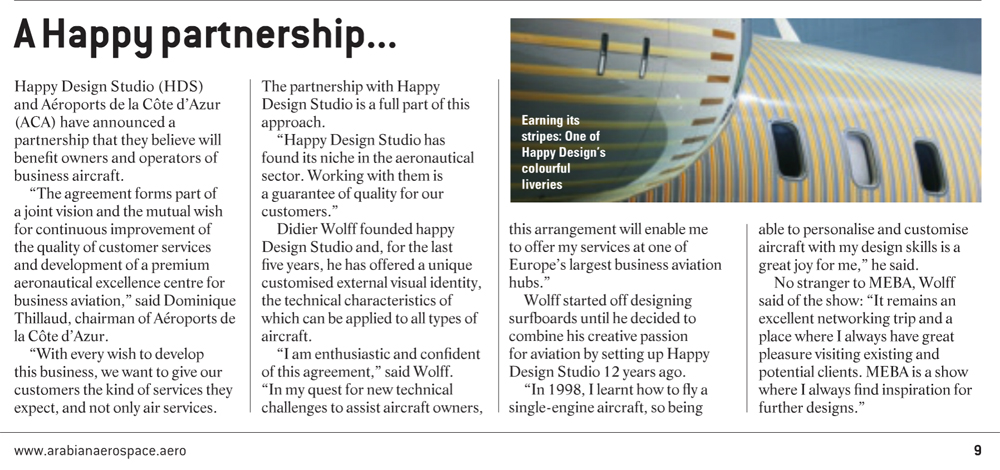
Read full article (text version) Source : SHOW BUSINESS NEWS / This article is reproduced for archival purposes. A Happy partnership… Happy Design Studio (HDS) and Aéroports de la Côte d’Azur (ACA) have announced a partnership that they believe will benefit owners and operators of business aircraft. “The agreement forms part of a joint vision and the mutual wish for continuous improvement of the quality of customer services and development of a premium aeronautical excellence centre for business aviation,” said Dominique Thillaud, chairman of Aéroports de la Côte d’Azur. “With every wish to develop this business, we want to give our customers the kind of services they expect, and not only air services.” The partnership with Happy Design Studio is a full part of this approach. “Happy Design Studio has found its niche in the aeronautical sector. Working with them is a guarantee of quality for our customers.” Didier Wolff founded Happy Design Studio and, for the last five years, he has offered a unique customised external visual identity, the technical characteristics of which can be applied to all types of aircraft. “I am enthusiastic and confident in this agreement,” said Wolff. “In my quest for new technical challenges to assist aircraft owners, this arrangement will enable me to offer my services at one of Europe’s largest business aviation hubs.” Wolff started off designing surfboards until he decided to combine his creative passion for aviation by setting up Happy Design Studio 12 years ago. “In 1998, I learnt how to fly a single-engine aircraft, so being able to personalise and customise aircraft with my design skills is a great joy for me,” he said. No stranger to MEBA, Wolff said of the show: “It remains an excellent networking trip and a place where I always have great pleasure visiting existing and potential clients. MEBA is a show where I always find inspiration for further designs.” Earning its stripes: One of Happy Design’s colourful liveries.

ARTICLE N° 215 / SHOW BUSINESS NEWS

 OCTOBRE 2014

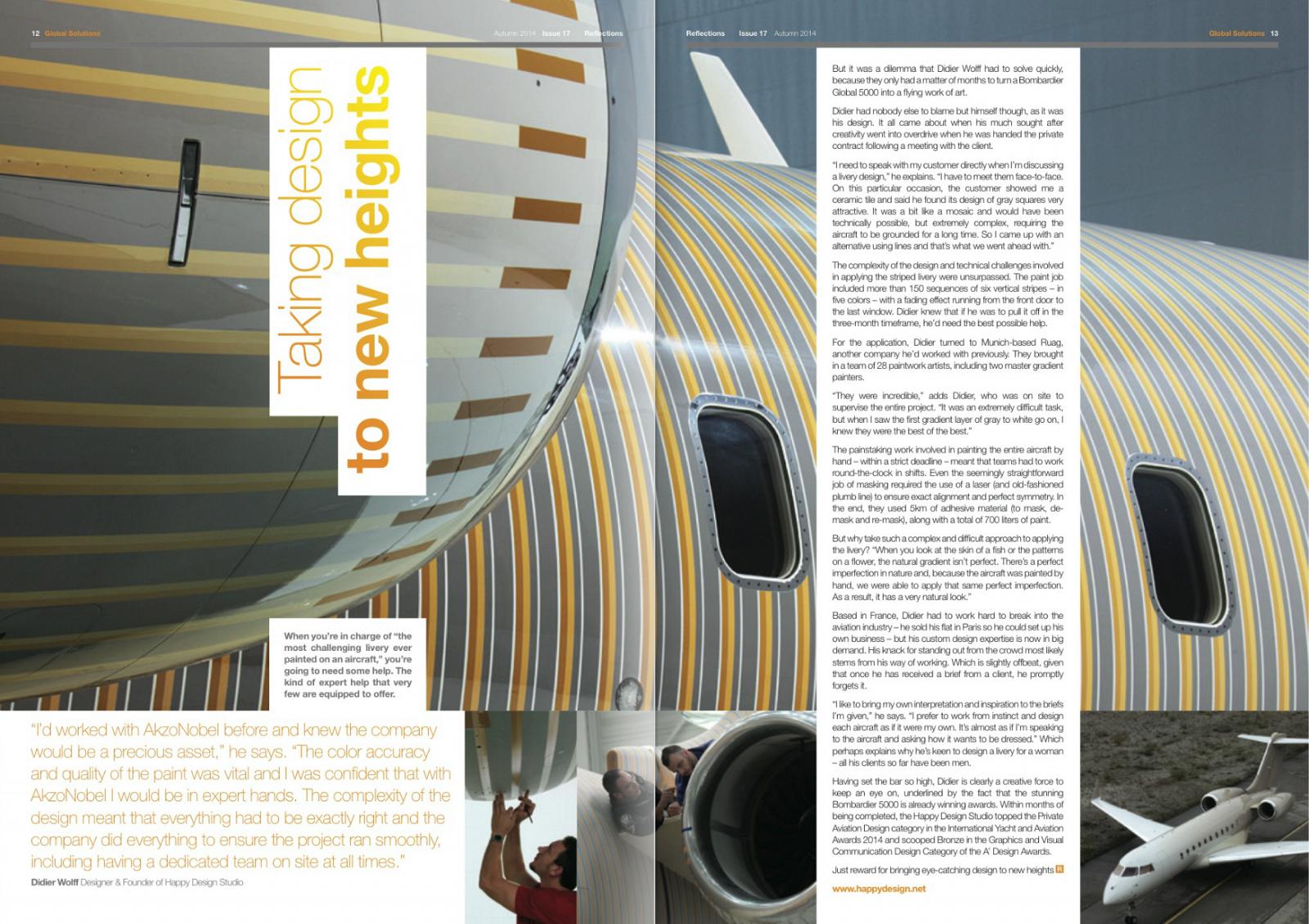
Read full article (text version) Source : REFLECTIONS AKZONOBEL / This article is reproduced for archival purposes. Taking design to new heights “When you’re in charge of ‘the most challenging livery ever painted on an aircraft,’ you’re going to need some help. The kind of expert help that very few are equipped to offer.” “I’d worked with AkzoNobel before and knew the company would be a precious asset,” he says. “The color accuracy and quality of the paint was vital and I was confident that with AkzoNobel I would be in expert hands. The complexity of the design meant that everything had to be exactly right and the company did everything to ensure the project ran smoothly, including having a dedicated team on site at all times.” Didier Wolff Designer & Founder of Happy Design Studio But it was a dilemma that Didier Wolff had to solve quickly, because they only had a matter of months to turn a Bombardier Global 5000 into a flying work of art. Didier had nobody else to blame but himself though, as it was his design. It all came about when his much sought after creativity went into overdrive when he was handed the private contract following a meeting with the client. “I need to speak with my customer directly when I’m discussing a livery design,” he explains. “I have to meet them face-to-face. On this particular occasion, the customer showed me a ceramic tile and said he found its design of gray squares very attractive. It was a bit like a mosaic and would have been technically possible, but extremely complex, requiring the aircraft to be grounded for a long time. So I came up with an alternative using lines and that’s what we went ahead with.” The complexity of the design and technical challenges involved in applying the striped livery were unsurpassed. The paint job included more than 150 sequences of six vertical stripes – in five colors – with a fading effect running from the front door to the last window. Didier knew that if he was to pull it off in the three-month timeframe, he’d need the best possible help. For the application, Didier turned to Munich-based Ruag, another company he’d worked with previously. They brought in a team of 28 paintwork artists, including two master gradient painters. “They were incredible,” adds Didier, who was on site to supervise the entire project. “It was an extremely difficult task, but when I saw the first gradient layer of gray to white go on, I knew we were the best of the best.” The painstaking work involved in painting the entire aircraft by hand – with a strict deadline – meant that teams had to work round-the-clock in shifts. Even the seemingly straightforward job of masking required the use of a laser (and old-fashioned plum line) to ensure exact alignment and perfect symmetry. In the end, they used 5km of adhesive material to mask, de-mask and re-mask, along with a total of 700 liters of paint. But why take such a complex and difficult approach to applying the livery? “When you look at the skin of the patterns on a flower, the natural gradient isn’t perfect. There’s a perfect imperfection in nature and, because the aircraft was painted by hand, we were able to apply that same perfect imperfection. As a result, it has a very natural look.” Based in France, Didier had to work hard to break into the aviation industry – he sold his flat in Paris so he could set up his own business – but his custom design expertise is now in big demand. His knack for standing out from the crowd most likely stems from his way of working. Which is slightly offbeat, given that once he has received a brief from a client, he promptly forgets it. “I like to bring my own interpretation and inspiration to the briefs I’m given,” he says. “I prefer to work from instinct and design each aircraft as if it were my own. It’s almost as if I’m speaking to the aircraft and asking how it wants to be dressed.” Which perhaps explains why he’s keen to design a livery for a woman – all his clients so far have been men. Having set the bar so high, Didier is clearly a creative force to be reckoned with – underlined by the fact that the stunning Bombardier 5000 is already winning awards. Within months of being completed, the Happy Design Studio topped the Private Aviation Design category in the International Yacht and Aviation Awards 2014 and scooped Bronze in the Graphics and Visual Communication Design Category of the A’ Design Awards. Just reward for bringing eye-catching design to new heights.

ARTICLE N° 214 / REFLECTIONS AKZONOBEL

 SEPTEMBRE 2014

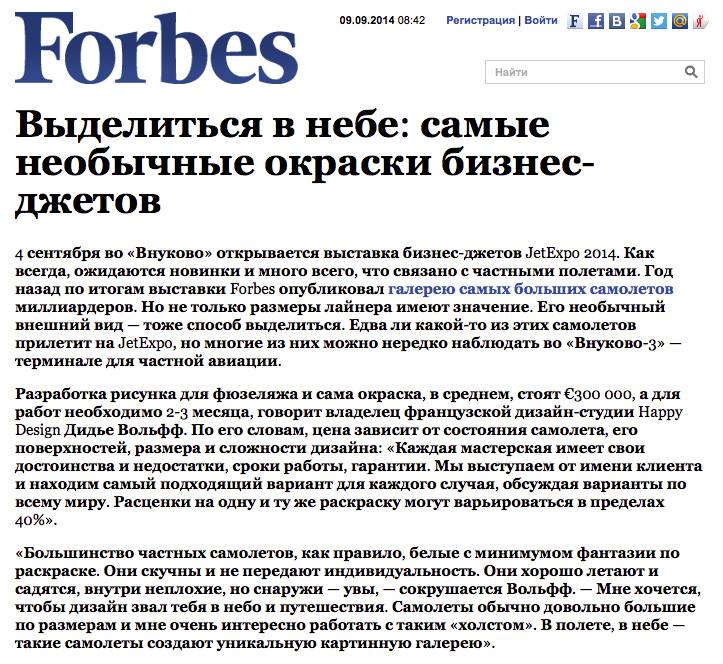
Read full article (text version) Source :Forbes / This article is reproduced for archival purposes. 09.09.2014 08:42 Выделиться в небе: самые необычные окраски бизнес-джетов 4 сентября во «Внуково» открывается выставка бизнес-джетов JetExpo 2014. Как всегда, ожидаются новинки и много всего, что связано с частными полетами. Год назад по итогам выставки Forbes опубликовал галерею самых больших самолетов миллиардеров. Но не только размеры лайнера имеют значение. Его необычный внешний вид — тоже способ выделиться. Едва ли какой-то из этих самолетов прилетит на JetExpo, но многие из них можно нередко наблюдать во «Внуково-3» — терминале для частной авиации. Разработка рисунка для фюзеляжа и сама окраска, в среднем, стоят €300 000, а для работ необходимо 2-3 месяца, говорит владелец французской дизайн-студии Happy Design Дидье Вольфф. По его словам, цена зависит от состояния самолета, его поверхностей, размера и сложности дизайна: «Каждая мастерская имеет свои достоинства и недостатки, сроки работы, гарантии. Мы выступаем от имени клиента и находим самый подходящий вариант для каждого случая, обсуждая варианты по всему миру. Расценки на одну и ту же раскраску могут варьироваться в пределах 40%». «Большинство частных самолетов, как правило, белые с минимумом фантазии по раскраске. Они скучны и не передают индивидуальность. Они хорошо летают и садятся, внутри неплохие, но снаружи — увы, — сокрушается Вольфф. — Мне хочется, чтобы дизайн звал тебя в небо и путешествия. Самолеты обычно довольно большие по размерам и мне очень интересно работать с таким «холстом». В полете, в небе — такие самолеты создают уникальную картинную галерею».

ARTICLE N° 213 / FORBES RUSSIA

 JUIN 2014

ARTICLE N° 212 / TRENDS

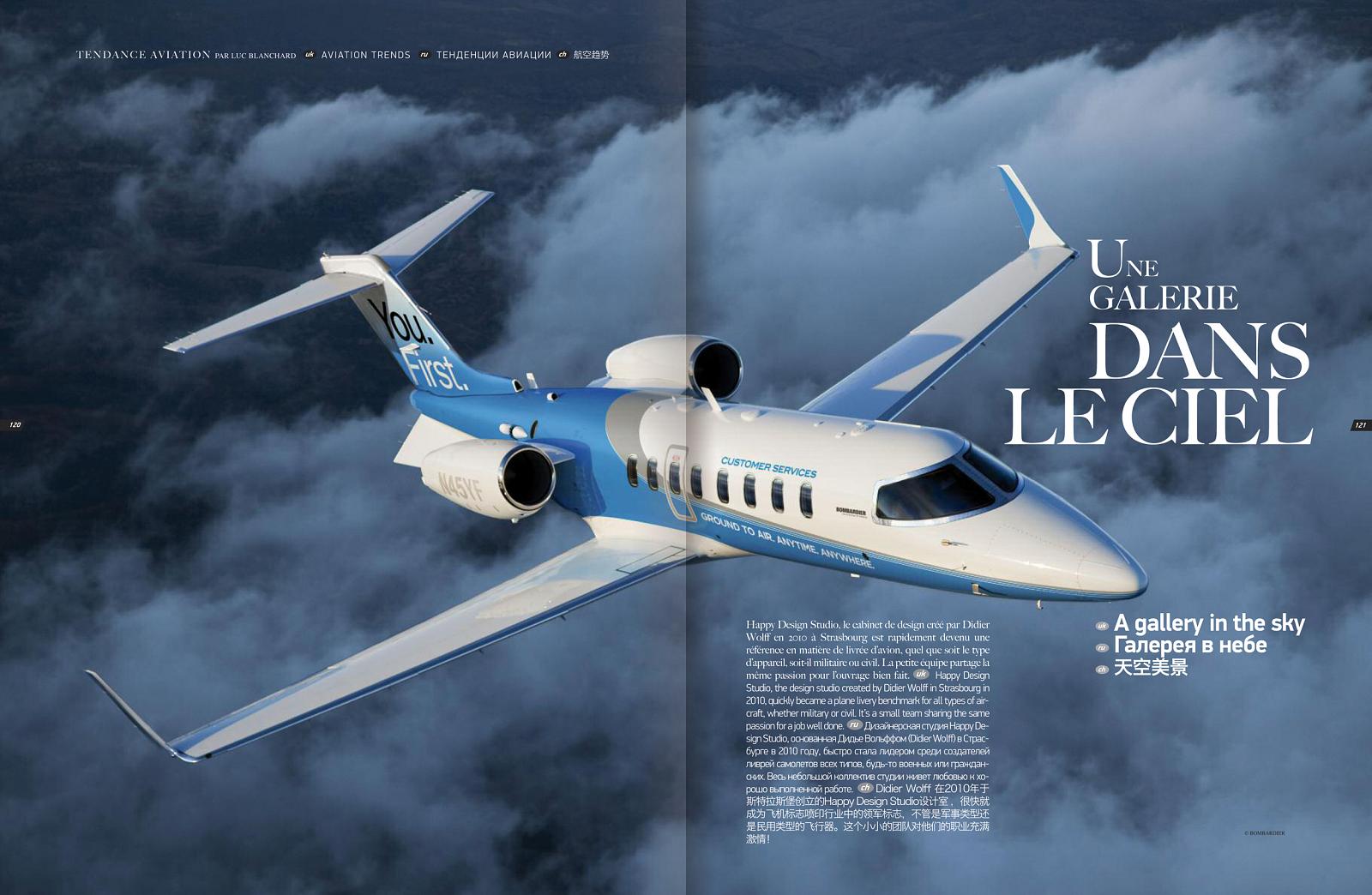
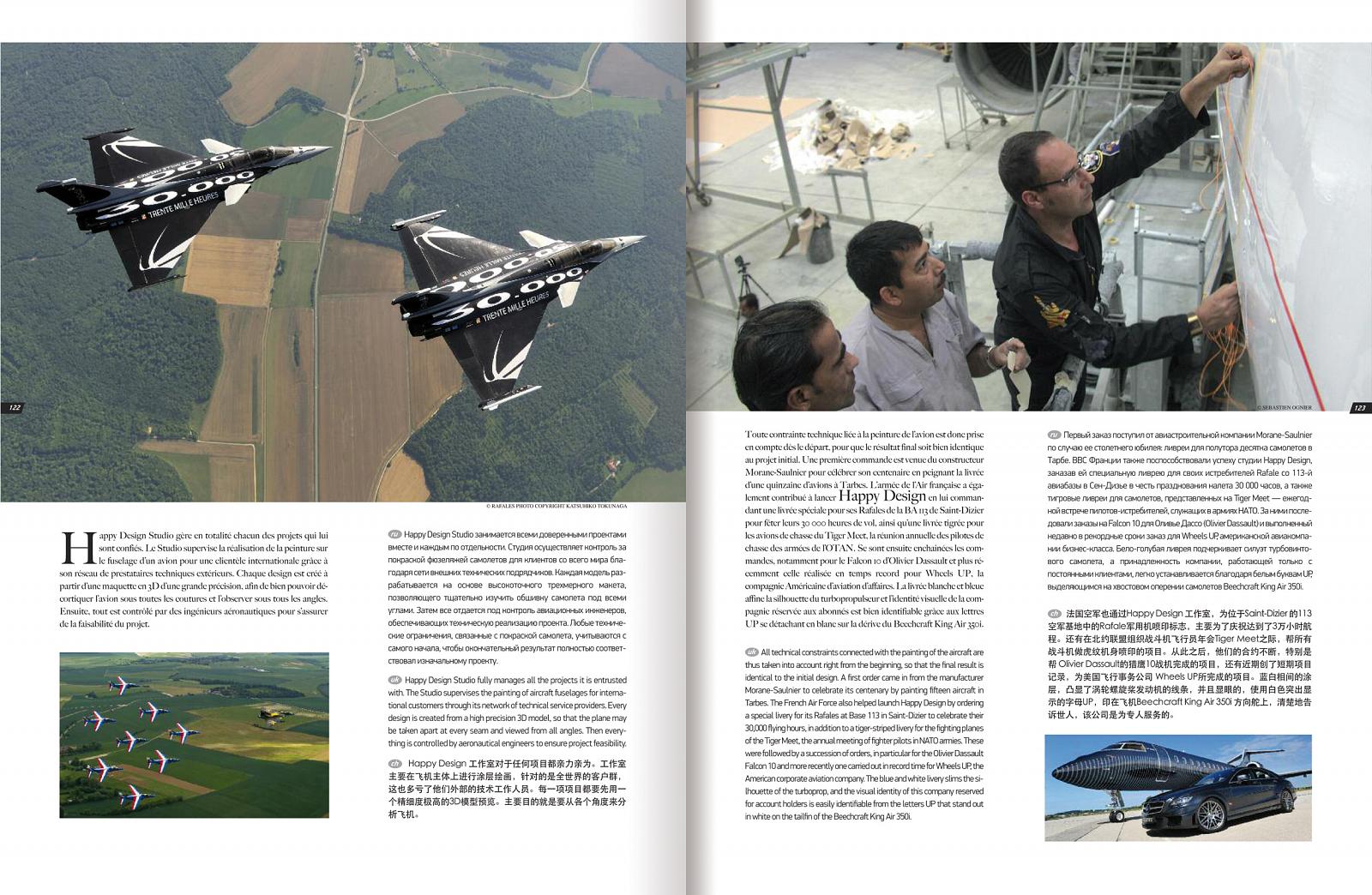
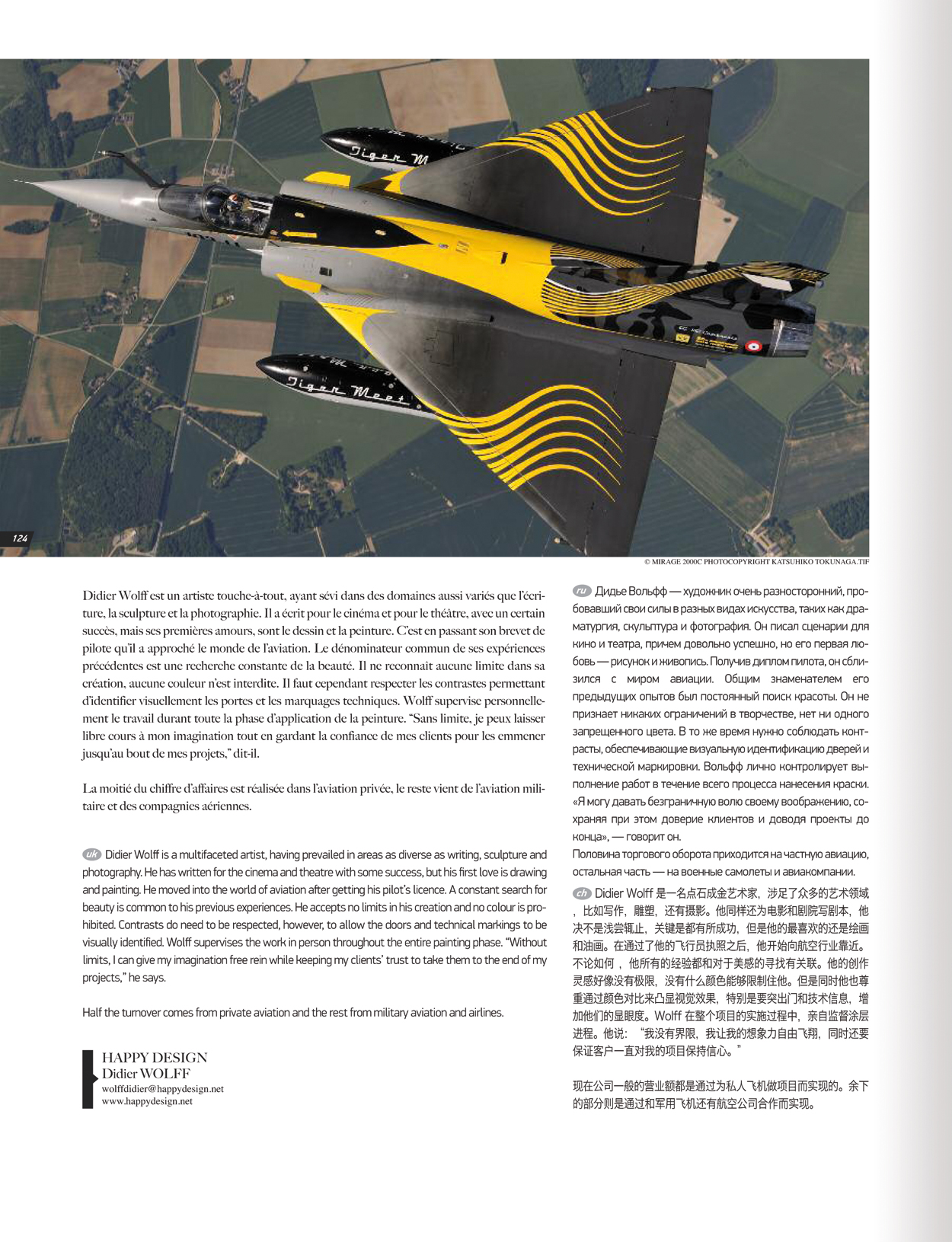
Read full article (text version) Source :TENDANCE AVIATION / This article is reproduced for archival purposes. par Luc Blanchard • AVIATION TRENDS • ТЕНДЕНЦИИ АВИАЦИИ • 航空趋势 Une Galerie Dans Le Ciel A gallery in the sky Галерея в небе 天空美景 Happy Design Studio, le cabinet de design créé par Didier Wolff en 2010 à Strasbourg est rapidement devenu une référence en matière de livrée d’avion, quel que soit le type d’appareil, soit-il militaire ou civil. La petite équipe partage la même passion pour l’ouvrage bien fait. Happy Design Studio, the design studio created by Didier Wolff in Strasbourg in 2010, quickly became a plane livery benchmark for all types of aircraft, whether military or civil. It’s a small team sharing the same passion for a job well done. Дизайнерская студия Happy Design Studio, основанная Дидье Вольффом (Didier Wolff) в Страсбурге в 2010 году, быстро стала лидером среди создателей ливрей самолетов всех типов, будь-то военных или гражданских. Весь небольшой коллектив студии живет любовью к хорошо выполненной работе. Didier Wolff 在2010年于斯特拉斯堡创立的Happy Design Studio设计室,很快就成为飞机标志喷印行业中的领军标志,不管是军事类型还是民用类型的飞行器。这个小小的团队对他们的职业充满激情! pp. 122–123 Happy Design Studio gère en totalité chacun des projets qui lui sont confiés. Le Studio supervise la réalisation de la peinture sur le fuselage d’un avion pour une clientèle internationale grâce à son réseau de prestataires techniques extérieurs. Chaque design est créé à partir d’une maquette en 3D d’une grande précision, afin de bien pouvoir décortiquer l’avion sous toutes les coutures et l’observer sous tous les angles. Ensuite, tout est contrôlé par des ingénieurs aéronautiques pour s’assurer de la faisabilité du projet. Happy Design Studio fully manages all the projects it is entrusted with. The Studio supervises the painting of aircraft fuselages for international customers through its network of technical service providers. Every design is created from a high precision 3D model, so that the plane may be taken apart at every seam and viewed from all angles. Then everything is controlled by aeronautical engineers to ensure project feasibility. Happy Design Studio занимается всеми доверенными проектами вместе и каждым по отдельности. Студия осуществляет контроль за покраской фюзеляжей самолетов для клиентов со всего мира благодаря сети внешних технических подрядчиков. Каждая модель разрабатывается на основе высокоточного трехмерного макета, позволяющего тщательно изучить обшивку самолета под всеми углами. Затем все подлежит контролю авиационных инженеров, обеспечивающих техническую реализацию проекта. Любые технические ограничения, связанные с покраской самолета, учитываются с самого начала, чтобы окончательный результат полностью соответствовал изначальному проекту. Happy Design 工作室对于任何项目都亲力亲为。工作室主要在飞机主体上进行涂层绘画,针对的是全世界的客户群,这也多亏了他们外部的技术工作人员。每一项项目都要先用一个精细度极高的3D模型预览。主要目的就是要从各个角度来分析飞机。 Toute contrainte technique liée à la peinture de l’avion est donc prise en compte dès le départ, pour que le résultat final soit bien identique au projet initial. Une première commande est venue du constructeur Morane-Saulnier pour célébrer son centenaire en peignant la livrée d’une quinzaine d’avions à Tarbes. L’armée de l’Air française a également contribué à lancer Happy Design en lui commandant une livrée spéciale pour ses Rafales de la BA 113 de Saint-Dizier pour fêter leurs 30 000 heures de vol, ainsi qu’une livrée tigrée pour les avions de chasse du Tiger Meet, la réunion annuelle des pilotes de chasse des armées de l’OTAN. Se sont ensuite enchaînées les commandes, notamment pour le Falcon 10 d’Olivier Dassault et plus récemment celle réalisée en temps record pour Wheels UP, la compagnie Américaine d’aviation d’affaires. La livrée blanche et bleue affine la silhouette du turbopropulseur et l’identité visuelle de la compagnie réservée aux abonnés est bien identifiable grâce aux lettres UP se détachant en blanc sur la dérive du Beechcraft King Air 350i. All technical constraints connected with the painting of the aircraft are thus taken into account right from the beginning, so that the final result is identical to the initial design. A first order came in from the manufacturer Morane-Saulnier to celebrate its centenary by painting fifteen aircraft in Tarbes. The French Air Force also helped launch Happy Design by ordering a special livery for its Rafales at Base 113 in Saint-Dizier to celebrate their 30,000 flying hours, in addition to a tiger-striped livery for the fighting planes of the Tiger Meet, the annual meeting of fighter pilots in NATO armies. These were followed by a succession of orders, in particular for the Olivier Dassault Falcon 10 and more recently one carried out in record time for Wheels UP, the American corporate aviation company. The blue and white livery slims the silhouette of the turboprop, and the visual identity of this company reserved for account holders is easily identifiable from the letters UP that stand out in white on the tail fin of the Beechcraft King Air 350i. Первый заказ поступил от авиастроительной компании Morane-Saulnier по случаю ее столетнего юбилея: ливреи для полутора десятков самолетов в Тарбе. ВВС Франции также поспособствовали успеху студии Happy Design, заказав ей специальную ливрею для своих истребителей Rafale со 113-й авиабазы в Сен-Дизье в честь празднования налета 30 000 часов, а также тигровые ливреи для самолетов, представленных на Tiger Meet — ежегодной встрече пилотов-истребителей, служащих в армиях НАТО. За ними последовали заказы на Falcon 10 для Оливье Дассо (Olivier Dassault) и выполненный недавно в рекордные сроки заказ для Wheels UP американской авиакомпании бизнес-класса. Бело-голубая ливрея подчеркивает силуэт турбовинтового самолета, а принадлежность компании, работающей только с постоянными клиентами, легко устанавливается благодаря белым буквам UP, выделяющимся на хвостовом оперении самолетов Beechcraft King Air 350i. 法国空军也通知Happy Design 工作室,为给子庆祝建军100年的项目,主要为了庆祝达到了3万小时航程。还有在北约联盟组织战斗机飞行员年会Tiger Meet之际,将所有战斗机做虎纹机身喷印的项目。从此之后,他们的合约不断,特别是帮 Olivier Dassault的猎鹰10战机完成的项目。还有近期对了短期项目记录,为美国飞行事务公司 Wheels UP所完成的项目。蓝白相间的涂层,凸显了涡轮螺旋桨发动机的线条,并且显眼的,使用白色突出显示的字母UP,印在飞机Beechcraft King Air 350i 方向舵上,清楚地告诉世人,该公司是为专人服务的。 p. 124 Didier Wolff est un artiste touche-à-tout, ayant sévi dans des domaines aussi variés que l’écriture, la sculpture et la photographie. Il a écrit pour le cinéma et pour le théâtre, avec un certain succès, mais ses premières amours, sont le dessin et la peinture. C’est en passant son brevet de pilote qu’il a approché le monde de l’aviation. Le dénominateur commun de ses expériences précédentes est une recherche constante de la beauté. Il ne reconnaît aucune limite dans sa création, aucune couleur n’est interdite. Il faut cependant respecter les contrastes permettant d’identifier visuellement les portes et les marquages techniques. Wolff supervise personnellement le travail durant toute la phase d’application de la peinture. “Sans limite, je peux laisser libre cours à mon imagination tout en gardant la confiance de mes clients pour les emmener jusqu’au bout de mes projets,” dit-il. La moitié du chiffre d’affaires est réalisée dans l’aviation privée, le reste vient de l’aviation militaire et des compagnies aériennes. Didier Wolff is a multifaceted artist, having prevailed in areas as diverse as writing, sculpture and photography. He has written for the cinema and theatre with some success, but his first love is drawing and painting. He moved into the world of aviation after getting his pilot’s licence. A constant search for beauty is common to his previous experiences. He accepts no limits in his creation and no colour is prohibited. Contrasts do need to be respected, however, to allow the doors and technical markings to be visually identified. Wolff supervises the work in person throughout the entire painting phase. “Without limits, I can give my imagination free rein while keeping my clients’ trust to take them to the end of my projects,” he says. Half the turnover comes from private aviation and the rest from military aviation and airlines. Дидье Вольфф — художник очень разносторонний, пробовавший свои силы в разных видах искусства, таких как драматургия, скульптура и фотография. Он писал сценарии для кино и театра, причем довольно успешно, но его первая любовь — рисунок и живопись. Получив диплом пилота, он сблизился с миром авиации. Общим знаменателем его предыдущих опытов был постоянный поиск красоты. Он не признает никаких ограничений в творчестве, нет ни одного запрещенного цвета. В то же время нужно соблюдать контрасты, обеспечивающие визуальную идентификацию дверей и технической маркировки. Вольфф лично контролирует выполнение работ в течение всего процесса нанесения краски. «Я могу давать безграничную волю своему воображению, сохраняя при этом доверие клиентов и доводя проекты до конца», — говорит он. Половина торгового оборота приходится на частную авиацию, остальная часть — на военные самолеты и авиакомпании. Didier Wolff 是一名点石成金艺术家,涉足了众多艺术领域,比如写作,雕塑,还有摄影。他同样也为电影和剧院写剧本,他决不是浅尝辄止,关键是都有所成功,但是他的最喜欢的还是绘画和油画。在通过了飞行员执照之后,他开始向航空行业靠近。不论如何,他所有的经验都和对于美感的寻找有联。他的创作灵感好像没有极限,没有什么颜色能够限制他。但是同时他也尊重通过颜色对比来凸显视觉效果,特别是突出出门和技术信息,增加他们的显眼度。Wolff 在整个项目的实施过程中,亲自监督涂层进程。他说:”我没有界限,我让我的想象力自由飞翔,同时还要保证客户一直对我的项目保持信心。” 现在公司一般的营业额都是通过私人飞机做项目而实现的。余下的部分则是通过和军用飞机还有航空公司合作而实现的。

 JUIN 2014

ARTICLE N° 211 / ORNORME STRASBOURG

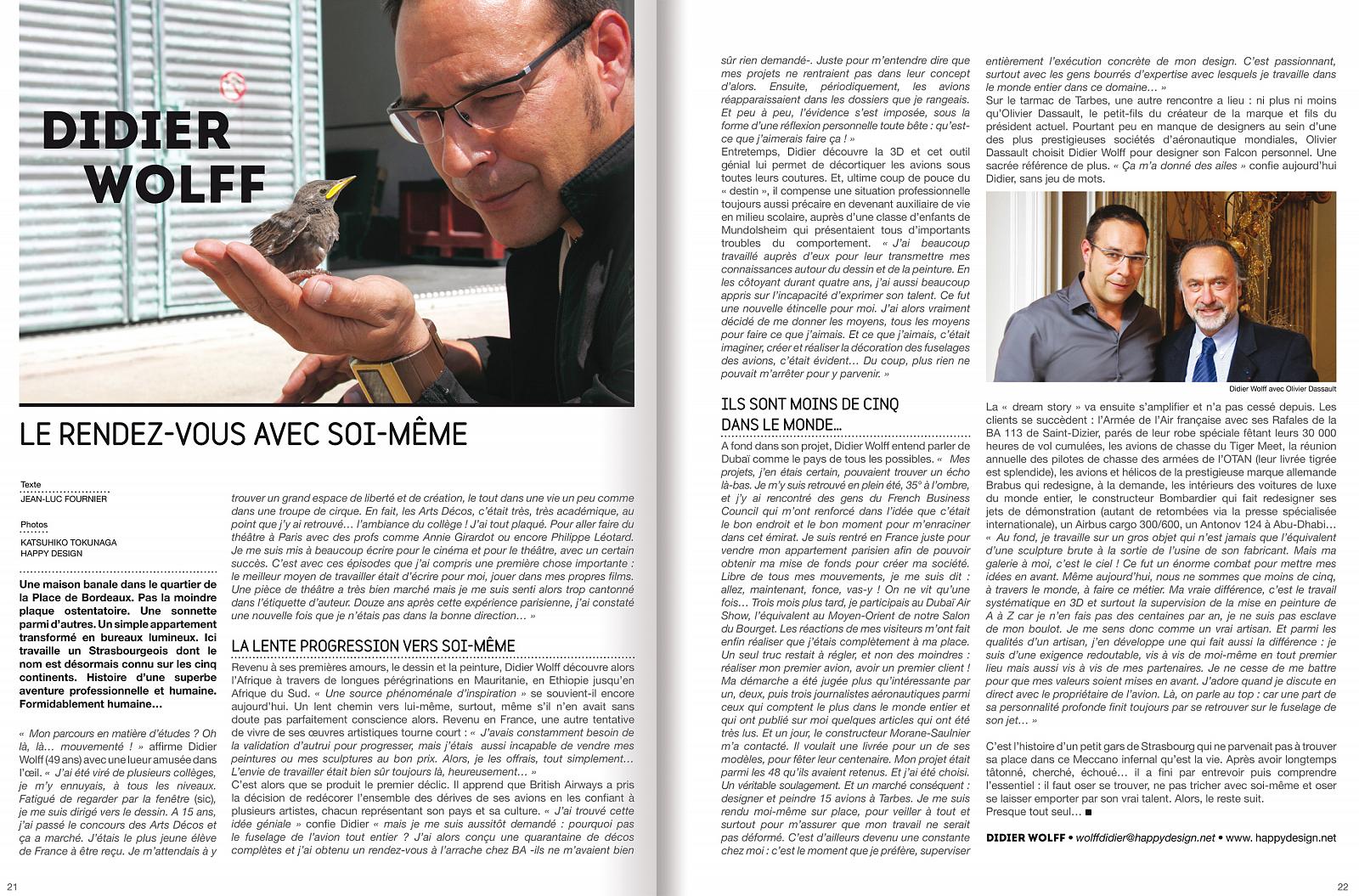
Read full article (text version) SOURCE : ORNORME STRASBOURG / This article is reproduced for archival purposes. DIDIER WOLFF LE RENDEZ-VOUS AVEC SOI-MÊME Texte JEAN-LUC FOURNIER Photos KATSUHIKO TOKUNAGA HAPPY DESIGN Une maison banale dans le quartier de la Place de Bordeaux. Pas la moindre plaque ostentatoire. Une sonnette parmi d’autres. Un simple appartement transformé en bureaux lumineux. Ici travaille un Strasbourgeois dont le nom est désormais connu sur les cinq continents. Histoire d’une superbe aventure professionnelle et humaine. Formidablement humaine… « Mon parcours en matière d’études ? Oh là là… mouvementé ! » affirme Didier Wolff (49 ans) avec une lueur amusée dans l’il. « J’ai été viré de plusieurs collèges, je m’y ennuyais, tout bas les niveaux. Fatigué de regarder par les fenêtres des lycées, je me suis dirigé vers le dessin. À 15 ans, j’ai passé le concours des Arts Déco, ça a marché. J’étais le plus jeune élève de France à être reçu. Je m’attendais à trouver un grand espace de liberté et de création, le tout dans une vie un peu comme dans une troupe de cirque. En fait, les Arts Déco, c’était très, très académique, au point que j’ai vite retrouvé… l’ambiance du collège ! J’ai tout plaqué. Pour aller faire du théâtre à Paris avec des pros comme Annie Girardot ou encore Philippe Léotard. Je me suis mis à beaucoup écrire pour le cinéma et pour le théâtre, avec un certain succès. C’est avec ces épisodes que j’ai compris une première chose importante : le meilleur moyen de travailler était d’écrire pour moi, jouer dans mes propres films. Une pièce de théâtre a très bien marché mais je me suis senti alors trop cantonné dans l’étiquette d’auteur. Deux ans après cette expérience parisienne, j’ai constaté une nouvelle fois que je n’étais pas dans la bonne direction… » LA LENTE PROGRESSION VERS SOI-MÊME Revenu à ses premiers amours, le dessin et la peinture, Didier Wolff délaisse alors l’Afrique à travers de longues pérégrinations en Mauritanie, en Éthiopie jusqu’en Afrique du Sud. « Une source phénoménale d’inspiration » se souvient-il encore aujourd’hui. Un lent chemin vers soi-même, surtout, même s’il n’en avait sans doute pas parfaitement conscience alors. Revenu en France, une autre tentative de vivre de ses uvres artistiques tourne court : « J’avais constamment besoin de la validation d’autrui pour progresser, mais j’étais aussi incapable de vendre mes peintures ou mes sculptures au bon prix. Alors, je les offrais, tout simplement… L’envie de travailler était bien toujours là, heureusement. » C’est alors que se produit le premier déclic. Il apprend que British Airways a pris la décision de redécorer l’ensemble des dérives de ses avions en se confiant à plusieurs artistes, chacun représentant son pays et sa culture. « J’ai trouvé cette idée géniale » confie Didier « mais je me suis aussitôt demandé : pourquoi pas le fuselage de l’avion tout entier ? J’ai alors conçu une quarantaine de décors complets et j’ai obtenu un rendez-vous à l’arraché chez BA – ils ne m’avaient bien sûr rien demandé – juste pour m’entendre dire que mes projets ne rentraient pas dans leur concept d’alors. Ensuite, périodiquement, les avions réapparaissaient dans les dossiers que je rangeais. Et peu à peu, l’évidence s’est imposée sous forme d’une réflexion personnelle toute bête : qu’est-ce que j’aimerais faire ça ! » Entretemps, Didier découvre la 3D et cet outil génial lui permet de décortiquer les avions sous toutes leurs coutures. Et, ultime coup de pouce du destin, il commence à enseigner dans une école de quartier, auprès d’une classe d’enfants de Mundolsheim qui présentaient tous d’importants troubles du comportement. « J’ai beaucoup travaillé auprès d’eux pour leur transmettre mes connaissances autour du dessin et de la peinture. En les côtoyant durant quatre ans, j’ai aussi beaucoup appris sur l’incapacité d’exprimer son talent. Ce fut une nouvelle étincelle pour moi. J’ai alors vraiment décidé de me donner les moyens, tous les moyens pour faire ce que j’aimais. Et ce que j’aimais, c’était imaginer, créer et réaliser la décoration des fuselages des avions, c’était évident… Du coup, plus rien ne pouvait m’arrêter pour y parvenir. » ILS SONT MOINS DE CINQ DANS LE MONDE… À fond dans son projet, Didier Wolff entend parler de Dubaï comme le pays de tous les possibles. « Mes projets, j’en étais certain, pouvaient trouver un écho là-bas. Je m’y suis retrouvé en plein été, 35° à l’ombre, et j’y ai rencontré des gens du French Business Council qui m’ont confirmé l’idée que c’était le bon endroit et le bon moment pour m’enraciner dans cet émirat. Je suis rentré en France juste pour vendre mon appartement parisien afin de pouvoir obtenir ma mise de fonds pour créer ma société. Libre de tous mes mouvements, je me suis dit : allez, maintenant, fonce, vas-y ! On n’a qu’une vie… Trois mois plus tard, je participais au Dubai Air Show, l’équivalent au Moyen-Orient de notre Salon du Bourget. Les réactions des visiteurs m’ont enfin permis de réaliser que j’étais complètement à ma place. Un seul truc restait à régler, et non des moindres : réaliser mon premier avion, avoir un premier client ! » Ma démarche a été jugée plus intéressante par ceux qui comptent le plus dans le monde entier et qui ont publié sur moi quelques articles qui ont fait le reste. Et un jour, le constructeur Morane-Saulnier m’a contacté. Il voulait une livrée pour un de ses modèles, pour fêter leur centenaire. Mon projet était parmi les 48 qu’ils avaient retenus. Et j’ai été choisi. Un véritable soulagement ! À Tarbes, sur le tarmac, je me suis rendu moi-même sur place, pour veiller à tout et surtout pour m’assurer que mon travail ne serait pas déformé. C’est d’ailleurs devenu une constante chez moi : c’est le moment que je préfère, superviser entièrement l’exécution concrète de mon design. C’est passionnant, surtout avec les gens bourrés d’expertise avec lesquels je travaille dans le monde entier dans ce domaine… » Sur le tarmac de Tarbes, une autre rencontre a lieu : ni plus ni moins qu’Olivier Dassault, le petit-fils du créateur de la marque et fils de son président actuel. Pourtant peu en manque de designers au sein d’une des plus prestigieuses sociétés d’aéronautique mondiales, Olivier Dassault choisit Didier Wolff pour designer son Falcon personnel. Une sacrée référence de plus. « Ça m’a donné des ailes » confie aujourd’hui Didier, sans jeu de mots. La « dream story » va ensuite s’amplifier et ne pas cesser depuis. Les clients se succèdent : l’Armée de l’Air française avec ses Rafales de la BA 113 de Saint-Dizier, parés de leur robe spéciale fêtant leurs 30 000 heures de vol cumulées, les avions de chasse du Tiger Meet, la réunion annuelle des pilotes de chasse des armées de l’OTAN (leur livrée tigre est splendide), les avions et hélicos de la prestigieuse marque allemande Brabus qui redessine, à la demande, les intérieurs des voitures de luxe du monde entier, le constructeur Bombardier qui fait redessiner ses intérieurs ainsi que ceux de ses avions d’affaires, Airbus cargo 300/600, un Antonov 124 à Abu-Dhabi. « Au fond, je travaille sur un gros objet qui n’est jamais que l’équivalent d’une sculpture brute à la sortie de l’usine de son fabricant. Mais ma galerie à moi, c’est le ciel ! Ce fut un énorme combat pour mettre mes idées en avant. Même aujourd’hui, nous ne sommes que moins de cinq à travers le monde à faire ce métier. Ma vraie différence, c’est le travail systématique en 3D et surtout la supervision de la mise en peinture de A à Z car je n’en fais pas des centaines par an, je ne suis pas esclave de mon boulot. Je me sens donc comme un vrai artisan. Et parmi les qualités d’un artisan, j’en développe aussi une qui fait la différence : je suis d’une exigence redoutable, vis-à-vis de moi-même tout comme vis-à-vis de mes valeurs et de mes partenaires. Je ne cesse de me battre pour que mes valeurs soient mises en avant. J’adore quand je discute en direct avec le propriétaire de l’avion. Là, on parle au top : car une part de sa personnalité profonde finit toujours par se retrouver sur le fuselage de son jet… » « C’est l’histoire d’un petit gars de Strasbourg qui ne parvenait pas à trouver sa place dans ce Meccano infernal qu’est la vie. Après avoir longtemps tâtonné, cherché, échoué… il a fini par entrevoir puis comprendre l’essentiel : il faut oser se trouver, ne pas tricher avec soi-même et oser se laisser emporter par son vrai talent. Alors, le reste suit. Presque tout seul… »

 AVRIL 2014

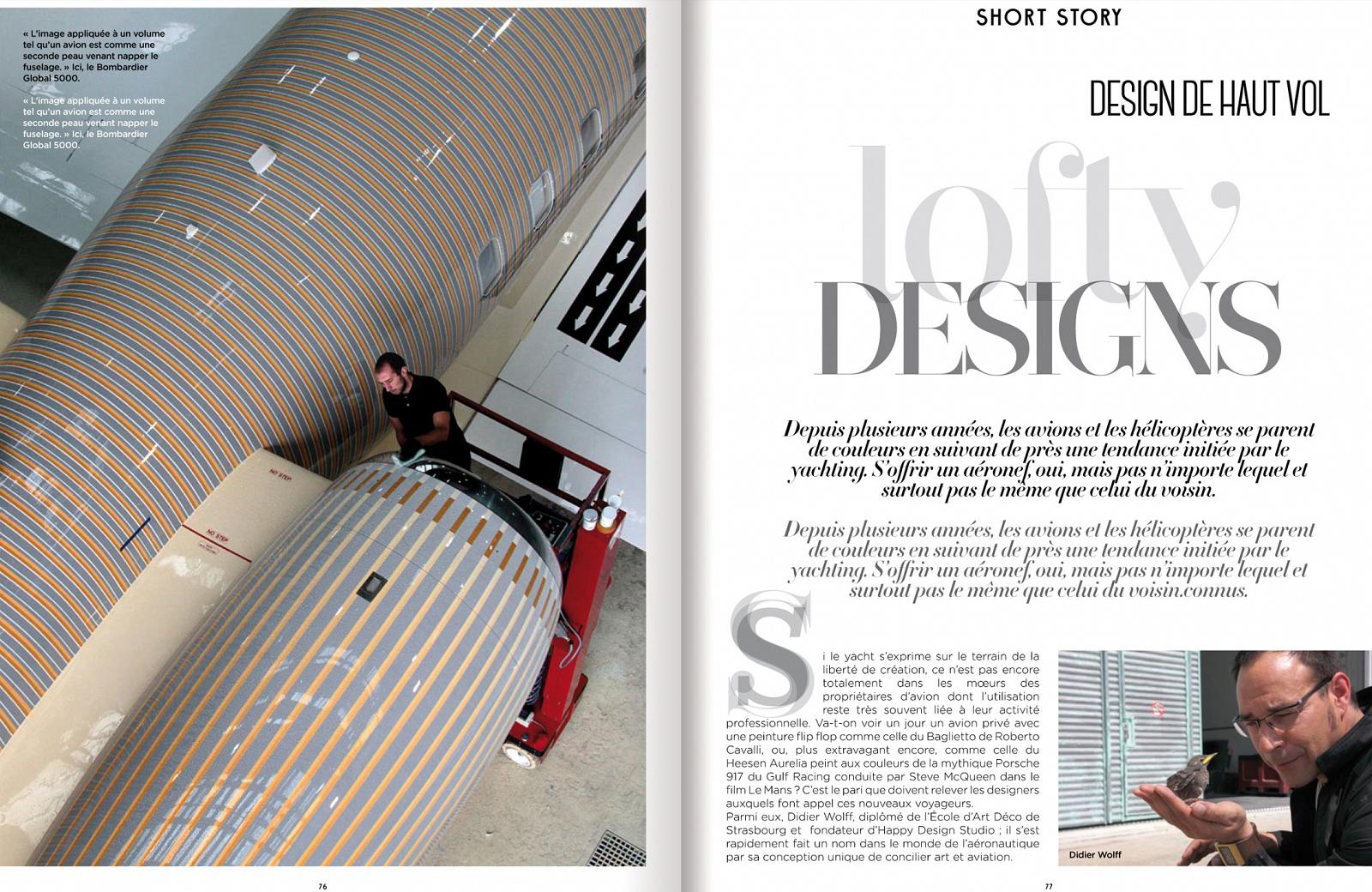
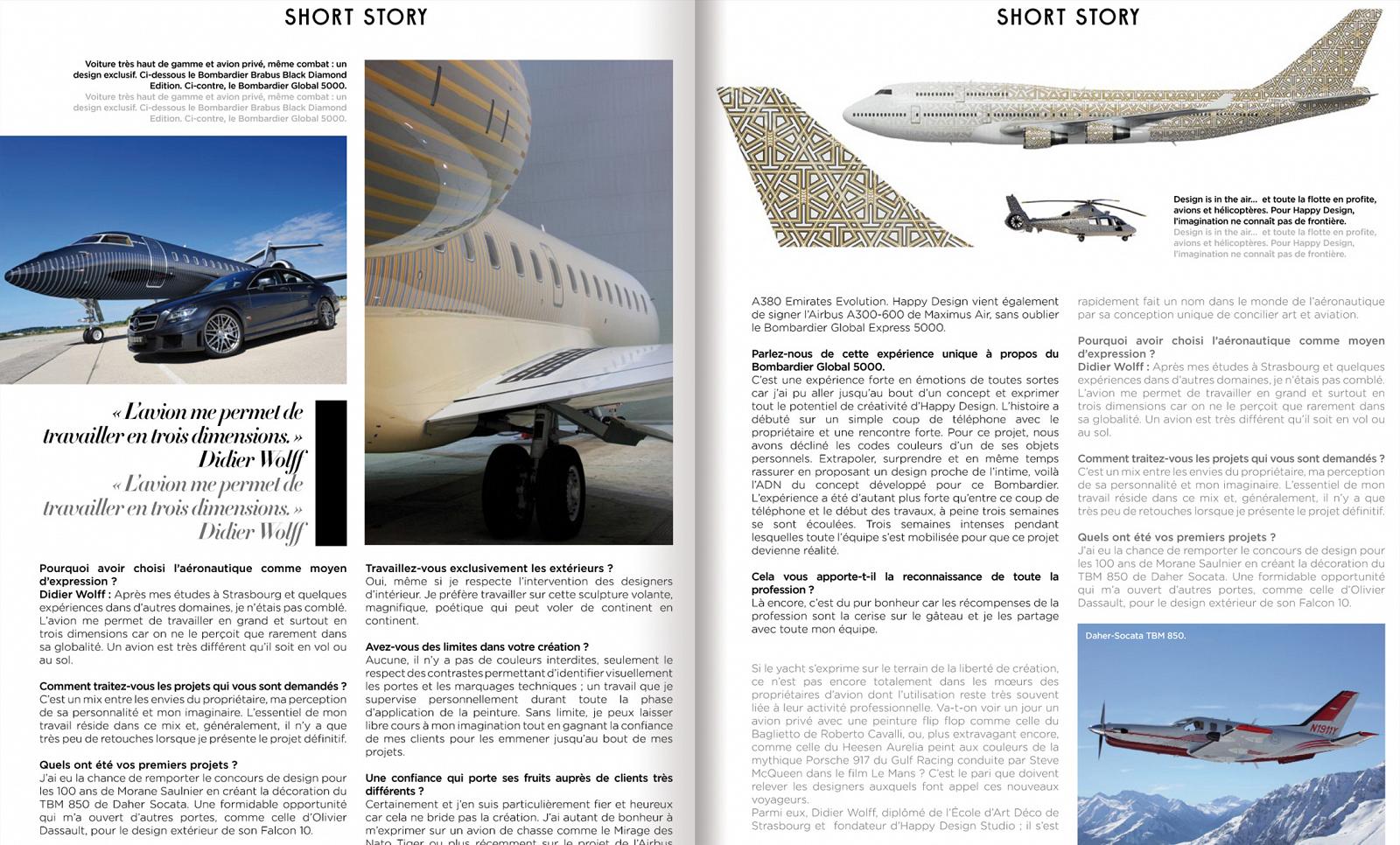
Read full article (text version) Source :SHORT STORY / This article is reproduced for archival purposes. DESIGN DE HAUT VOL Depuis plusieurs années, les avions et les hélicoptères se parent de couleurs en suivant de près une tendance initiée par le yachting. S’offrir un aéronef, oui, mais pas n’importe lequel et surtout pas le même que celui du voisin. Si le yacht s’exprime sur le terrain de la liberté de création, ce n’est pas encore totalement dans les mœurs des propriétaires d’avion dont l’utilisation reste très souvent liée à leur activité professionnelle. Va-t-on voir un jour un avion privé avec une peinture flip flop comme celle du Baglietto de Roberto Cavalli, ou, plus extravagant encore, comme celle du Heesen Aurelia peint aux couleurs de la mythique Porsche 917 du Gulf Racing conduite par Steve McQueen dans le film Le Mans ? C’est le pari que doivent relever les designers auxquels font appel ces nouveaux voyageurs. Parmi eux, Didier Wolff, diplômé de l’École d’Art Déco de Strasbourg et fondateur d’Happy Design Studio ; il s’est rapidement fait un nom dans le monde de l’aéronautique par sa conception unique de concilier art et aviation. « L’image appliquée à un volume tel qu’un avion est comme une seconde peau venant napper le fuselage. » Ici, le Bombardier Global 5000. Voiture très haut de gamme et avion privé, même combat : un design exclusif. Ci-dessous le Bombardier Brabus Black Diamond Edition. Ci-contre, le Bombardier Global 5000. « L’avion me permet de travailler en trois dimensions. » Didier Wolff. Pourquoi avoir choisi l’aéronautique comme moyen d’expression ? Didier Wolff : Après mes études à Strasbourg et quelques expériences dans d’autres domaines, je n’étais pas comblé. L’avion me permet de travailler en grand et surtout en trois dimensions car on ne le perçoit que rarement dans sa globalité. Un avion est très différent qu’il soit en vol ou au sol. Comment traitez-vous les projets qui vous sont demandés ? C’est un mix entre les envies du propriétaire, ma perception de sa personnalité et mon imaginaire. L’essentiel de mon travail réside dans ce mix et, généralement, il n’y a que très peu de retouches lorsque je présente le projet définitif. Quels ont été vos premiers projets ? J’ai eu la chance de remporter le concours de design pour les 100 ans de Morane Saulnier en créant la décoration du TBM 850 de Daher Socata. Une formidable opportunité qui m’a ouvert d’autres portes, comme celle d’Olivier Dassault, pour le design extérieur de son Falcon 10. Travaillez-vous exclusivement les extérieurs ? Oui, même si je respecte l’intervention des designers d’intérieur. Je préfère travailler sur cette sculpture volante, magnifique, poétique qui peut voler de continent en continent. Avez-vous des limites dans votre création ? Aucune, il n’y a pas de couleurs interdites, seulement le respect des contrastes permettant d’identifier visuellement les portes et les marquages techniques ; un travail que je supervise personnellement durant toute la phase d’application de la peinture. Sans limite, je peux laisser libre cours à mon imagination tout en gagnant la confiance de mes clients pour les emmener jusqu’au bout de mes projets. Une confiance qui porte ses fruits auprès de clients très différents ? Certainement et j’en suis particulièrement fier et heureux car cela ne bride pas la création. J’ai autant de bonheur à m’exprimer sur un avion de chasse comme le Mirage des Nato Tiger ou plus récemment sur le projet de l’Airbus A380 Emirates Evolution. Happy Design vient également de signer l’Airbus A300-600 de Maximus Air, sans oublier le Bombardier Global Express 5000. Parlez-nous de cette expérience unique à propos du Bombardier Global 5000. C’est une expérience forte en émotions de toutes sortes car j’ai pu aller jusqu’au bout d’un concept et exprimer tout le potentiel de créativité d’Happy Design. L’histoire a débuté sur un simple coup de téléphone avec le propriétaire et une rencontre forte. Pour ce projet, nous avons décliné les codes couleurs d’un de ses objets personnels. Extrapoler, surprendre et en même temps rassurer en proposant un design proche de l’intime, voilà l’ADN du concept développé pour ce Bombardier. L’expérience a été d’autant plus forte qu’entre ce coup de téléphone et le début des travaux, à peine trois semaines se sont écoulées. Trois semaines intenses pendant lesquelles toute l’équipe s’est mobilisée pour que ce projet devienne réalité. Cela vous apporte-t-il la reconnaissance de toute la profession ? Là encore, c’est du pur bonheur car les récompenses de la profession sont la cerise sur le gâteau et je les partage avec toute mon équipe. Design is in the air… et toute la flotte en profite, avions et hélicoptères. Pour Happy Design, l’imagination ne connaît pas de frontière. L’Airbus A380 Evolution d’Emirates.

ARTICLE N° 210 / PREMIUM AIRPORT

 AVRIL 2014

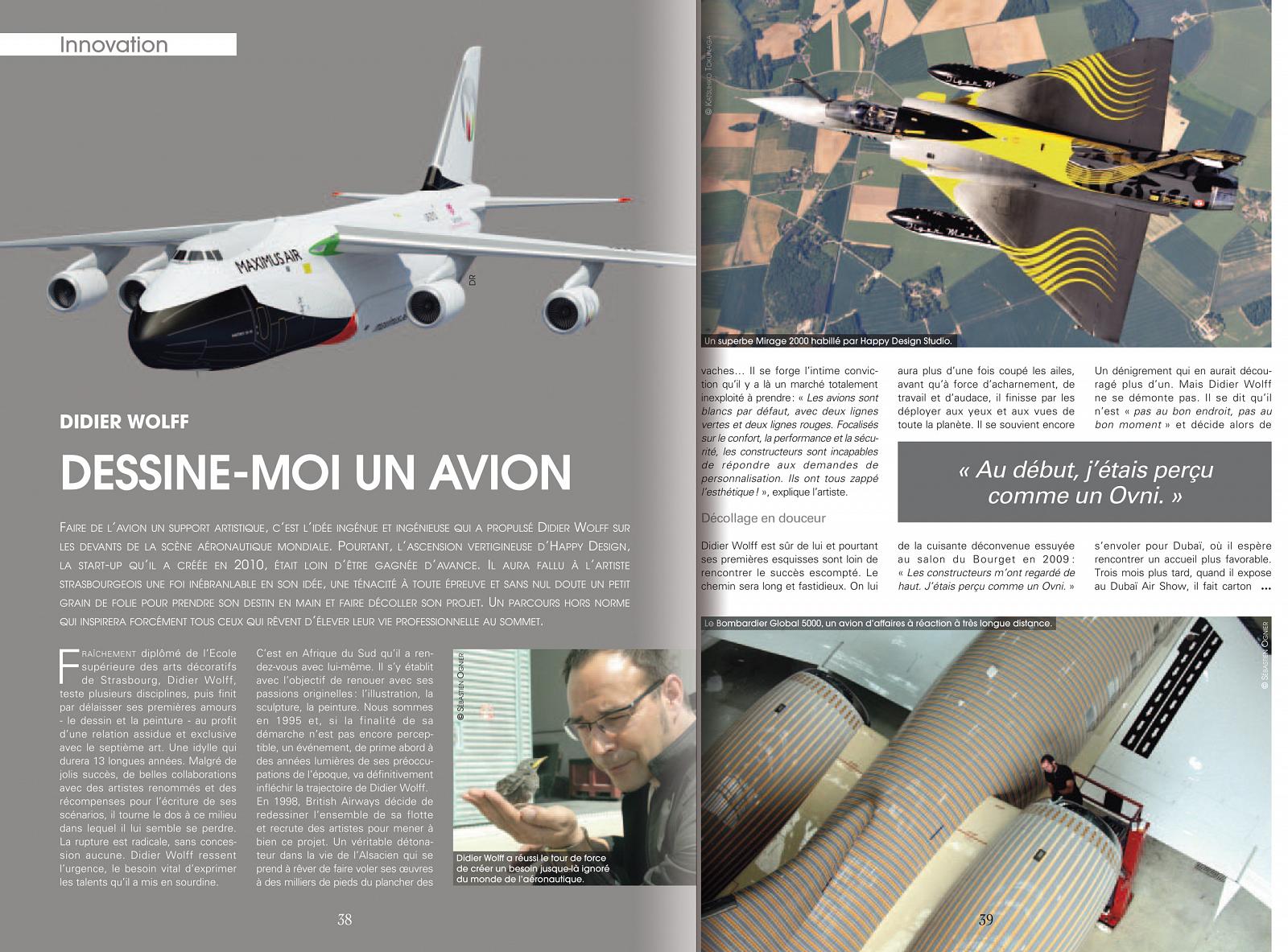
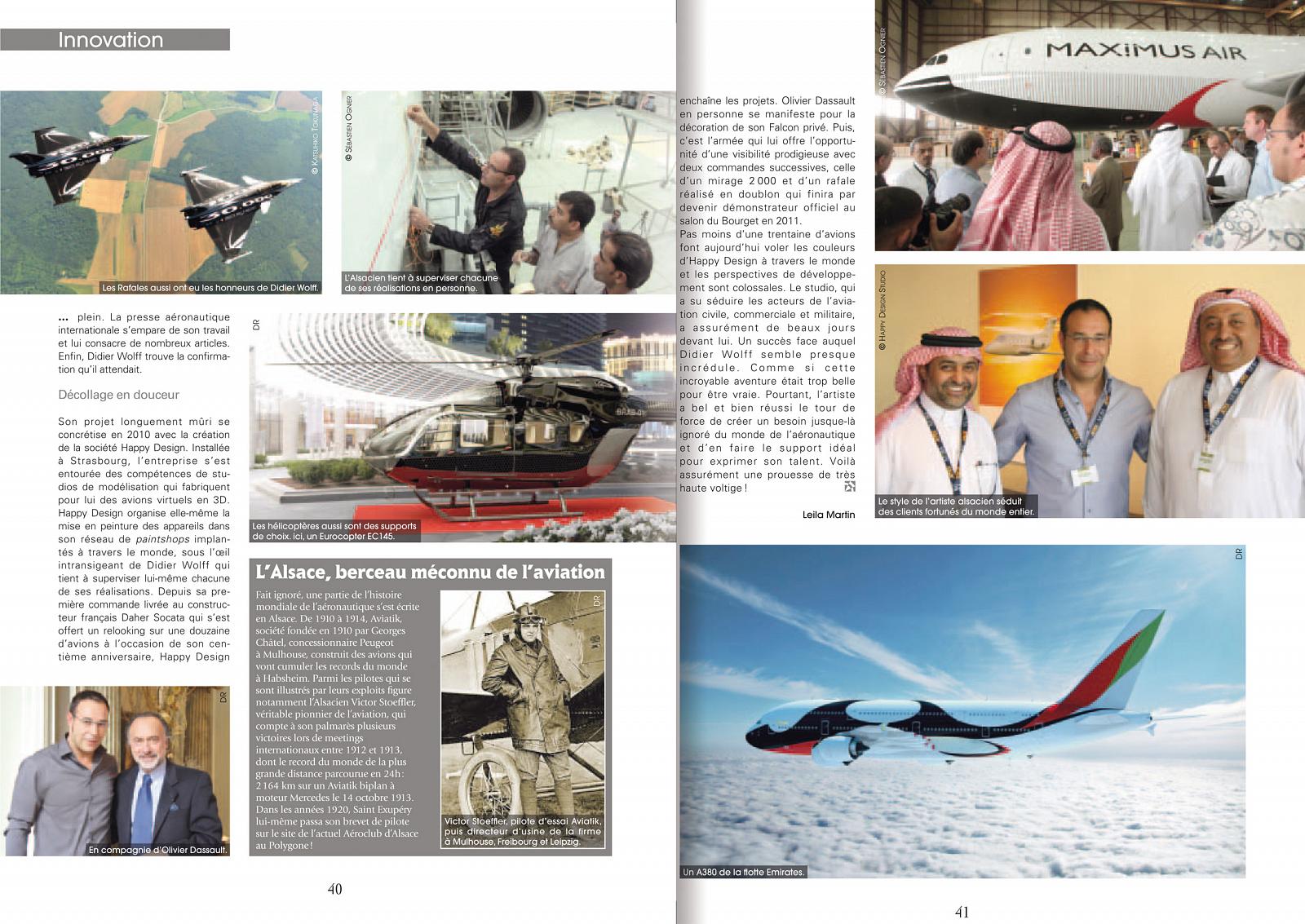
Read full article (text version) Source : En Alsace innovation / This article is reproduced for archival purposes. DIDIER WOLFF DESSINE-MOI UN AVION Faire de l’avion un support artistique, c’est l’idée ingénue et ingénieuse qui a propulsé Didier Wolff sur les devants de la scène aéronautique mondiale. Pourtant, l’ascension vertigineuse d’Happy Design, la start-up qu’il a créée en 2010, était loin d’être gagnée d’avance. Il aura fallu à l’artiste strasbourgeois une foi inébranlable en son idée, une ténacité à toute épreuve et sans nul doute un petit grain de folie pour prendre son destin en main et faire décoller son projet. Un parcours hors norme qui inspirera forcément tous ceux qui rêvent d’élever leur vie professionnelle au sommet. Fraîchement diplômé de l’École supérieure des arts décoratifs de Strasbourg, Didier Wolff teste plusieurs disciplines, puis finit par délaisser ses premières amours – le dessin et la peinture – au profit d’une relation assidue et exclusive avec le septième art. Un idylle qui durera 13 longues années. Malgré de jolis succès, de belles collaborations avec des artistes renommés et des récompenses pour l’écriture de ses scénarios, il tourne le dos à ce milieu dans lequel il lui semble se perdre. La rupture est radicale, sans concession aucune. Didier Wolff ressent l’urgence, le besoin d’exprimer les talents qu’il a mis en sourdine. C’est en Afrique du Sud qu’il a rendez-vous avec lui-même. Il s’y établit avec l’objectif de renouer avec ses passions originelles : l’illustration, la sculpture, la peinture. Nous sommes en 1995 et, si la finalité de sa démarche n’est pas encore perceptible, un événement, de prime abord à des années-lumière de ses préoccupations de l’époque, va définitivement infléchir la trajectoire de Didier Wolff. En 1998, British Airways décide de redessiner l’ensemble de sa flotte et recrute des artistes pour mener à bien ce projet. Une véritable détonation dans la vie de l’Alsacien qui se prend à rêver de faire voler ses uvres à des milliers de pieds du plancher des vaches… Il se forge l’intime conviction qu’il y a là un marché totalement inexploité à prendre : « Les avions sont blancs par défaut, avec deux lignes vertes et deux lignes rouges. Focalisés sur le confort, la performance et la sécurité, les constructeurs ont incapables de répondre aux demandes de personnalisation. Ils ont tout zappé l’esthétique », explique l’artiste. Didier Wolff a réussi le tour de force de créer un besoin jusque-là ignoré du monde de l’aéronautique. Un superbe Mirage 2000 habillé par Happy Design Studio. Didier Wolff est sûr de lui et pourtant ses premières esquisses sont loin de rencontrer le succès escompté. Le chemin sera long et fastidieux. On lui aura plus d’une fois coupé les ailes, avant qu’à force d’acharnement, de travail et d’audace, il finisse par les déployer aux yeux et aux vues de toute la planète. Il se souvient encore de la cuisante déconvenue essuyée au salon du Bourget en 2009 : « Les constructeurs m’ont regardé de haut. J’étais perçu comme un Ovni. » « Au début, j’étais perçu comme un Ovni. » Un dénigrement qui en aurait découragé plus d’un. Mais Didier Wolff ne se démonte pas. Il se dit qu’il n’est « pas au bon endroit, pas au bon moment » et décide alors de s’envoler pour Dubaï où il espère rencontrer un accueil plus favorable. Trois mois plus tard, quand il expose au Dubai Air Show, il fait carton plein. Le Bombardier Global 5000, un avion d’affaires à réaction très longue distance. Les Rafales aussi ont eu les honneurs de Didier Wolff. L’Alsacien tient à superviser chacune de ses réalisations en personne. … plein. La presse aéronautique internationale s’empare de son travail et lui consacre de nombreux articles. Enfin, Didier Wolff trouve la confirmation qu’il attendait. Décollage en douceur Son projet longuement mûri se concrétise en 2010 avec la création de la société Happy Design. Installée à Strasbourg, l’entreprise s’est entourée des compétences de studios de modélisation qui fabriquent pour lui des avions virtuels en 3D. Happy Design organise elle-même la mise en peinture des appareils dans son réseau de paintshops implantés à travers le monde, sous l’il intransigeant de Didier Wolff qui tient à superviser lui-même chacune de ses réalisations. Depuis sa première commande livrée au constructeur français Daher Socata qui s’est offert un relooking sur une douzaine d’avions à l’occasion de son centième anniversaire, Happy Design enchaîne les projets. Olivier Dassault en personne se manifeste pour la décoration de son Falcon privé. Puis, c’est l’armée qui lui offre l’opportunité d’une visibilité prodigieuse avec deux commandes successives, celle d’un Mirage 2000 et d’un Rafale réalisé en doublon qui finira par devenir démonstrateur officiel au salon du Bourget en 2011. Pas moins d’une trentaine d’avions ont aujourd’hui vu voler les couleurs d’Happy Design à travers le monde et les perspectives de développement sont colossales. Le studio, qui a su séduire les acteurs de l’aviation civile, commerciale et militaire, a assurément de beaux jours devant lui. Un succès face auquel Didier Wolff semble presque incrédule. Comme si cette incroyable aventure était trop belle pour être vraie. Pourtant, l’artiste a bel et bien réussi le tour de force de créer un besoin jusque-là ignoré dans le monde de l’aéronautique et d’en faire le support idéal pour exprimer son talent. Voilà assurément une prouesse de très haute voltige ! Leila Martin Les hélicoptères aussi sont des supports de choix. Ici, un Eurocopter EC145. L’Alsace, berceau méconnu de l’aviation Fait ignoré, une partie de l’histoire mondiale de l’aéronautique s’est écrite en Alsace. De 1910 à 1914, Aviatik, société fondée en 1910 par Georges Châtel, concessionnaire Peugeot à Mulhouse, construit des avions qui vont cumuler les records du monde à Habsheim. Parmi les pilotes qui se sont illustrés par leurs exploits figure notamment l’Alsacien Victor Stoeffler, véritable pionnier de l’aviation, qui compte à son palmarès plusieurs victoires lors des meetings internationaux entre 1912 et 1913, dont le record du monde de la plus grande distance parcourue en 24 h : 2 164 km sur un Aviatik biplan à moteur Mercedes le 14 octobre 1913. Dans les années 1920, Saint-Exupéry lui-même passe son brevet de pilote sur le site de l’actuel Aéroclub d’Alsace à Polygone ! Victor Stoeffler, pilote d’essai Aviatik, puis directeur d’usine de la firme à Mulhouse, Fribourg et Leipzig. En compagnie d’Olivier Dassault.

ARTICLE N° 209 / EN ALSACE

 AVRIL 2014

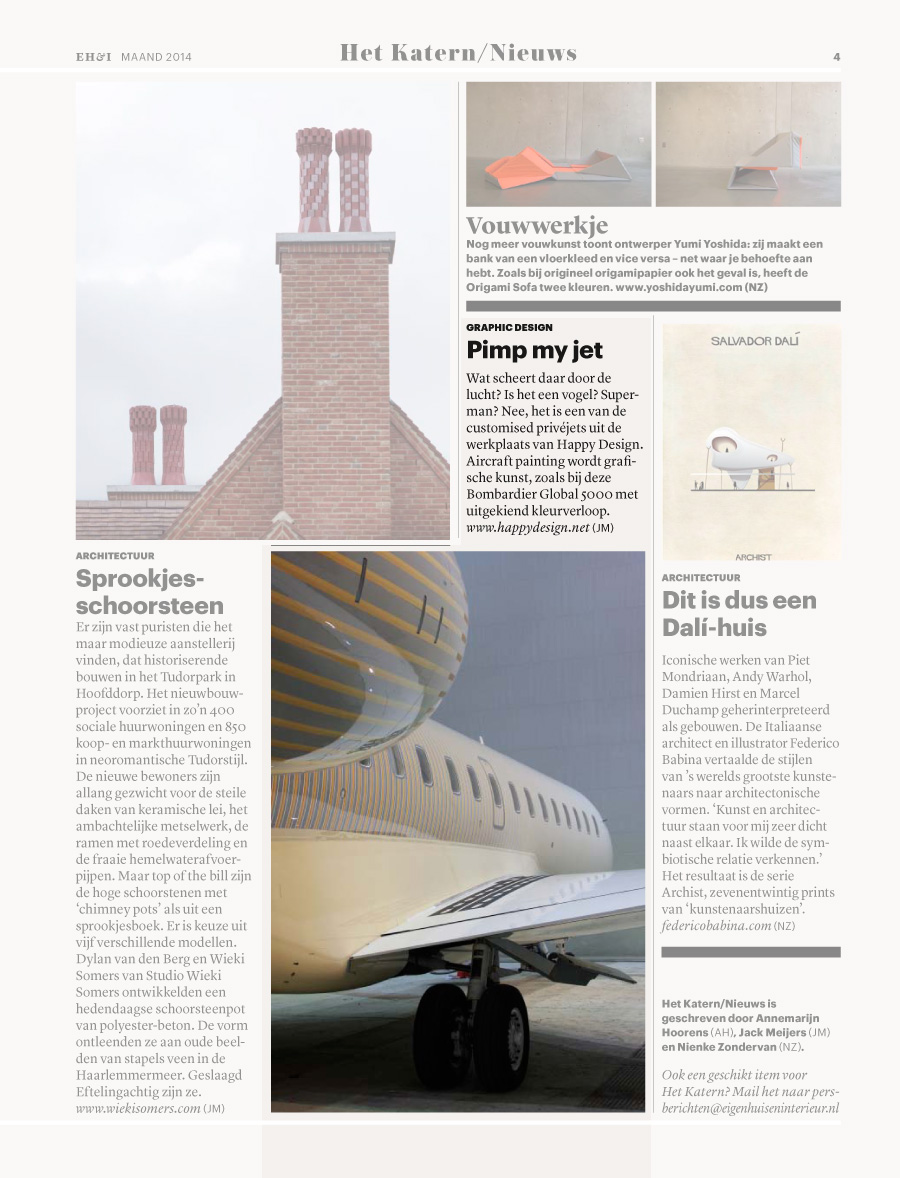
Read full article (text version) Source : GRAPHIC DESIGN / This article is reproduced for archival purposes. Pimp my jet Wat scheert daar door de lucht? Is het een vogel? Superman? Nee, het is een van de customised privéjets uit de werkplaats van Happy Design. Aircraft painting wordt grafische kunst, zoals bij deze Bombardier Global 5000 met uitgekiend kleurverloop.

ARTICLE N° 208

 AVRIL 2014

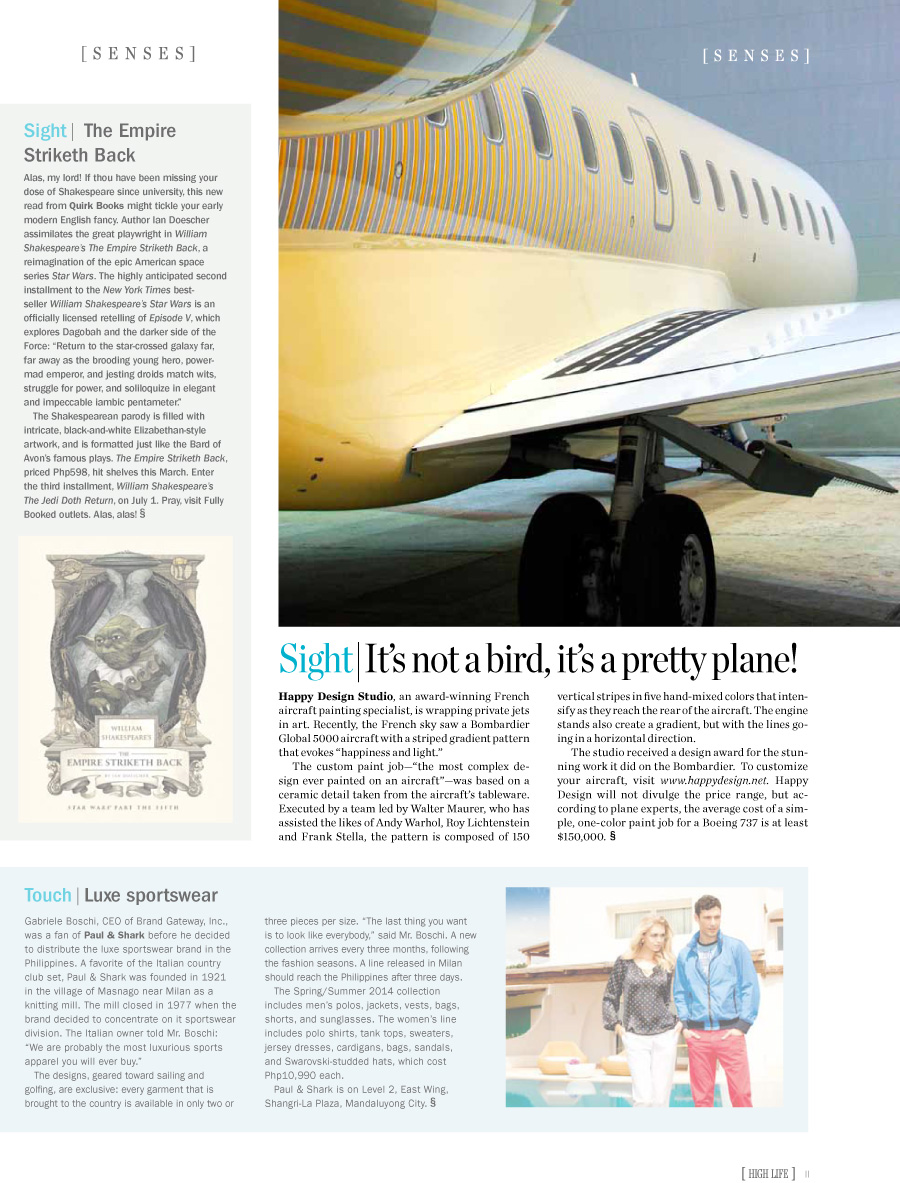
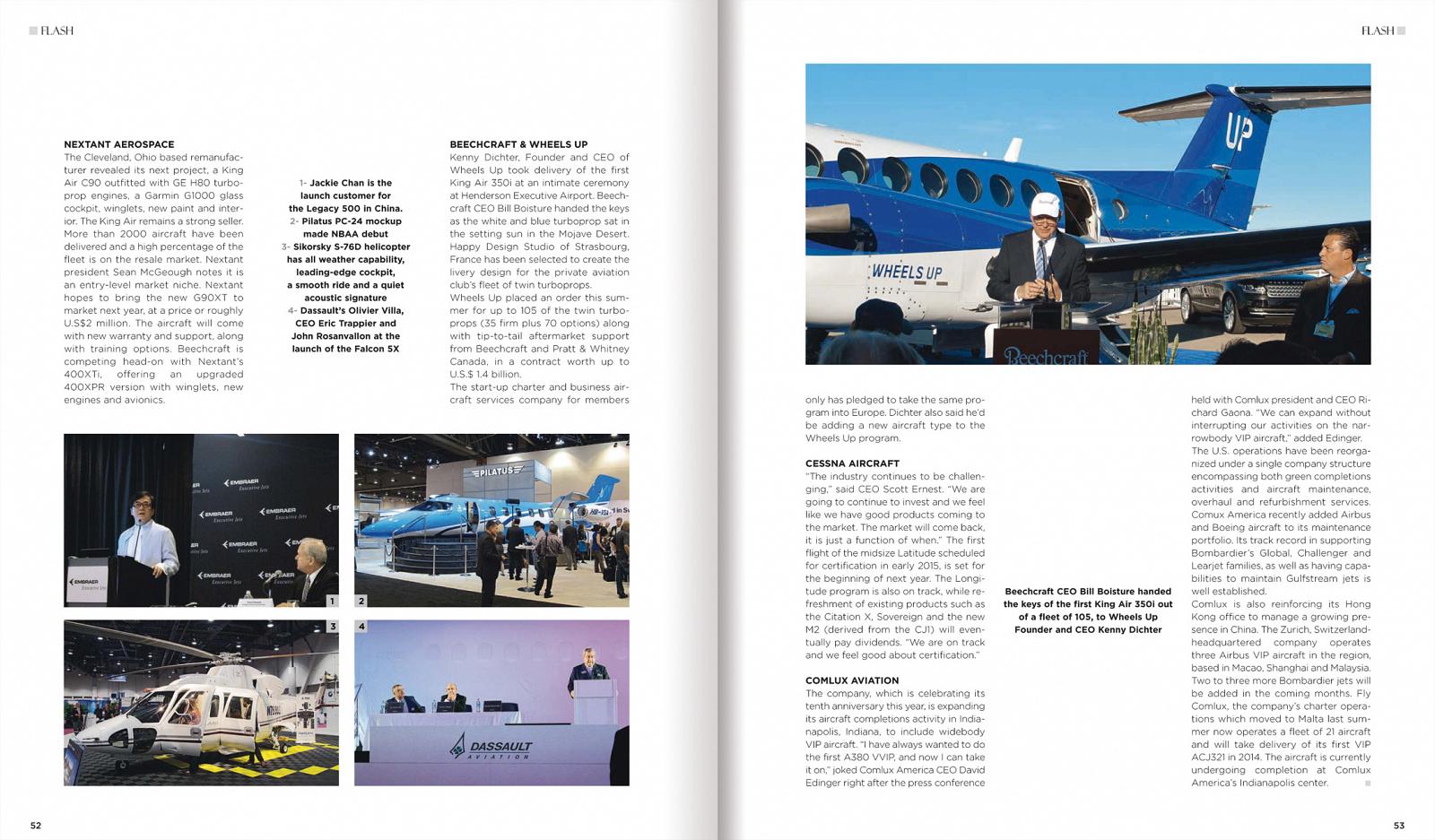
Read full article (text version) Source : Sight / This article is reproduced for archival purposes. It’s not a bird, it’s a pretty plane! Happy Design Studio, an award-winning French aircraft painting specialist, is wrapping private jets in art. Recently, the French sky saw a Bombardier Global 5000 aircraft with a striped gradient pattern that evokes “happiness and light.” The custom paint job—the most complex design ever painted on an aircraft—was based on a ceramic detail taken from the aircraft’s tableware. Executed by a team led by Walter Maurer, who has assisted the likes of Andy Warhol, Roy Lichtenstein and Frank Stella, the pattern is composed of 150 vertical stripes in five hand-mixed colors that intensify as they reach the rear of the aircraft. The engine stands also create a gradient, but with the lines going in a horizontal direction. The studio received a design award for the stunning work it did on the Bombardier. To customize your aircraft, visit www.happydesign.net.

ARTICLE N° 207

 AVRIL 2014

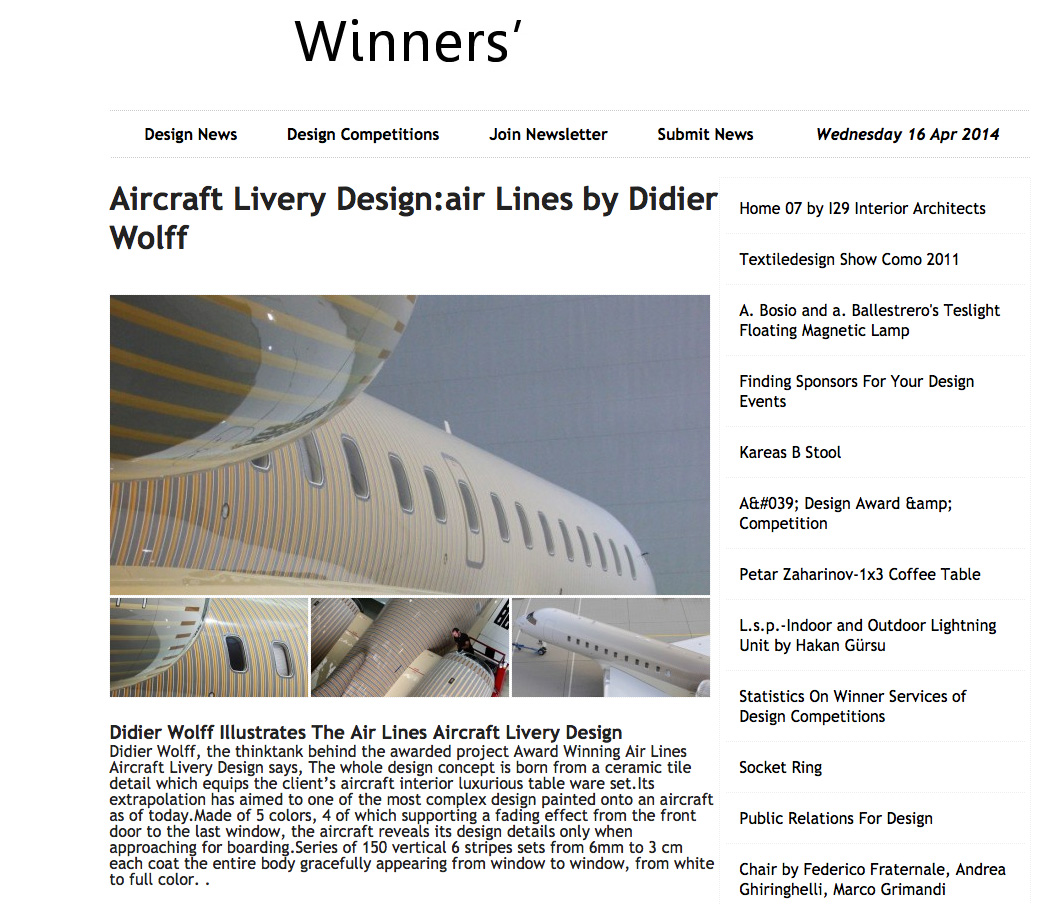
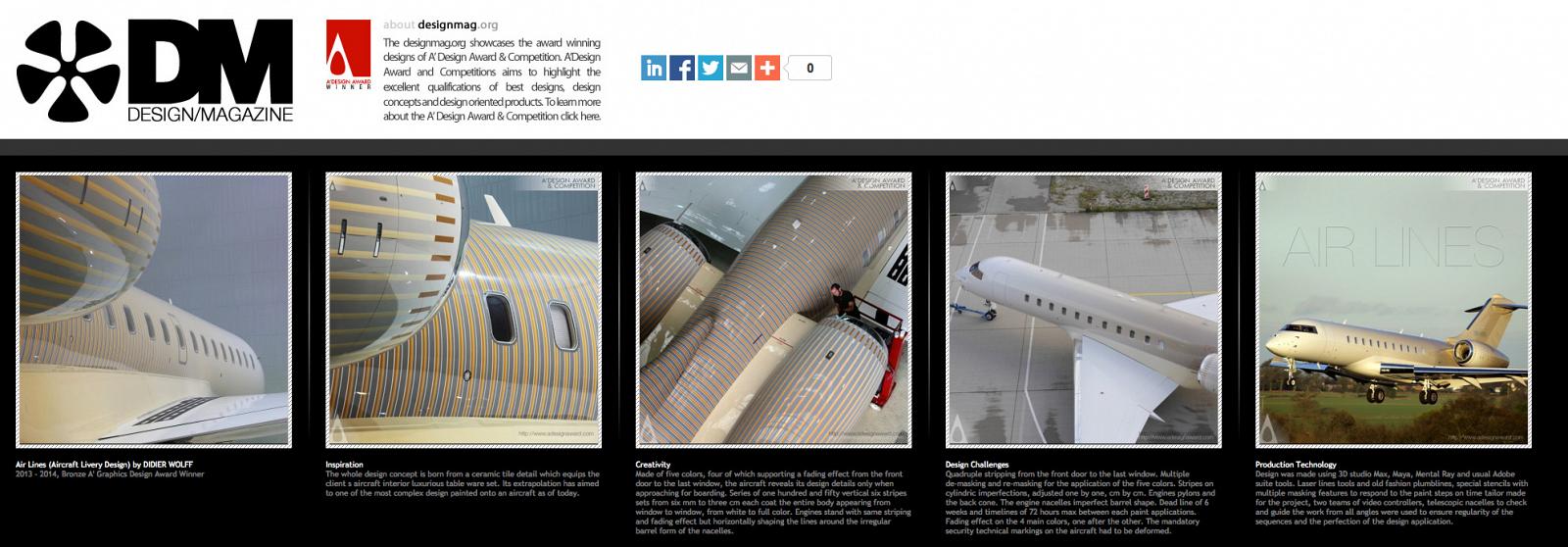
Read full article (text version) Soure : A’Design Award / This article is reproduced for archival purposes. Aircraft Livery Design: air Lines by Didier Wolff Didier Wolff Illustrates The Air Lines Aircraft Livery Design Didier Wolff, the thinktank behind the awarded project Award Winning Air Lines Aircraft Livery Design says, The whole design concept is born from a ceramic tile detail which equips the client’s aircraft interior luxurious table ware set. Its extrapolation has aimed to one of the most complex design painted on to an aircraft as of today. Made of 5 colors, 4 of which supporting a fading effect from the front door to the last window, the aircraft reveals its design details only when approaching for boarding. Series of 150 vertical 6 stripes sets from 6mm to 3 cm each coat the entire body gracefully appearing from window to window, from white to full color.

ARTICLE N° 206 / A’ DESIGN AWARD

 MARS 2014

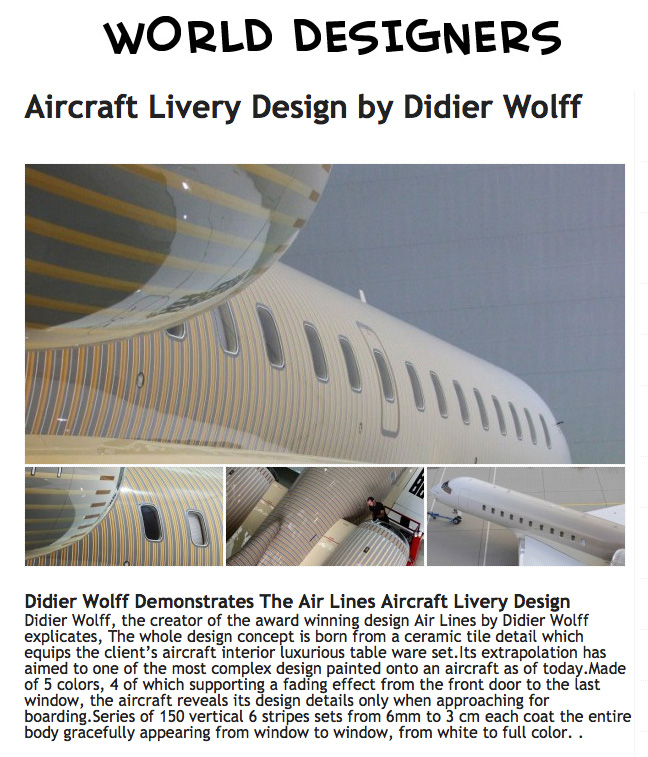
Read full article (text version) Source : WORLD DESIGNERS / This article is reproduced for archival purposes. Aircraft Livery Design by Didier Wolff Didier Wolff Demonstrates The Air Lines Aircraft Livery Design Didier Wolff, the creator of the award winning design Air Lines by Didier Wolff explicates, The whole design concept is born from a ceramic tile detail which equips the client’s aircraft interior luxurious table ware set. Its extrapolation has aimed to one of the most complex design painted onto an aircraft as of today. Made of 5 colors, 4 of which supporting a fading effect from the front door to the last window, the aircraft reveals its design details only when approaching for boarding. Series of 150 vertical 6 stripes sets from 6mm to 3 cm each coat the entire body gracefully appearing from window to window, from white to full color.

ARTICLE N° 205 / WORLD DESIGNER

 MARS 2014

ARTICLE N° 204 / DM DESIGN MAGAZINE

 MARS 2014

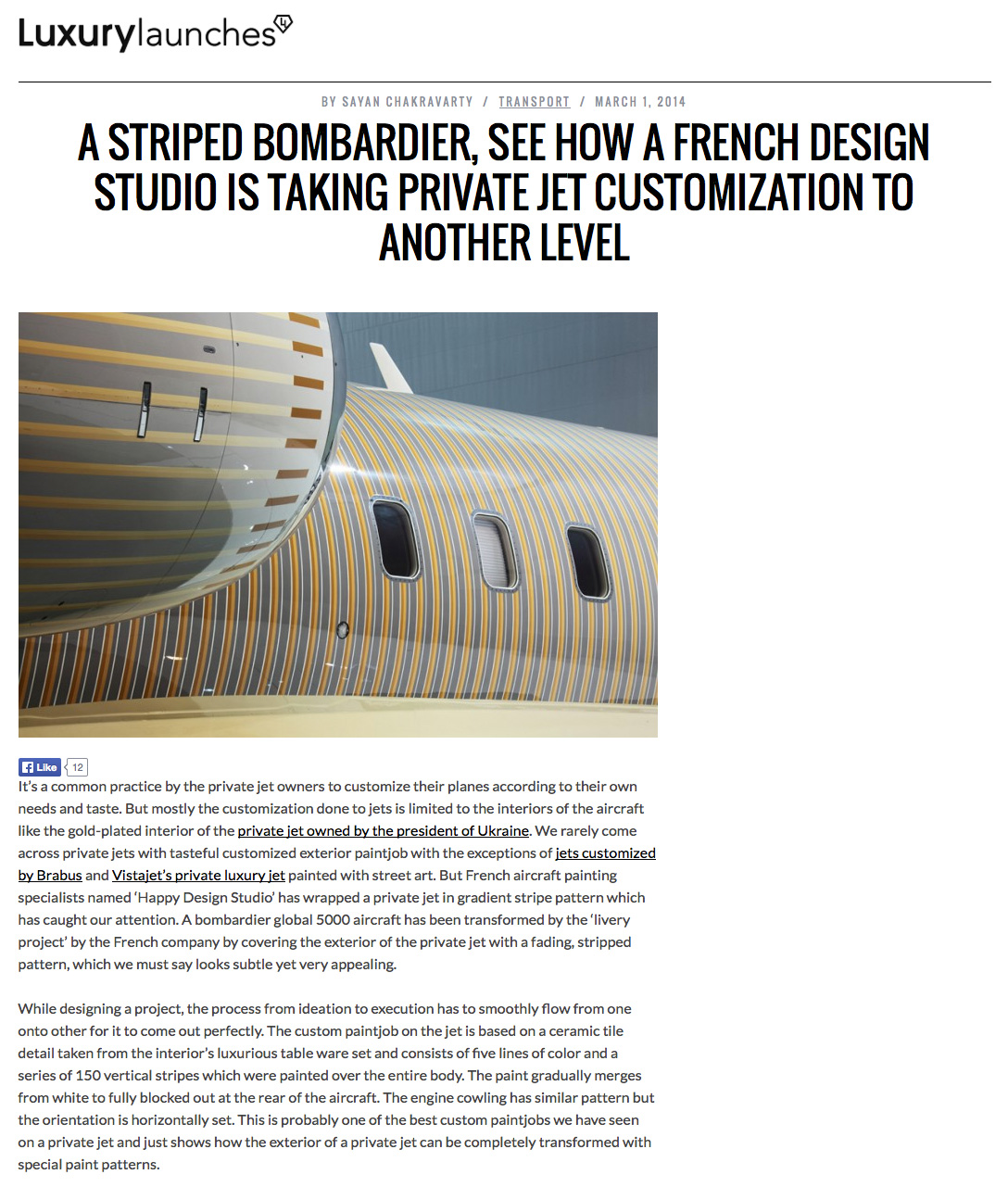
Read full article (text version) Source :LUXURY network / This article is reproduced for archival purposes. Luxurylaunches BY SAYAN CHAKRAVARTY / TRANSPORT / MARCH 1, 2014 A STRIPED BOMBARDIER, SEE HOW A FRENCH DESIGN STUDIO IS TAKING PRIVATE JET CUSTOMIZATION TO ANOTHER LEVEL It’s a common practice by the private jet owners to customize their planes according to their own needs and taste. But mostly the customization done to jets is limited to the interiors of the aircraft like the gold-plated interior of the private jet owned by the president of Ukraine. We rarely come across private jets with tastefully customized exterior paintjob with the exceptions of jets customized by Brabus and VistaJet’s private luxury jet painted with street art. But French aircraft painting specialists named ‘Happy Design Studio’ has wrapped a private jet in gradient stripe pattern which has caught our attention. A Bombardier global 5000 aircraft has been transformed by the ‘livery project’ by the French company by covering the exterior of the private jet with a fading, striped pattern, which we must say looks subtle yet very appealing. While designing a project, the process from ideation to execution has to smoothly flow from one onto other for it to come out perfectly. The custom paintjob on the jet is based on a ceramic tile detail taken from the interior’s luxurious table ware set and consists of five lines of color and a series of 150 vertical stripes which were painted over the entire body. The paint gradually merges from white to fully blocked out at the rear of the aircraft. The engine cowling has similar pattern but the orientation is horizontally set. This is probably one of the best custom paintjobs we have seen on a private jet and just shows how the exterior of a private jet can be completely transformed with special paint patterns.

ARTICLE N° 203 / LUXURY LAUNCHES

 MARS 2014

ARTICLE N° 202 / LUXURY NETWORK

 MARS 2014

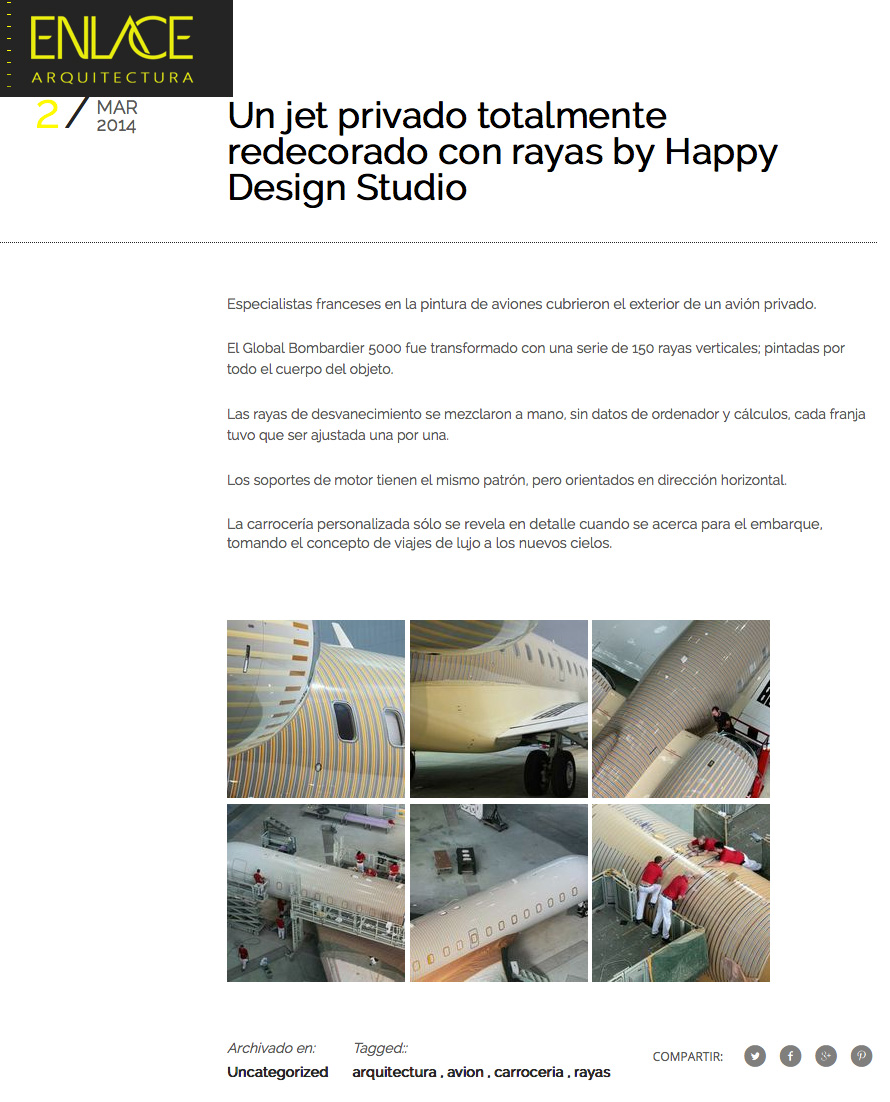
Read full article (text version) Source :ENLACE ARQUITECTURA. This article is reproduced for archival purposes. 27 MAR 2014 Un jet privado totalmente redecorado con rayas by Happy Design Studio Especialistas franceses en la pintura de aviones cubrieron el exterior de un avión privado. El Global Bombardier 5000 fue transformado con una serie de 150 rayas verticales; pintadas por todo el cuerpo del objeto. Las rayas de desvanecimiento se mezclaron a mano, sin datos de ordenador y cálculos, cada franja tuvo que ser ajustada una por una. Los soportes de motor tienen el mismo patrón, pero orientados en dirección horizontal. La carrocería personalizada sólo se revela en detalle cuando se acerca para el embarque, tomando el concepto de viajes de lujo a los nuevos cielos.

ARTICLE N° 201 / ENLACE

 MARS 2014

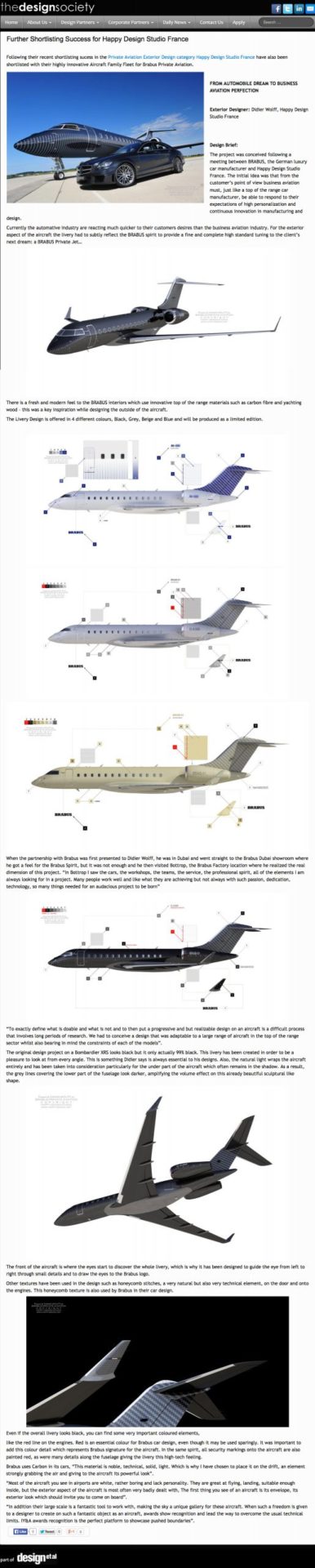
Read full article (text version) Source :thedesignsociety / This article is reproduced for archival purposes. Further Shortlisting Success for Happy Design Studio France Following their recent shortlisting success in the Private Aviation Exterior Design category Happy Design Studio France have also been shortlisted with their highly innovative Aircraft family Fleet for Brabus Private Aviation. FROM AUTOMOBILE DREAM TO BUSINESS AVIATION PROJECT Exterior Designer: Didier Wolff, Happy Design Studio France Design Brief: The project was conceived following a meeting between BRABUS, the German luxury car manufacturer and Happy Design Studio France. The initial idea was that from the customer’s point of view the transition from automobile to aircraft must be seamless and natural, just like a step to a strange car manufacturer and expectations of high personalization and continuous innovation in manufacturing and customization. Currently the automotive industry are reacting much quicker to their customers desires than the business aviation industry. For the exterior aspect of the aircraft theivery had to satisfy reflect the BRABUS spirit to provide a fine and complete high standard tuning to the client’s next dream: a BRABUS Private Jet. There is a fresh and modern feel to the BRABUS interiors which use innovative top of the range materials such as carbon fibre and yachting wood – this was a key inspiration while designing the outside of the aircraft. The Livery Design is offered in 4 different colours, black, grey, beige and blue and will be produced as a limited edition. When the partnership with Brabus was first presented to Didier Wolff, he was in Dubai and went straight to the Brabus Dubai showroom where he got a feel for the Brabus Spirit, but it was not enough and he then visited Bottrop, the Brabus Factory location where he realized the real dimension of this project. “In Bottrop I saw the cars, the workshops, the teams, the service, the professional spirit, all of the elements I am always looking for in a project. Many people work well and like what they are achieving but not always with such passion, dedication, consistency, so many things needed for an ambitious project to be born”. “To exactly define what’s doable and what’s not and then to put a progressive and but realizable design on an aircraft is a difficult process that involves long periods of research. We had to conceive a design that was adaptable to a large range of aircraft in the top of the market while also bearing in mind the constraints of each of the models. The original design project on a Bombardier XRS looks black but is only actually semi black. This livery has been created in order to be a pleasure to look at from every angle. This is something Didier says is always essential to his designs. Also, the natural light wraps the aircraft entirely and has been taken into consideration particularly for the under part of the aircraft which often remains in the shade. As a result, the grey lines covering the lower part of the fuselage look darker, amplifying the volume effect on this already beautiful sculptural like shape. The front of the aircraft is where the eyes start to discover the whole livery, which is why it has been designed to guide the eye from left to right through small details and to draw the eyes to the Brabus logo. Other textures have been used in the design such as honeycomb stickers, a very natural but also very technical element, on the door and onto the engines. This honeycomb texture is also used by Brabus in their car design. Even if the overall livery looks black, you can find some very important coloured elements, like the red line on the engines. Red is an essential colour for Brabus car design, even though it may be used sparingly. It was important to add this colour detail which represents Brabus signature for the aircraft. In the same spirit, all security markings on the aircraft are also painted red, as were many details along the fuselage giving the livery this high-tech feeling. Brabus uses Carbon in its cars, “this material is noble, technical, solid, light. Which is why I have chosen to place it on the drift, an element strongly grabbing the air and giving to the aircraft its powerful look”. “Most of the aircraft you see in airports are white, rather boring and lack personality. They are great at flying, landing, suitable enough inside, but the exterior aspect of the aircraft is less often very sexy. The first thing you see of an aircraft is its exterior, and in my opinion exterior look which should invite you to come on board”. “In a design their livery scale is a fantastic tool to work with, making the sky a unique gallery for these aircraft. When such a freedom is given to designers to create such a fantastic object as an aircraft, awards show recognition and lead the way to overcome the usual technical limits. MBA awards recognition is the perfect platform to showcase such boundaries.”

ARTICLE N° 200 / DESIGN SOCIETY

 MARS 2014

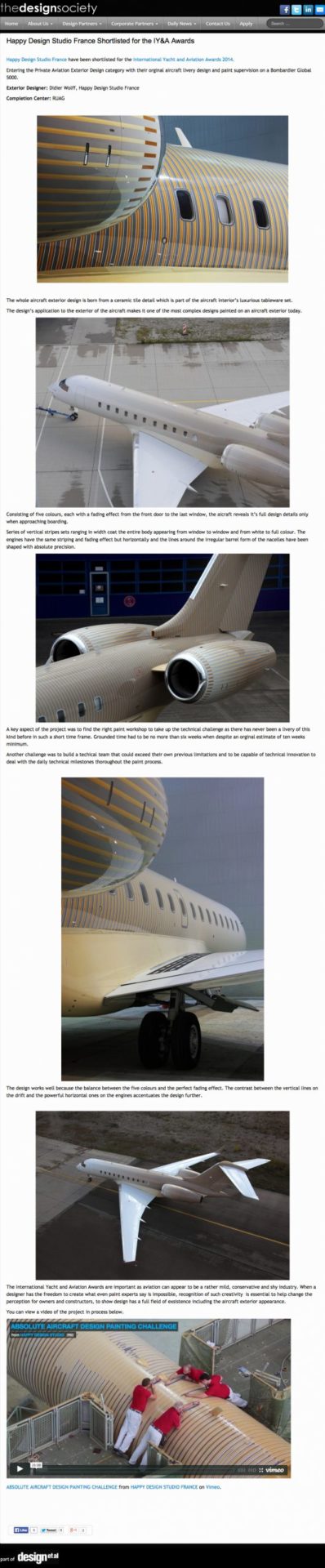
Read full article (text version) Source :thedesignsociety / This article is reproduced for archival purposes. Happy Design Studio France Shortlisted for the IY&A Awards Happy Design Studio France have been shortlisted for the International Yacht & Aviation Awards 2014. Entering the Private Aviation Exterior Design category with their original aircraft livery design and paint supervision on a Bombardier Global 5000. Exterior Designer: Didier Wolff, Happy Design Studio France Completion Center: RUAG The whole aircraft exterior design is born from a ceramic tile detail which is part of the aircraft interior’s luxurious tableware set. The design’s application to the exterior of the aircraft makes it one of the most complex designs painted on an aircraft exterior today. Consisting of five colours, each with a fading effect from the front door to the last window, the aircraft reveals it’s full design details only when approaching for boarding. Series of vertical stripes sets ranging in width coat the entire body appearing from window to window, from white to full colour. The engines have the same striping and fading effect but horizontally and the lines around the irregular barrel form of the nacelles have been shaped with absolute precision. A key aspect of the project was to find the right paint workshop to take up the technical challenge as there has never been a livery of this kind before in such a short time frame. Grounded time had to be no more than six weeks when despite an original estimate of ten weeks minimum. Another challenge was to build a technical team that could exceed their own previous limitations and to be capable of technical innovation to deal with the daily technical milestones throughout the paint process. The design works well because the balance between the five colours and the perfect fading effect. The contrast between the vertical lines on the fuselage and the powerful horizontal ones on the engines accentuates the design further. The International Yacht and Aviation Awards are important as aviation can appear to be a rather mild, conservative and shy industry. When a designer has the freedom to create when paint experts say is impossible, recognition of such creativity is essential to help change the perception for owners and constructors, to move design has a full field of existence including the aircraft exterior appearance. You can view a video of the project in process below.

ARTICLE N° 199 / DESIGN SOCIETY

 FEVRIER 2014

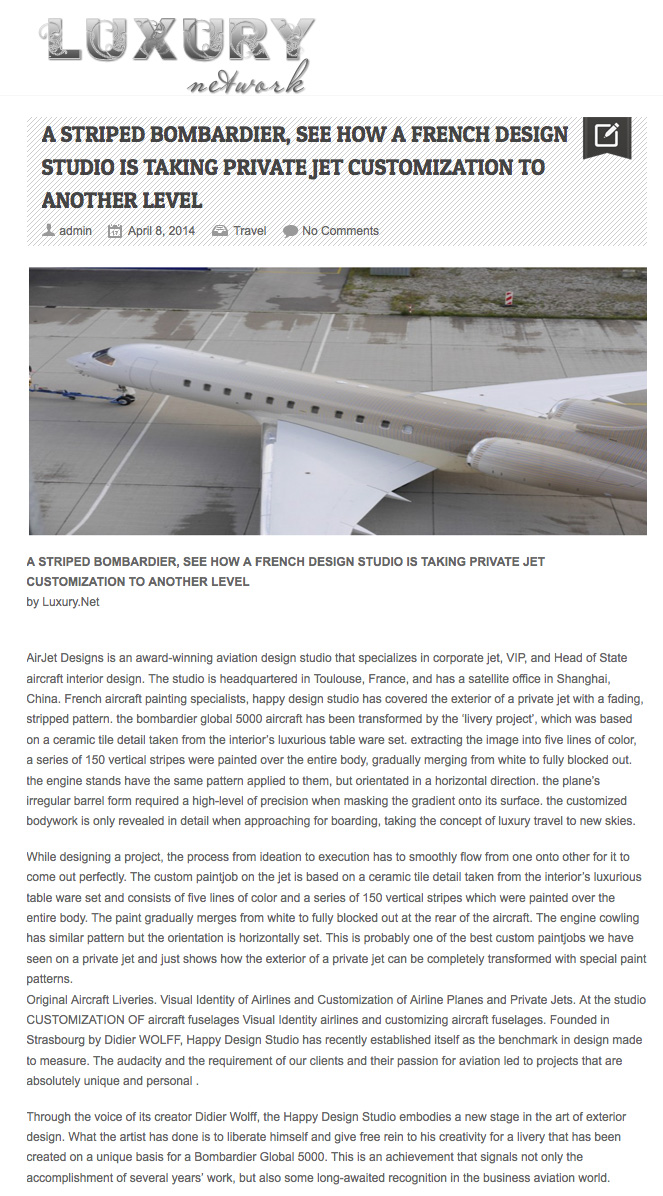
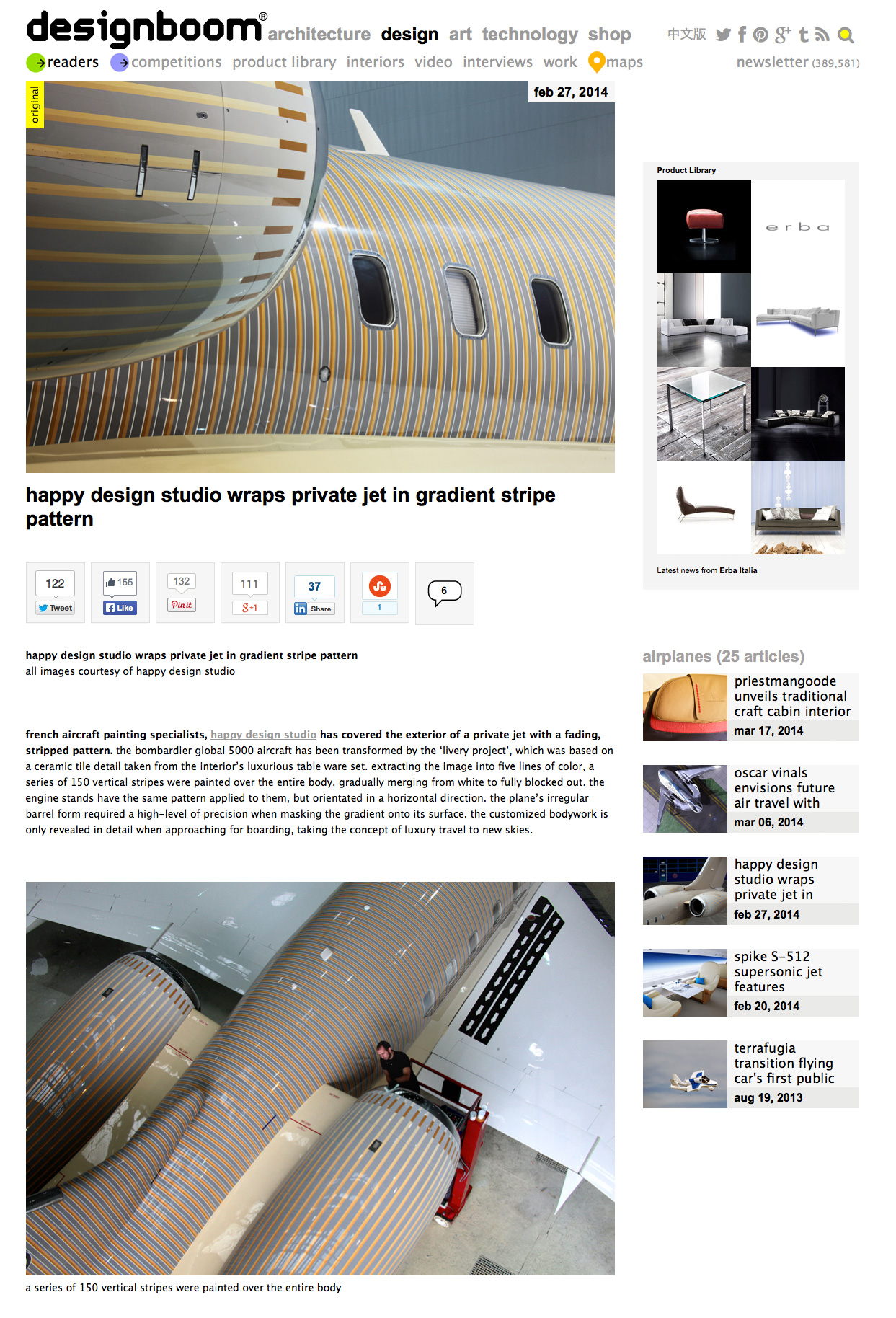
Read full article (text version) ABSOLUTE AIRCRAFT DESIGN PAINTING CHALLENGE FEVRIER 2014 ARTICLE N° 198 Source : designboom / This article is reproduced for archival purposes. architecture | design | art | technology | shop readers | competitions | product library | interiors | video | interviews | work | maps feb 27, 2014 happy design studio wraps private jet in gradient stripe pattern all images courtesy of happy design studio french aircraft painting specialists, happy design studio has covered the exterior of a private jet with a fading, striped pattern. the bombardier global 5000 aircraft has been transformed by the ‘livery project’, which was based on a ceramic tile detail taken from the interior’s luxurious table ware set. extracting the image into five lines of color, a series of 150 vertical stripes were painted over the entire body, gradually merging from white to fully blocked out. the engine stands have the same pattern applied to them, but orientated in a horizontal direction. the plane’s irregular barrel form required a high-level of precision when masking the gradient onto its surface. the customized bodywork is only revealed in detail when approaching for boarding, taking the concept of luxury travel to new skies. a series of 150 vertical stripes were painted over the entire body

ARTICLE N° 198 / DESIGNBOOM

 JANVIER 2014

ARTICLE N° 197

 JANVIER 2014

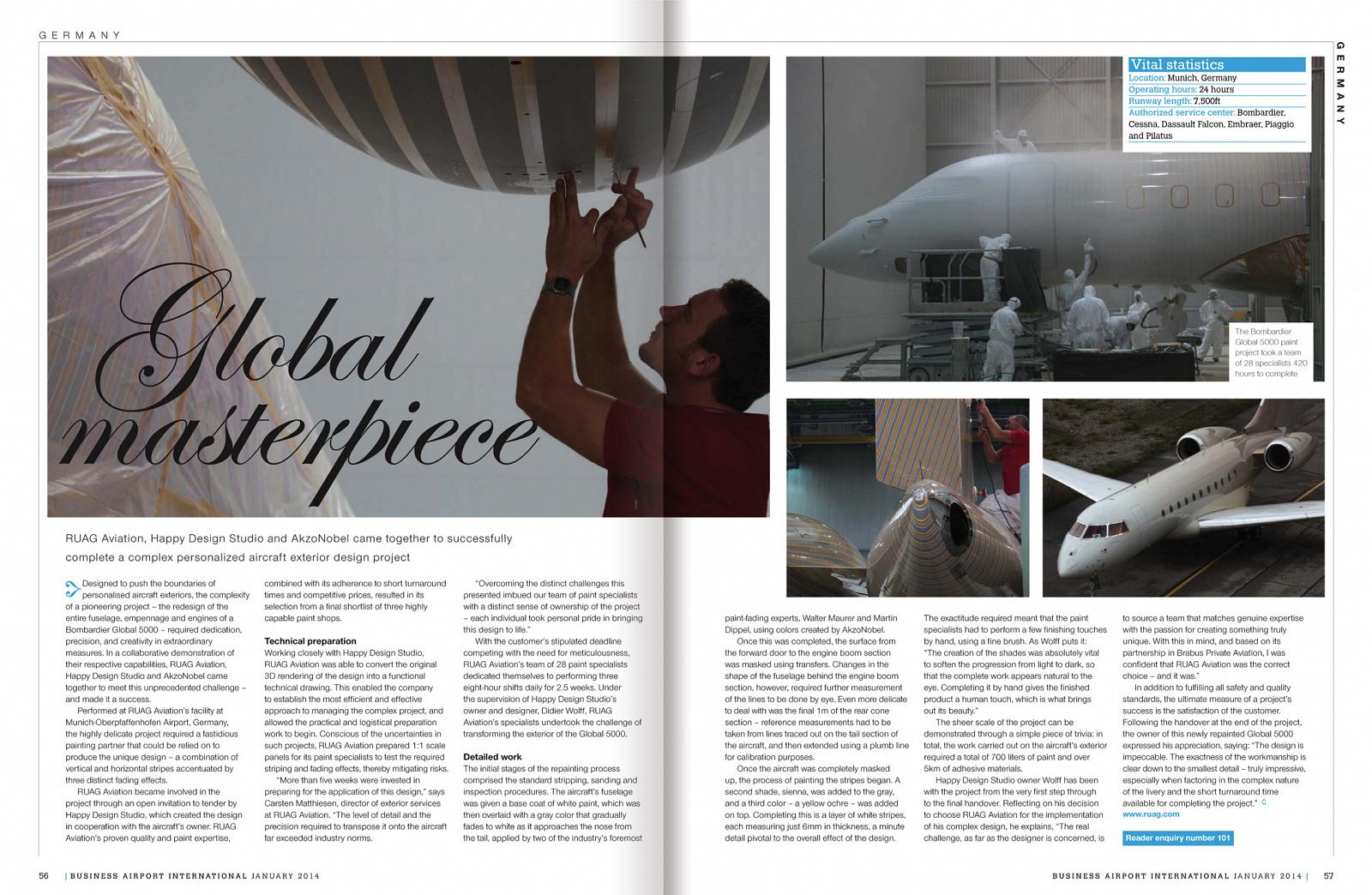
Read full article (text version) Source : BUSINESS AIRPORT MAGAZINE GERMANY Global masterpiece RUAG Aviation, Happy Design Studio and AkzoNobel came together to successfully complete a complex personalized aircraft exterior design project Designed to push the boundaries of personalised aircraft exteriors, the complexity of a pioneering project – the redesign of the entire fuselage, empennage and engines of a Bombardier Global 5000 – required dedication, precision, and creativity in extraordinary measures. In a collaborative demonstration of their respective capabilities, RUAG Aviation, Happy Design Studio and AkzoNobel came together to meet this unprecedented challenge – and made it a success. Performed at RUAG Aviation’s facility at Munich-Oberpfaffenhofen Airport, Germany, the highly delicate project required a fastidious painting partner that could be relied on to produce the unique design – a combination of vertical and horizontal stripes accentuated by three distinct fading effects. RUAG Aviation became involved in the project through an open invitation to tender by Happy Design Studio, which created the design in cooperation with the aircraft’s owner. RUAG Aviation’s proven quality and paint expertise, combined with its adherence to short turnaround times and competitive prices, resulted in its selection from a final shortlist of three highly capable paint shops. Technical preparation Working closely with Happy Design Studio, RUAG Aviation was able to convert the original 3D rendering of the design into a functional technical drawing. This enabled the company to establish the most efficient and effective approach to managing the complex project, and allowed the practical and logistical preparation work to begin. Conscious of the uncertainties such projects, RUAG Aviation prepared 1:1 scale panels for its paint specialists to test the required striping and fading effects, thereby mitigating risks. “More than five weeks were invested preparing for the application of this design,” says Carsten Matthiesen, director of exterior services at RUAG Aviation. “The level of detail and precision required to transport it onto the aircraft far exceeded industry norms.” Detailed work The initial stages of the repainting process comprised the standard stripping, sanding and inspection procedures. The aircraft’s fuselage was given a base coat of white paint, which was then overlaid with a grey color that gradually fades to white as it approaches the nose from the tail, applied by two of the industry’s foremost paint-fading experts, Walter Maurer and Martin Dippel, using colors created by AkzoNobel. Once this was completed, the surface from the forward door to the engine boom section was masked using transfers. Changes in the shape of the fuselage behind the engine boom section, however, required further measurement of the lines to be done by eye. Even more delicate to deal with was the final 1m of the rear cone section – reference measurements had to be taken from lines traced out on the tail section of the aircraft, and then extended using a plumb line for calibration purposes. Once the aircraft was completely masked up, the process of painting the stripes began. A second shade, sienna, was added to the grey, and a top layer – a yellow ochre – was added on top. Completing this is a layer of white stripes, each measuring just 6mm in thickness, a minute detail pivotal to the overall effect of the design. The exactitude required meant that the paint specialists had to perform a few finishing touches by hand, using a fine brush. As Wolff puts it: “The creation of the shades was absolutely vital to soften the progression from light to dark, so that the complete work appears natural to the eye. Completing it by hand gives the finished product a human touch, which is what brings out its beauty.” The sheer scale of the project can be demonstrated through a simple piece of trivia: in total, the work carried out on the aircraft’s exterior required a total of 700 liters of paint and over 5km of adhesive materials. Happy Design Studio owner Wolff has been with the project from the very first step through to the final handover. Reflecting on his decision to choose RUAG Aviation for the implementation of his complex design, he explains: “The real challenge, as far as the designer is concerned, is to source a team that matches genuine expertise with the passion for creating something truly unique. With this in mind, and based on its partnership in Brabus Private Aviation, I was confident that RUAG Aviation was the correct choice – and it was.” In addition to fulfilling all safety and quality standards, the ultimate measure of a project’s success is the satisfaction of the customer. Following the handover at the end of the project, the owner of this newly repainted Global 5000 expressed his appreciation, saying: “The design is impeccable. The exactness of the workmanship is clear down to the smallest detail – truly impressive, especially when factoring in the complex nature of the livery and the short turnaround time available for completing the project.” Vital statistics Location: Munich, Germany Operating hours: 24 hours Runway length: 7,500ft Authorized service center: Bombardier, Cessna, Dassault Falcon, Embraer, Piaggio and Pilatus The Bombardier Global 5000 paint project took a team of 28 specialists 420 hours to complete

ARTICLE N° 196 / BUSINESS AIRPORT

Press

2025
2024
2023
2022
2020-2021
2019
2018
2017
2016
2015
2014
2013
2012
2011
2010
2009