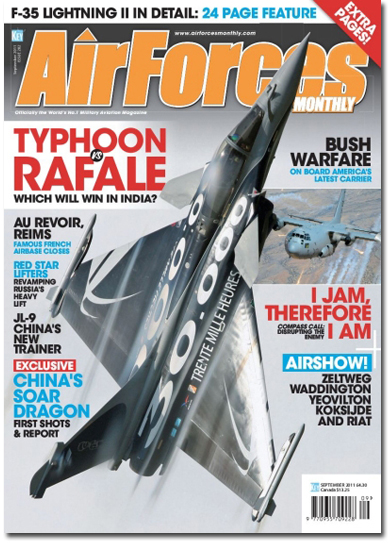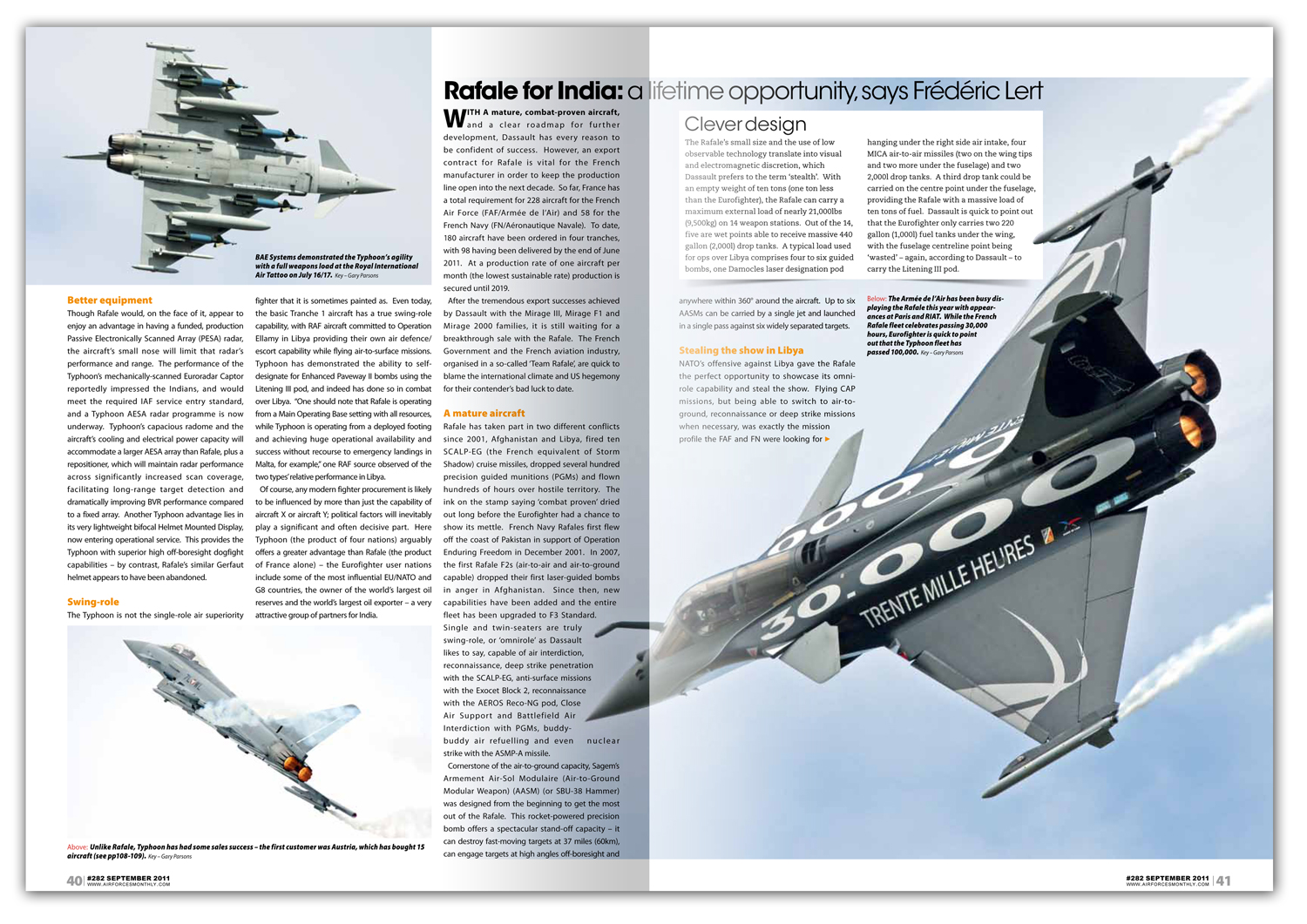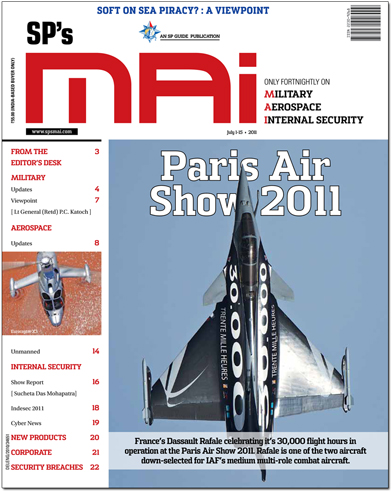
Press

RAFALE PRESS IMPACT
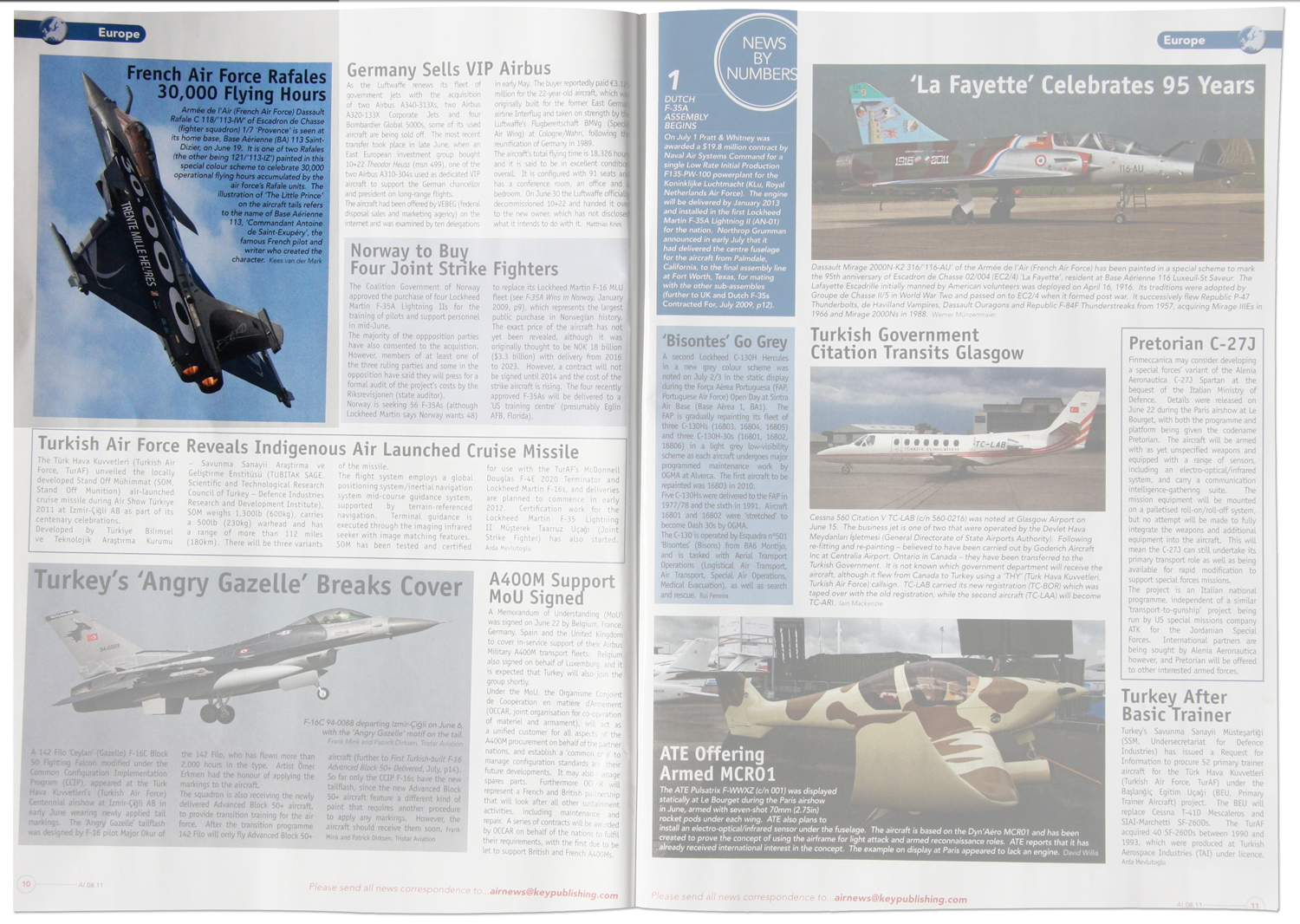
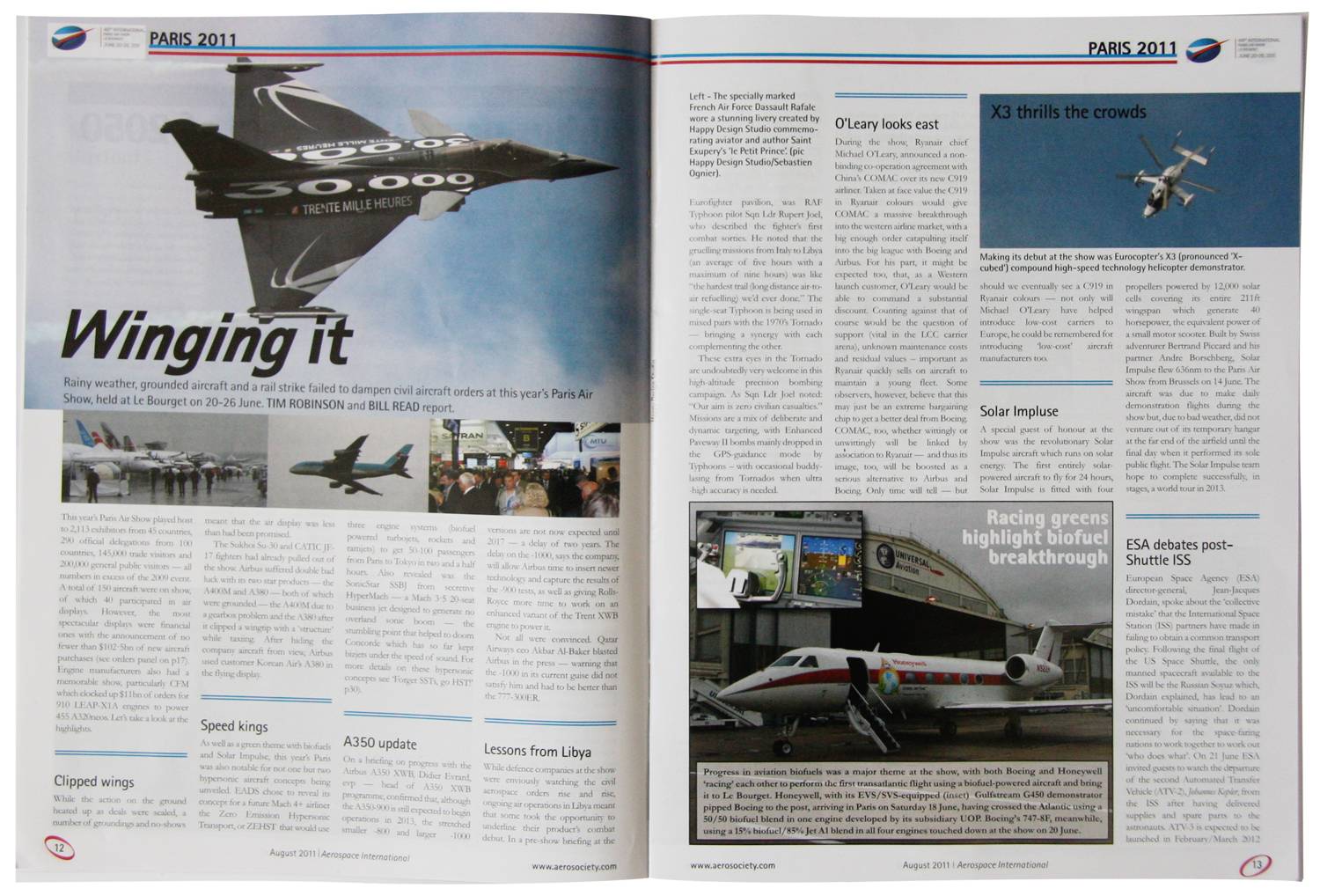
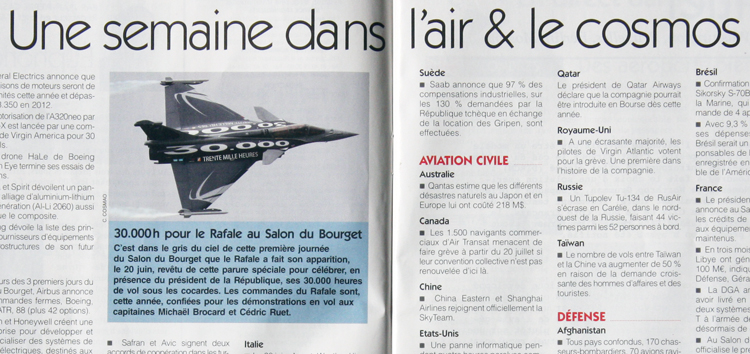
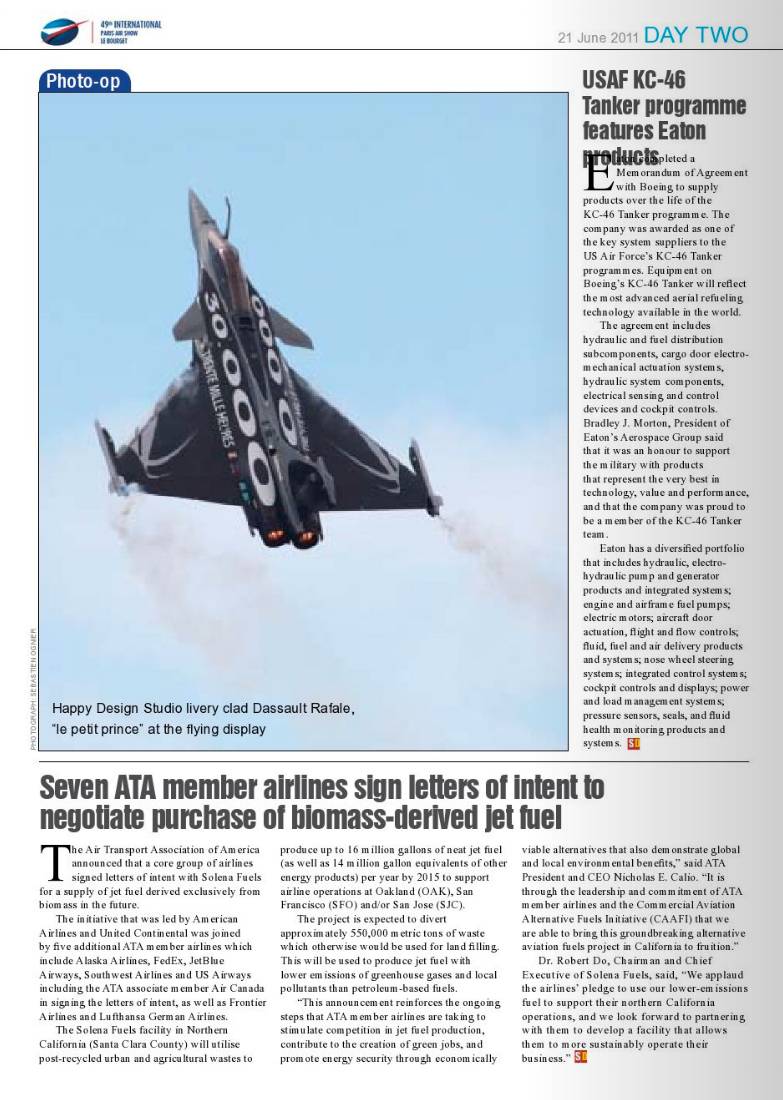
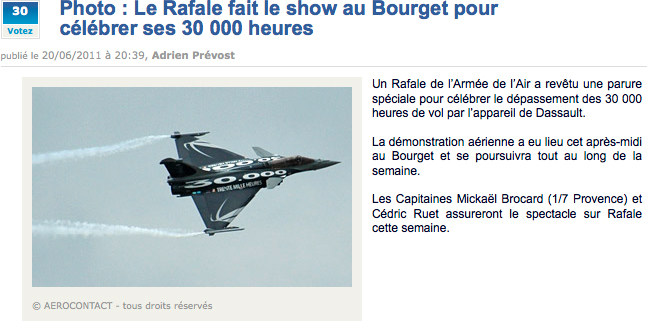
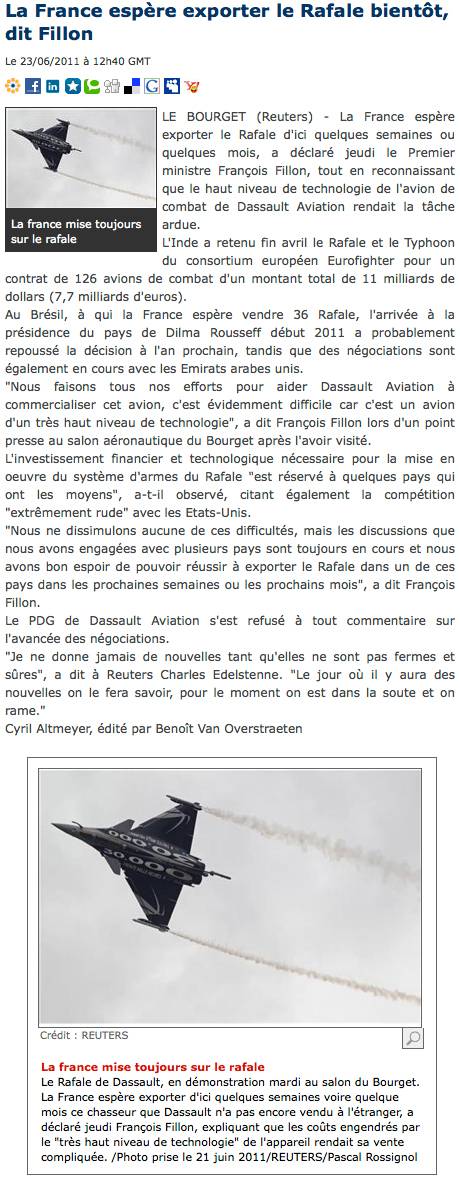
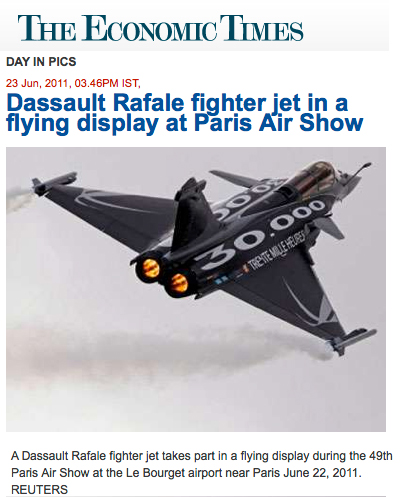
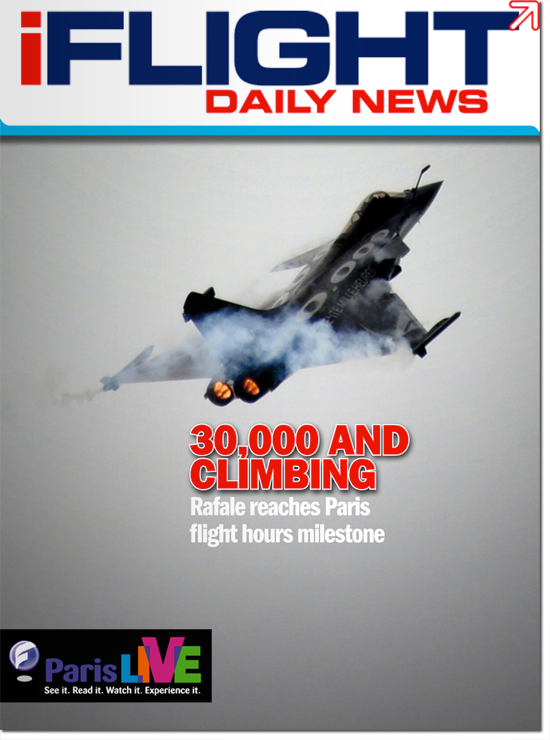
L’engouement de la presse internationale pour la livrée Rafale réalisée par Happy Design Studio est tel, particulièrement en cette période où l’actualité abonde sur le sujet, que de nombreuses agences de presse communiquent en utilisant son image. Ainsi, nous avons décidé de créer une page spéciale dans laquelle nous présentons le traitement de l’information Dassault Rafale par de multiples rédactions et agences de presse. 143 articles.
DÉCEMBRE 2011
ARTICLE N° 118


DÉCEMBRE 2011
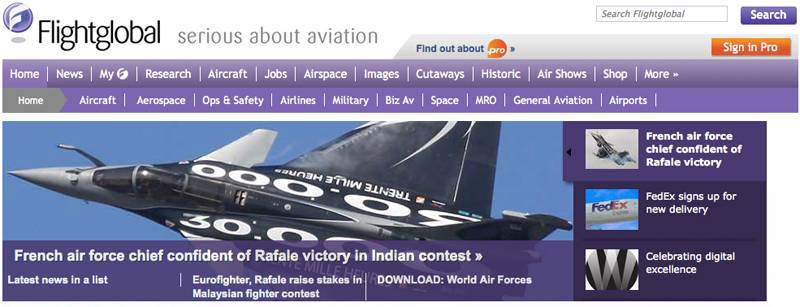
ARTICLE N° 117 / FLIGHT GLOBAL
DÉCEMBRE 2011
ARTICLE N° 116 / FRANCE INFO


DÉCEMBRE 2011
ARTICLE N° 115 / NATION SHIELD


HAPPY DESIGN !!! New Exterior Livery Design to be unveiled at the Dubai Air Show !
HAPPY DESIGN STUDIO to design new livery for MAXIMUS AIR CARGO. Following the stunning presentation of the French Rafale 30 000 Hours Design at the last Paris Air Show and its international echo, Happy Design Studio will unveil the new Design specially created for Maximus Air Cargo’s fleet. French designer Didier Wolff, founding owner of Happy Design Studio, is leaving his first footprints in the United Arab Emirates by designing the new livery for Abu Dhabi- based Maximus Air Cargo as part of the cargo airliner’s new branding strategy. Maximus Air Cargo today operates a fleet comprised of Airbus A300-600, Antonov 124, Ilyushin 76, etc. and has set its ambitions to soon become one of the world’s foremost cargo airliners.
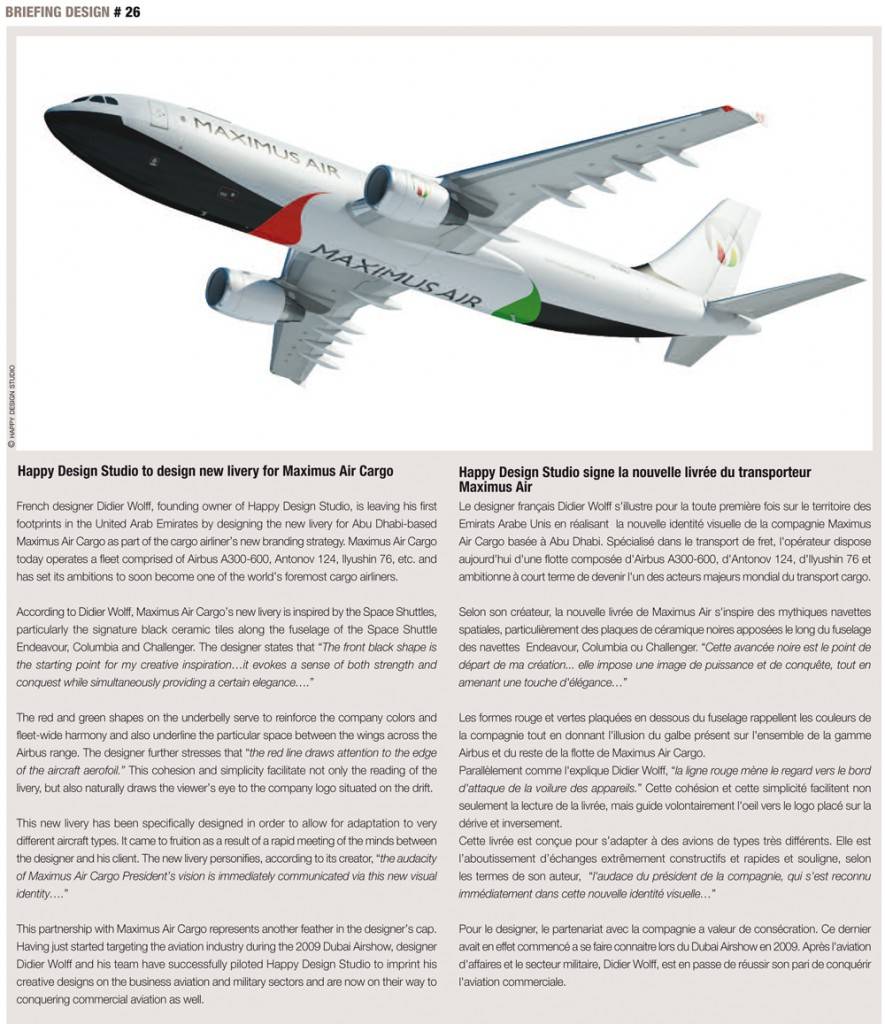
According to Didier Wolff, Maximus Air Cargo’s new livery is inspired by the Space Shuttles, particularly the signature black ceramic tiles along the fuselage of the Space Shuttle Endeavour, Columbia and Challenger. The designer states that “The front black shape is the starting point for my creative inspiration…it evokes a sense of both strength and conquest while simultaneously providing a certain elegance….”
This new livery has been specifically designed in order to allow for adaptation to very different aircraft types. It came to fruition as a result of a rapid meeting of the minds between the designer and his client. The new livery personifies, according to its creator, “the audacity of Maximus Air Cargo President’s vision is immediately communicated via this new visual identity….”
Maximus Air Cargo has been establishing itself as a highly successful operator and the largest all-cargo airline in the UAE, has set itself out from the crowd in recent years. Now the company has further ambitions to become one of the world’s foremost air cargo companies and has embarked on a new marketing strategy to achieve this goal, which includes an alliance with HDS.
As one of the aviation industry’s most creative designer of aircraft liveries Didier Wolff has been working closely with the Abu Dhabi based airline to help shape the Maximus Air Cargo brand for the future.
Fathi Buhazza, President & CEO of Maximus Air Cargo, said: «We have always done business with ambition and innovation, and now we are looking to add even more panache to our business as we aim for an even-bigger share of the global cargo market.
One of Happy Design Studios’ most recent liveries was seen on the Dassault Rafale, which was the star of the flying displays at the Paris Air Show and the Moscow’s Air Show.
Speaking about the alliance Didier Wolff, owner and designer at Happy Design Studio (HDS) said: «As an acknowledged leader in the field aircraft livery
design, we are very excited at the prospect of playing a visual role in re-positioning Maximus to a new level on the global
air cargo stage.»
This partnership with Maximus Air Cargo represents another feather in the designer’s cap. Having just started targeting the aviation industry during the 2009 Dubai Airshow, designer Didier Wolff and his team have successfully piloted Happy Design Studio to imprint his creative designs on the business aviation and military sectors and are now on their way to conquering commercial aviation as well.
DÉCEMBRE 2011
ARTICLE N° 114 / AIR ACTUALITES

NOVEMBRE 2011
ARTICLE N° 113 / THE NEW YORK TIME


NOVEMBRE 2011
Read full article (text version)
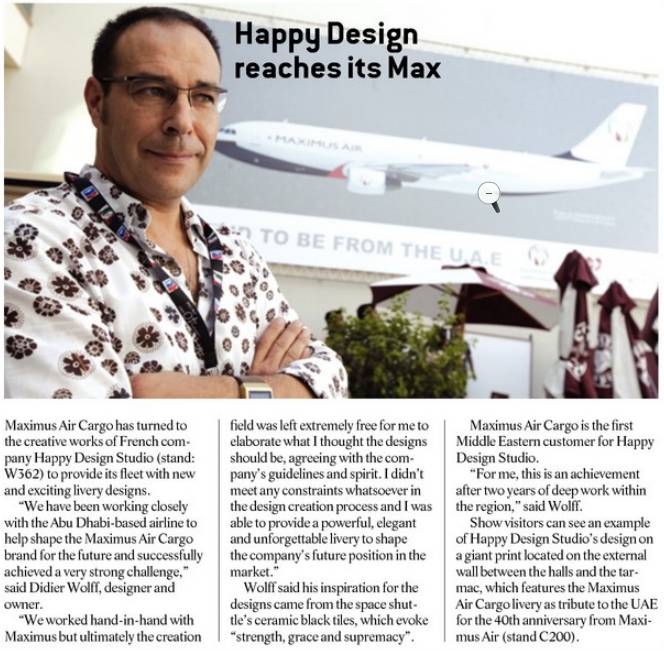
Source :SHOW BUSINESS NEWS ARABIAN AEROSPACE / This article is reproduced for archival purposes. Happy Design reaches its Max Maximus Air Cargo has turned to the creative works of French company Happy Design Studio (stand W36.2) to provide its fleet with new and exciting livery designs. “We have been working closely with the Abu Dhabi-based airline to help shape the Maximus Air Cargo brand for the future and successfully achieved a very strong challenge,” said Didier Wolff, designer and owner. “We worked hand-in-hand with Maximus but ultimately the creation field was left extremely free for me to elaborate what I thought the designs should be, agreeing with the company’s guidelines and spirit. I didn’t meet any constraints whatsoever in the design creation process and I was able to provide a powerful, elegant and unforgettable livery to shape the company’s future position in the market.” Wolff said his inspiration for the designs came from the space shuttle’s ceramic black tiles, which evoke “strength, grace and supremacy.” Maximus Air Cargo is the first Middle Eastern customer for Happy Design Studio. “For me, this is an achievement after two years of deep work within the region,” said Wolff. Show visitors can see an example of Happy Design Studio’s design on a giant print located on the external wall between the halls and the tarmac, which features the Maximus Air Cargo livery as tribute to the UAE for the 40th anniversary from Maximus Air (stand C200).ARTICLE N° 112 / ARABIAN AEROSPACE


NOVEMBRE 2011
Read full article (text version)
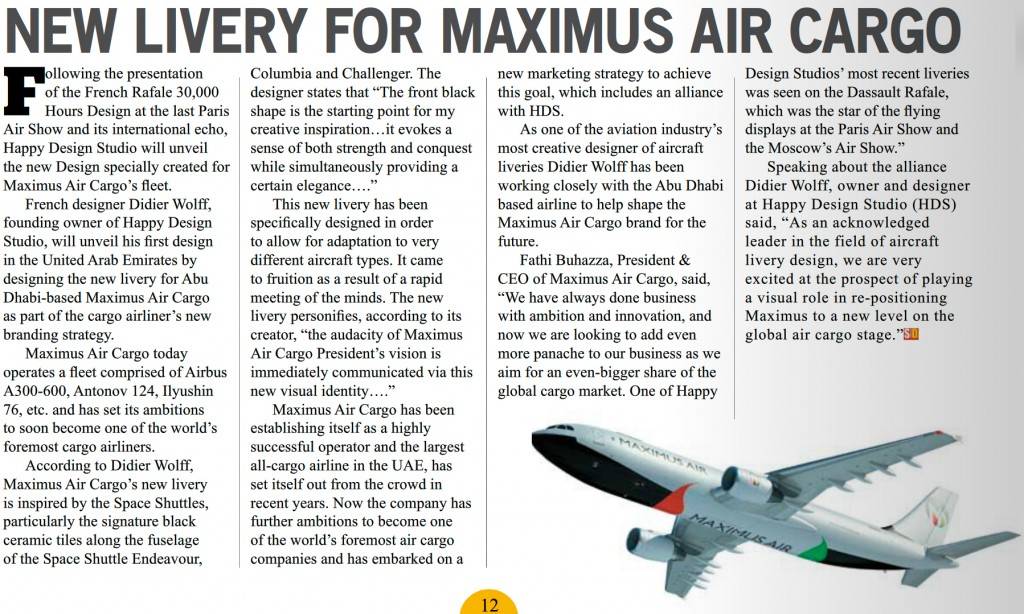
Source SHOW DAILY / This article is reproduced for archival purposes. Following the presentation of the French Rafale 30,000 Hours Design at the last Paris Air Show and its international echo, Happy Design Studio will unveil the new Design specially created for Maximus Air Cargo’s fleet. French designer Didier Wolff, founder and owner of Happy Design Studio, will unveil his first design in the United Arab Emirates by designing the new livery for Abu Dhabi-based Maximus Air Cargo as part of the cargo airliner’s new branding strategy. Maximus Air Cargo today operates a fleet comprised of Airbus A300-600, Antonov 124, Ilyushin 76, etc. and has set its ambitions to soon become one of the world’s foremost cargo airliners. According to Didier Wolff, Maximus Air Cargo’s new livery is inspired by the Space Shuttles, particularly the signature black ceramic tiles along the fuselage of the Space Shuttle Endeavour, Columbia and Challenger. The designer states that “The front black shape is the starting point for my creative inspiration… it evokes a sense of both strength and conquest while simultaneously providing a certain elegance…” This new livery has been specifically designed in order to allow for adaptation to very different aircraft types. It came to fruition as a result of a rapid meeting of the minds. The new livery personifies, according to its creator, “the audacity of Maximus Air Cargo President’s vision is immediately communicated via this new visual identity….” Maximus Air Cargo has been establishing itself as a highly successful operator and the largest all-cargo airline in the UAE, has set itself out from the crowd in recent years. Now the company has further ambitions to become one of the world’s foremost air cargo companies and has embarked on a new marketing strategy to achieve this goal, which includes an alliance with HDS. As one of the aviation industry’s most creative designer of aircraft liveries Didier Wolff has been working closely with the Abu Dhabi-based airline to help shape the Maximus Air Cargo brand for the future. Fathi Buhazza, President & CEO of Maximus Air Cargo, said, “We have always done business with ambition and innovation, and now we are looking to add even more panache to our business as we aim for an even-bigger share of the global cargo market. One of Happy Design Studios’ most recent liveries was seen on the Dassault Rafale, which was the star of the flying displays at the Paris Air Show and the Moscow’s Air Show.” Speaking about the alliance Didier Wolff, owner and designer at Happy Design Studio (HDS) said, “As an acknowledged leader in the field of aircraft livery design, we are very excited at the prospect of playing a visual role in re-positioning Maximus to a new level on the global air cargo stage.”ARTICLE N° 111 / SHOW DAILY DUBAI AIR SHOW


NOVEMBRE 2011
ARTICLE N° 110 / ROYAL AERONAUTICAL SOCIETY

Maximus Air Cargo rebrands and gets new livery
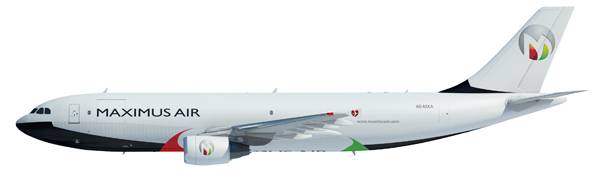
Nope not a A300 spaceplane – but Maximus Air’s new livery.
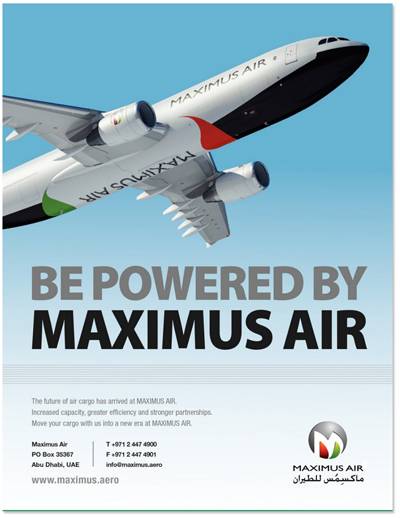
UAE- based cargo airline Maximus Air Cargo has rebranded as Maximus Air, and has also commissioned a new livery from Happy Design Studio, which is quickly notching up a reputation as the go-to aircraft scheme experts. The Maximus scheme, seen above on a poster, was inspired by the Space Shuttle and its iconic thermal tiles.
NOVEMBRE 2011
Read full article (text version)
SOURCE : ULTIMATE JET MAGAZINE BRIEFING DESIGN #26 / This article is reproduced for archival purposes. Happy Design Studio to design new livery for Maximus Air Cargo French designer Didier Wolff, founding owner of Happy Design Studio, is leaving his first footprints in the United Arab Emirates by designing the new livery for Abu Dhabi-based Maximus Air Cargo as part of the cargo airliner’s new branding strategy. Maximus Air Cargo today operates a fleet comprised of Airbus A300-600, Antonov 124, Ilyushin 76, etc., and has set its ambitions to soon become one of the world’s foremost cargo airliners. According to Didier Wolff, Maximus Air Cargo’s new livery is inspired by the Space Shuttles, particularly the signature black ceramic tiles along the fuselage of the Space Shuttle Endeavour, Columbia and Challenger. The designer states that “The front black shape is the starting point for my creative inspiration… it evokes a sense of both strength and conquest while simultaneously providing a certain elegance…” The red and green shapes on the underbelly serve to reinforce the company colors and fleet-wide harmony and also underline the particular space between the wings across the Airbus range. The designer further stresses that “the red line draws attention to the edge of the aircraft aerofoil.” This cohesion and simplicity facilitate not only the reading of the livery, but also naturally draws the viewer’s eye to the company logo situated on the drift. This new livery has been specifically designed in order to allow for adaptation to very different aircraft types. It came to fruition as a result of a rapid meeting of the minds between the designer and his client. The new livery personifies, according to its creator, “the audacity of Maximus Air Cargo President’s vision is immediately communicated via this new visual identity…” This partnership with Maximus Air Cargo represents another feather in the designer’s cap. Having just started targeting the aviation industry during the 2009 Dubai Airshow, designer Didier Wolff and his team have successfully piloted Happy Design Studio to imprint his creative designs on the business aviation and military sectors and are now on their way to conquering commercial aviation as well. Happy Design Studio signe la nouvelle livrée du transporteur Maximus Air Le designer français Didier Wolff s’illustre pour la toute première fois sur le territoire des Emirats Arabes Unis en réalisant la nouvelle identité visuelle de la compagnie Maximus Air Cargo basée à Abu Dhabi. Spécialisé dans le transport de fret, l’opérateur dispose aujourd’hui d’une flotte composée d’Airbus A300-600, d’Antonov 124, d’Ilyushin 76 et ambitionne à court terme de devenir l’un des acteurs majeurs mondiaux du transport cargo. Selon son créateur, la nouvelle livrée de Maximus Air s’inspire des mythiques navettes spatiales, particulièrement des plaques de céramique noire posées le long du fuselage des navettes Endeavour, Columbia ou Challenger. “Cette avancée noire est le point de départ de ma création… elle impose une image de puissance et de conquête, tout en amenant une touche d’élégance…” Les formes rouge et vertes plaquées en dessous du fuselage rappellent les couleurs de la compagnie tout en donnant l’illusion du galbe présent sur l’ensemble de la gamme Airbus et du reste de la flotte Maximus Air Cargo. Parallèlement comme l’explique Didier Wolff, “la ligne rouge mène le regard vers le bord d’attaque de la voilure des appareils.” Cette cohésion et cette simplicité facilitent non seulement la lecture de la livrée, mais guident volontairement l’il vers le logo placé sur la dérive et inversement. Cette livrée est conçue pour s’adapter à des avions de types très différents. Elle est l’aboutissement d’échanges extrêmement constructifs et rapides et souligne, selon les termes de son auteur, “l’audace du président de la compagnie, qui s’est reconnue immédiatement dans cette nouvelle identité visuelle.” Pour le designer, le partenariat avec la compagnie a valeur de consécration. Ce dernier avait en effet commencé à se faire connaître lors du Dubai Airshow en 2009. Après l’aviation d’affaires et le secteur militaire, Didier Wolff est en passe de réussir son pari de conquérir l’aviation commerciale.ARTICLE N° 109 / ULTIMATE JET MAGAZINE


NOVEMBRE 2011
Read full article (text version)
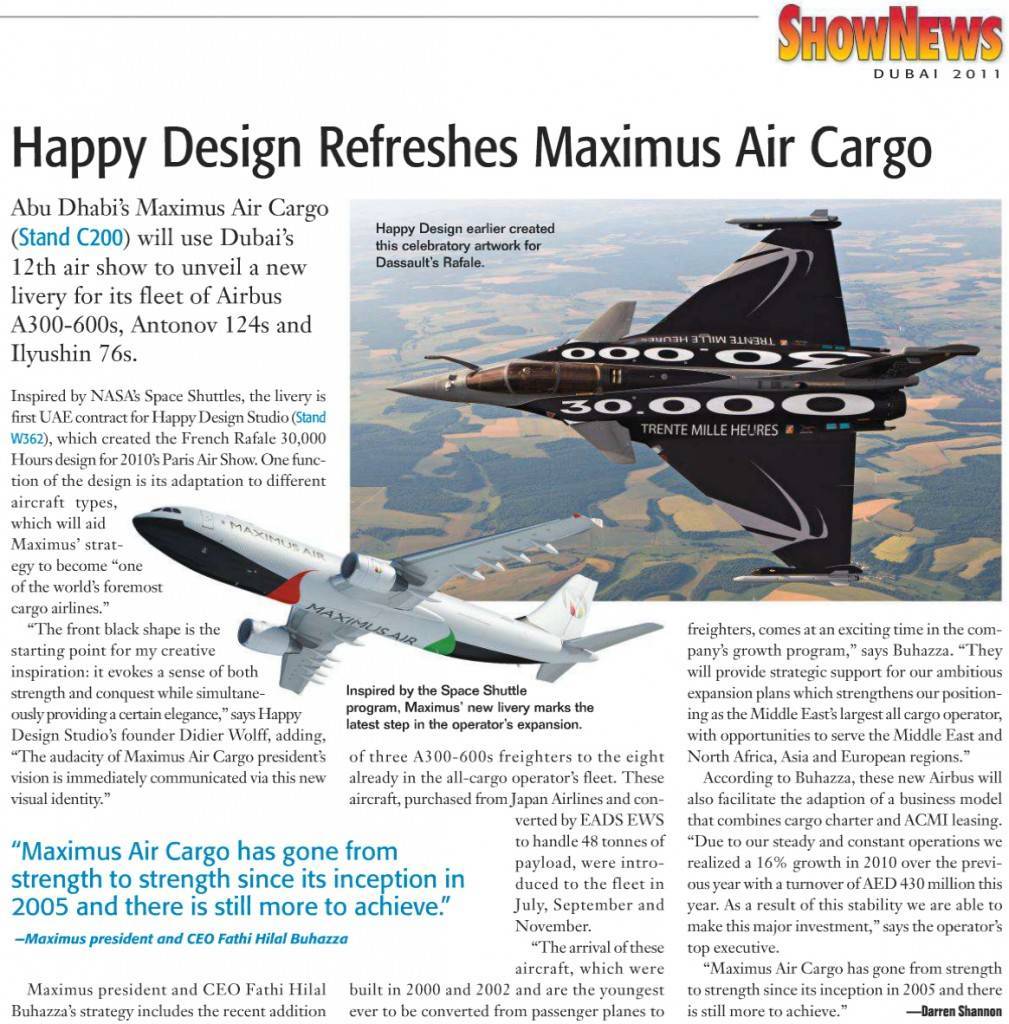
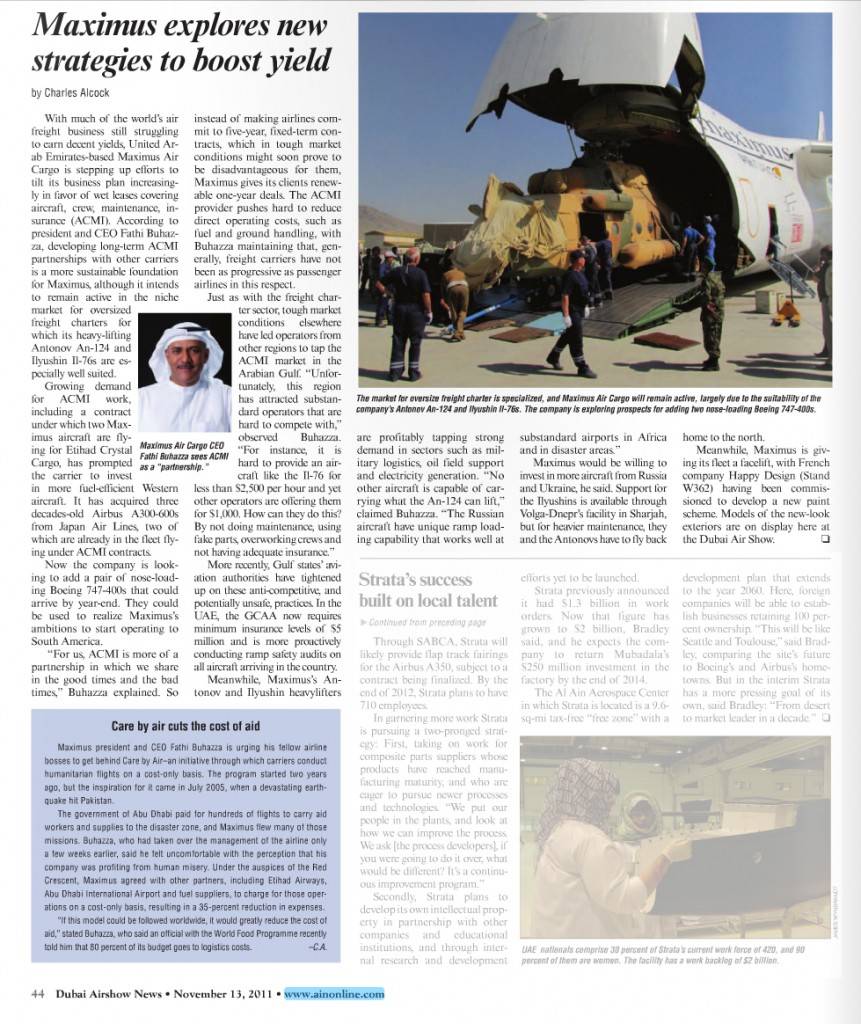
Source : Show News Dubai 2011 / This article is reproduced for archival purposes. Happy Design Refreshes Maximus Air Cargo Abu Dhabi’s Maximus Air Cargo (Stand C200) will use Dubai’s 12th air show to unveil a new livery for its fleet of Airbus A300-600s, Antonov 124s and Ilyushin 76s. Inspired by NASA’s Space Shuttles, the livery is first UAE contract for Happy Design Studio (Stand W362), which created the French Rafale 30,000 Hours design for 2010’s Paris Air Show. One function of the design is its adaptation to different aircraft types, which will aid Maximus’ strategy to become “one of the world’s foremost cargo airlines.” “The front black shape is the starting point for my creative inspiration: it evokes a sense of both strength and conquest while simultaneously providing a certain elegance,” says Happy Design Studio’s founder Didier Wolff, adding, “The audacity of Maximus Air Cargo president’s vision is immediately communicated via this new visual identity.” Inspired by the Space Shuttle program, Maximus’ new livery marks the latest step in the operator’s expansion. The addition of three A300-600s freighters to the eight already in the all-cargo operator’s fleet. These aircraft, purchased from Japan Airlines and converted by EADS EWS to handle 48 tonnes of payload, were introduced to the fleet in July, September and November. “The arrival of these freighters, comes at an exciting time in the company’s growth program,” says Buhazza. “They will provide strategic support for our ambitious expansion plans which strengthens our position as the Middle East’s largest all cargo operator, with opportunities to serve the Middle East and North Africa, Asia and European regions.” According to Buhazza, these new Airbus will also facilitate the adaptation of a business model that combines cargo charter and ACMI leasing. “Due to our steady and constant operations we realized a 16% growth in 2010 over the previous year with a turnover of AED 430 million this year. As a result of this stability we are able to make this major investment,” says the operator’s top executive. “Maximus Air Cargo has gone from strength to strength since its inception in 2005 and there is still more to achieve.” — Maximus president and CEO Fathi Hilal Buhazza nOVEMBRE 2011ARTICLE N° 108 / SHOW NEWS DUBAI AIR SHOW

NOVEMBRE 2011
Read full article (text version)
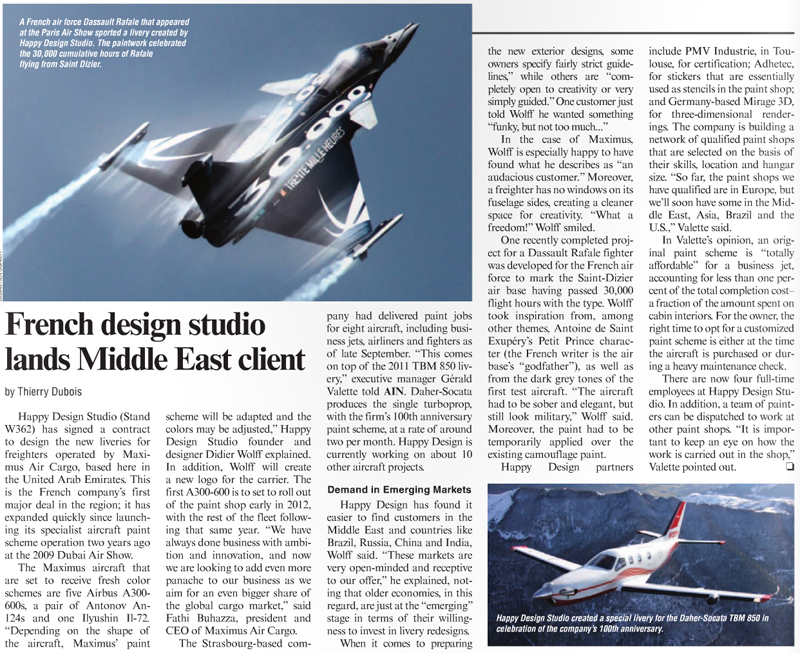
Source : Dubai Air Show News / This article is reproduced for archival purposes. French design studio lands Middle East client by Thierry Dubois Happy Design Studio (Stand W362) has signed a contract to design the new liveries for freighters operated by Maximus Air Cargo, based here in the United Arab Emirates. This is the French company’s first major deal in the region; it has expanded quickly since launching its specialist aircraft paint scheme operation two years ago at the 2009 Dubai Air Show. The Maximus aircraft that are set to receive fresh color schemes are five Airbus A300-600s, a pair of Antonov An-124s and one Ilyushin Il-76. “Depending on the shape of the aircraft, Maximus’ paint scheme will be adapted, and the colors may be adjusted,” Happy Design Studio founder and designer Didier Wolff explained. In addition, Wolff will create a new logo for the carrier. The first A300-600 is set to roll out with the new paint shop early next year, with the rest of the fleet following in the same year. “We have always done business with ambition and innovation, and now we are looking to add even more panache to our business as we aim for an even bigger share of the global cargo market,” said Fathi Buhazza, president and CEO of Maximus Air Cargo. The Strasbourg-based company had delivered paint jobs for eight aircraft, including business jets, airliners and fighters as of late September. This comes on top of the 2011 TBM 850 livery; executive manager Gérard Valette told AIN. Daher-Socata produces the single turboprop with the firm’s 100th anniversary paint scheme, at a rate of around two per month. Happy Design is currently working on about 10 other aircraft projects. The new exterior designs, some owners specify fairly strict guidelines; while others are “completely open to creativity or very simply guided.” One customer just told Wolff he wanted something “funky, but not too much.” In the case of Maximus, Wolff especially happy to have found what he describes as “an audacious customer.” Moreover, a freighter has no windows on its fuselage sides, creating a cleaner space for creativity. “What a freedom!” Wolff smiled. One recently completed project for a Dassault Rafale fighter was developed for the French air force to mark the Saint-Dizier air base having passed 30,000 flight hours with the type. Wolff took inspiration from, among other themes, Antoine de Saint Exupéry’s Petit Prince character (the French writer is the air base’s “godfather”), as well as the dark grey tones of the first test aircraft. “The aircraft had to be sober and elegant, but still military,” Wolff said. Moreover, the paint had to be temporarily applied over the existing camouflage paint. Happy Design’s most recent liveries include PMV Industrie, in Toulouse, for certification; Adhetec, for stickers that are essentially used as stencils in the painting; and Germany-based Mirage 3D, for three-dimensional renderings. The company is building a network of qualified paint shops that are selected on the basis of their skills, location and hangar size. “So far, the paint shops we have qualified are in Europe, but we’ll soon have some in the Middle East, Asia, Brazil and the U.S.,” Valette said. In Valette’s opinion, an original paint scheme is “totally affordable” for a business jet, accounting for less than one percent of the total completion cost – a fraction of the amount spent on cabin interiors. For the owner, the right time to opt for a customized paint scheme is either at the time the aircraft is purchased or during a heavy maintenance check. There are now four full-time employees at Happy Design Studio. In addition, a team of three can be dispatched to work at other paint shops. “It is important to keep an eye on how the work is carried out in the shop,” Valette pointed out. Demand in Emerging Markets Happy Design has found it easier to find customers in the Middle East and countries like Brazil, Russia, China and India, Wolff said. “These markets are very open-minded and receptive to our offer,” he explained, noting that older economies, in this regard, are just at the “emerging” stage in terms of their willingness to invest in livery redesigns. When it comes to preparing new exterior designs, some owners specify fairly strict guidelines; while others are completely open to creativity or very simply guided. Caption: A French air force Dassault Rafale that appeared at the Paris Air Show sported a livery created by Happy Design Studio. The paintwork celebrated the 30,000 cumulative hours of Rafale flying from Saint Dizier. Caption: Happy Design Studio created a special livery for the Daher-Socata TBM 850 in celebration of the company’s 100th anniversary.ARTICLE N° 107 / DUBAI AIRSHOW NEWS


NOVEMBRE 2011
ARTICLE N° 106 / DUBAI AIRSHOW NEWS


NOVEMBER 2011
ARTICLE N° 105 / ARAB AVIATION

French Design Studio lands Middle East Clients
Saturday, November 12 2011
Abu Dhabi, Maximus Air will be unveiled to the public at the Dubai Air Show, as the company’s President and Chief Executive announced a new name and brand identity for the all-cargo airline, alongside details of an exciting growth strategy.
In its first six years of operation, Maximus Air Cargo has established itself as a the region’s foremost regional air cargo carrier and cargo aircraft ACMI lease operator, employing close to 250 staff. Now, as Maximus Air, says Fathi Hilal Buhazza, President and CEO, the time is right for the next big step forward.
“Having grown from a local operator to a regional operator with some international trade, we are now ready to turn that business model on its head, “he said. “We have a lofty ambition, and that is to become one of the top three players in the global air cargo market.
“To achieve this we need to forge long term partnerships rather than being just a cargo operator, and therefore a larger fleet, and a more diverse range of services have to be introduced,” he adds. “This is one of the reasons we engaged the services of one of the aviation industry’s most creative designers of aircraft liveries, Happy Design Studio (HDS) in France to help shape the company’s brand within the context of this new strategy.
Buhazza adds that Maximus Air is looking to add seven new aircraft to the fleet by 2015, bringing the number to 15.
“The Airbus A300-600RP2F forms the core of the current fleet, but we are looking at all types, including Boeing 747-400s to give us greater range, increased flexibility and operational efficiency,” he said.”We are also looking to diversify through mergers, acquisition and/or strategic partnerships in a number of different areas ranging from consultancy to brokerage and from storage to delivery with the aim of giving us better control of all aspects of the logistics chain rather than having to rely on third parties.
Buhazza adds that the company is also looking to change its business mix by increasing its geographic footprint.
“At present 50 per cent of our business comes from within the UAE and 50 per cent from outside the country,” he said. “We want the mix to be 80/20 in favour of international markets and so we are looking to the fast growing regions of the Mahgreb, Africa, Asia and South America.”
As an Abu Dhabi based company, Maximus is ideally located to serve the former of these fast growing markets and the airline’s expansion plans dovetail with the Abu Dhabi 2030 economic vision, whereby the government is looking to create a suitable business environment to enable the aviation sector – and therefore Maximus Air to flourish.
“We are looking west to the Mahgreb, which will open up North West Africa and provide the springboard into South America, while from the Far East, our Abu Dhabi hub provides a route through to Morocco to complete the link,” Buhazza said.
Market forecasts predict that worldwide air cargo is expected to triple over the next 20 years with the strongest growth from Asia and within Asia, while all-freighter operators will increase to represent 66 per cent of all air cargo by 2029.
Buhazza says that while the market forecasts are bullish, the uncertainty around the global economic recovery and within that context the cost of fuel is still paramount. “Therefore it is our view that a lot of air cargo carriers will use ACMI, one of Maximus Air’s USPs,” he said. “Flying for client airlines around the world on medium and long-term contracts, using our own crew and AOC, we can assure clients of: high dispatch reliability, advanced aircraft, experienced crews, comprehensive maintenance and spare parts support and a focus on reducing operating costs.
“We have gained significant experience in operating scheduled cargo services on behalf of a diverse range of airlines, including a long term relationship with Etihad which was recently extended. A new deal with another global company, to be announced at the Dubai Air Show, will reinforce our capability in this arena.”
Buhazza said that there had been very few developments in the cargo business over the last few decades and Maximus Air aims to leverage its existing business to grow to nearly double the existing size by 2015.
“We have come a long way, very quickly, very successfully and I am pleased to say, very profitably in our six years of operation,” he concludes. “We have made a profit each and every year and in the last 30 months alone, our turnover has grown by 250 per cent. So in this new growth strategy we are setting ourselves some very challenging goals, which I am confident we can achieve and in the not too distant future, Maximus Air will be amongst the top brands in this industry.”
NOVEMBRE 2011
ARTICLE N° 104 / FLIGHT GLOBAL

DUBAI: Designer details new Maximus Air Cargo livery
06:32 15 Nov 2011
French designer Didier Wolff, founding owner of Happy Design Studio, is leaving his first footprints in the United Arab Emirates by designing the new livery for Abu Dhabi-based Maximus Air Cargo as part of the cargo airline’s branding strategy.
Wolff said Maximus Air Cargo’s new livery is inspired by the Space Shuttle, particularly the signature black ceramic tiles along the fuselage. “The front black shape is the starting point for my creative inspiration it evokes a sense of both strength and conquest while simultaneously providing a certain elegance,” said the designer.
“The audacity of the Maximus Air Cargo president’s vision is immediately communicated via this new visual identity.”
NOVEMBRE 2011
ARTICLE N° 103 / NATION SHIELD

NOVEMBRE 2011
Read full article (text version)
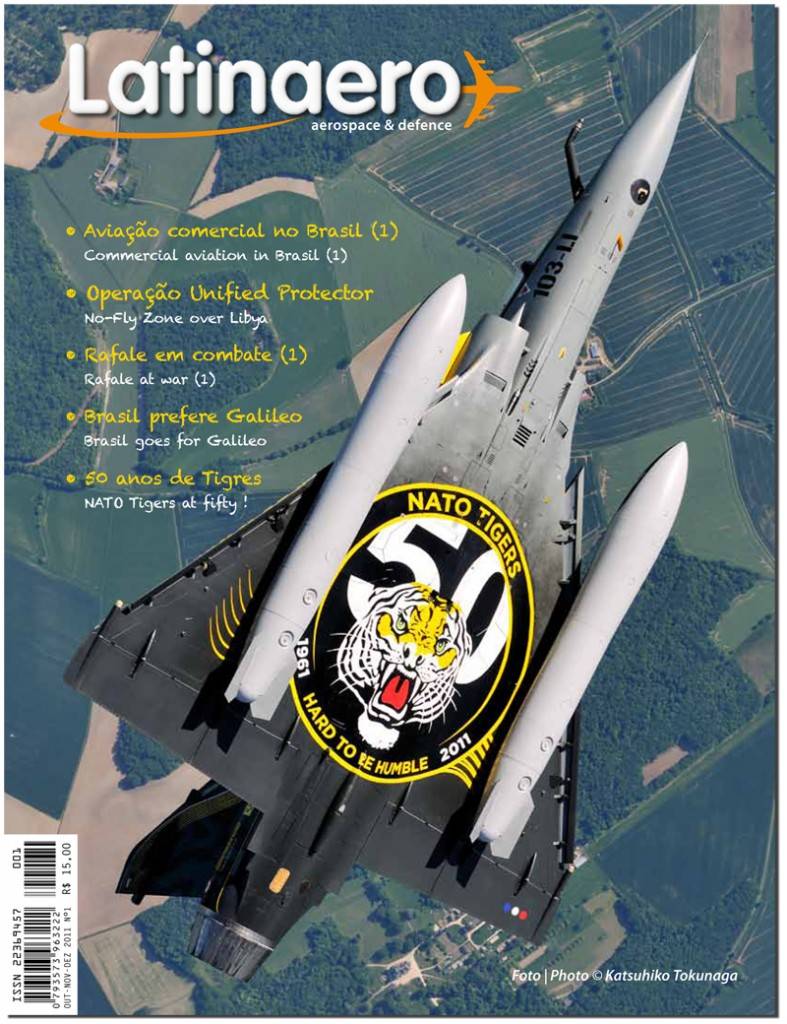
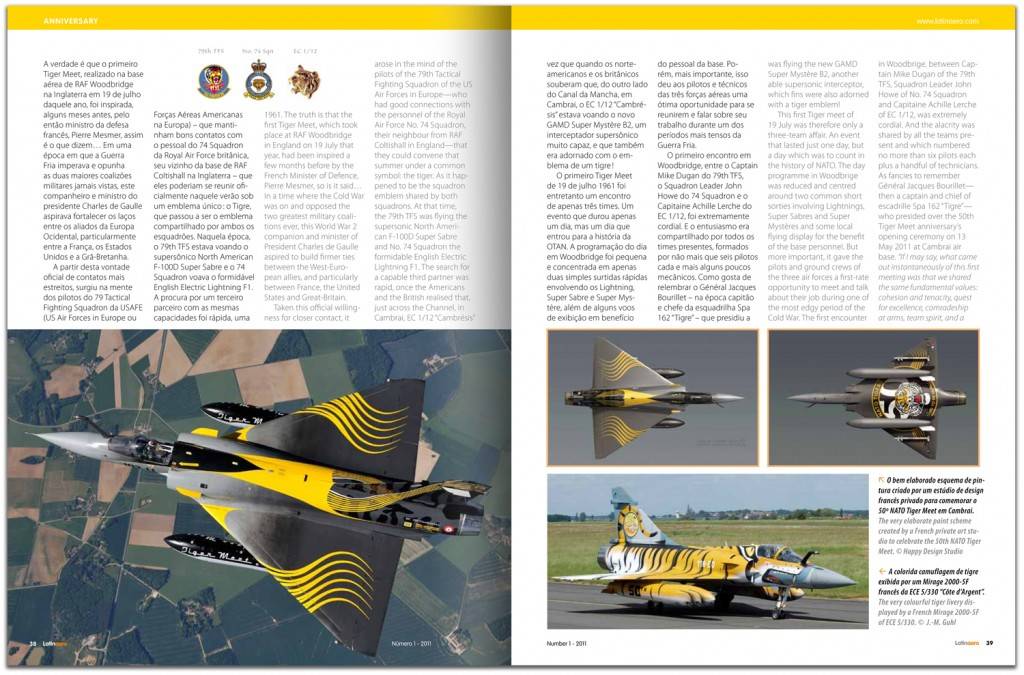
Source :LATINAERO / This article is reproduced for archival purposes. Europa — como também aeronaves do esquadrão nº 74 da Royal Air Force britânica — participaram do encontro com caças F-86 Sabre e F-100 Super Sabre, representando uma força aérea moderna e altamente capacitada para a época. Com o passar dos anos, o Tiger Meet passou a incorporar cada vez mais nações e aeronaves, transformando-se num dos eventos mais emblemáticos da aviação militar internacional. Em 1961, a realidade é que o primeiro Tiger Meet não foi um grande evento político. O contexto era o início da Guerra Fria e, embora os Estados Unidos e o Reino Unido fossem aliados próximos, ainda havia um certo nível de cautela nas cooperações militares. No entanto, com o tempo, o evento evoluiu para se tornar um símbolo de cooperação entre forças aéreas, refletindo a crescente integração militar entre os países da OTAN. Ao longo das décadas seguintes, o Tiger Meet cresceu significativamente, tanto em número de participantes quanto em complexidade. A introdução de aeronaves como o F-100 Super Sabre, Jaguar e Lightning trouxe novas capacidades ao encontro, elevando o nível técnico e operacional das demonstrações. Mais recentemente, o evento tem sido palco para demonstrações de novas aeronaves e esquemas de pintura especiais, que celebram a identidade dos esquadrões participantes. Um exemplo notável é o Mirage 2000 com pintura especial desenvolvida para o Tiger Meet, incorporando elementos visuais marcantes que refletem o espírito do evento. Hoje, o Tiger Meet continua a ser uma celebração única da aviação militar, reunindo pilotos e aeronaves de diferentes países num ambiente de camaradagem e excelência operacional.ARTICLE N° 102 / LATINAERO


NOVEMBRE 2011
ARTICLE N° 101 AVIAO REVUE


NOVEMBRE 2011
ARTICLE N° 100 / AVIA REVUE


OCTOBRE 2011
ARTICLE N° 99 / LE MONDE

OCTOBRE 2011
ARTICLE N° 98 / AVIATION REPORT


IL DASSAULT RAFALE SPECIAL COLOUR 30000 ORE DI VOLO DELL’ARMEE DE L’AIR
Tutti conoscono il romanzo “Il Piccolo Principe” del famous scrittore ed aviatore francese Antoine de Saint Exupéry. He Commander Antoine de Saint Exupéry served in the French aeronautical service as he piloted Air Base 113 Saint Dizier during the second World War.
His death, which occurred on 31 July 1944 off Corsica in the Tyrrhenian Sea, was shrouded in mystery for many years until the discovery in 2008 of the wreckage of his plane, a Lockheed P-38 Lightning reconnaissance fighter, shot down by a Messerschmitt. BF- German 109 fighter.
Saint Dizier air base (Base Aerienne) 113, named after the French writer, is currently the military airport of the Armée de l’Air with more examples of the Dassault fighter currently in service.
The following departments are based at this airport:
– Fighter Squadron 01.091 Gascony (Rafale-ASMPA)
– Fighter Squadron 01.007 Provence (Rafale)
– Transformation Squadron Rafale 02.092 Aquitaine (Rafale)
– Ground Air Defense Squadron 05.950 “Barrois” (Crotale NG, Mistral, 20mm cannoni)
Just this year the local airshow had the “Little Prince” as its distinctive symbol.
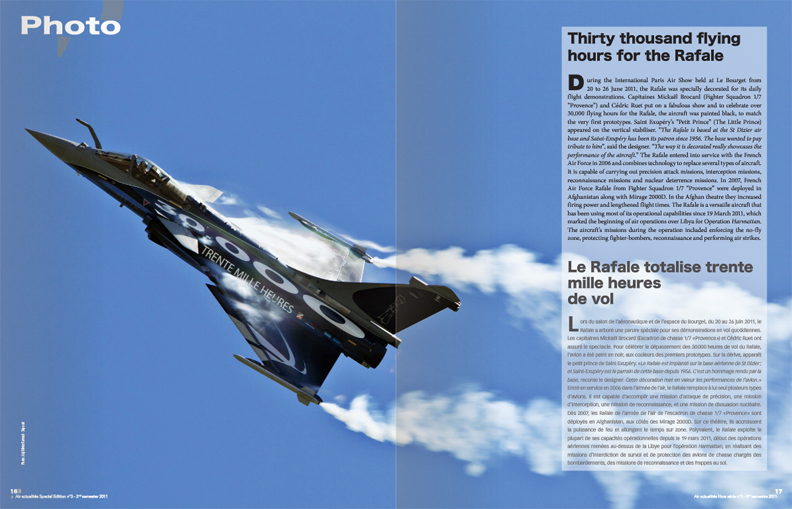
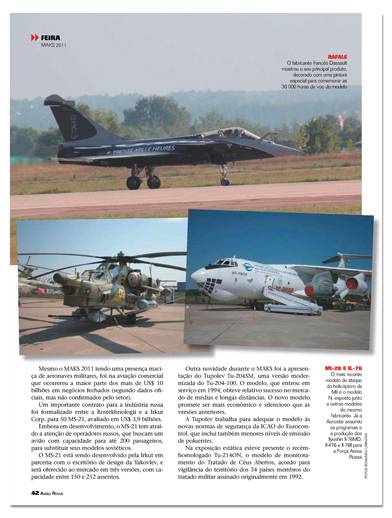
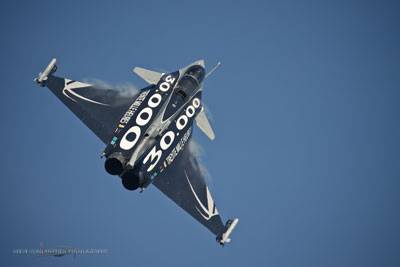
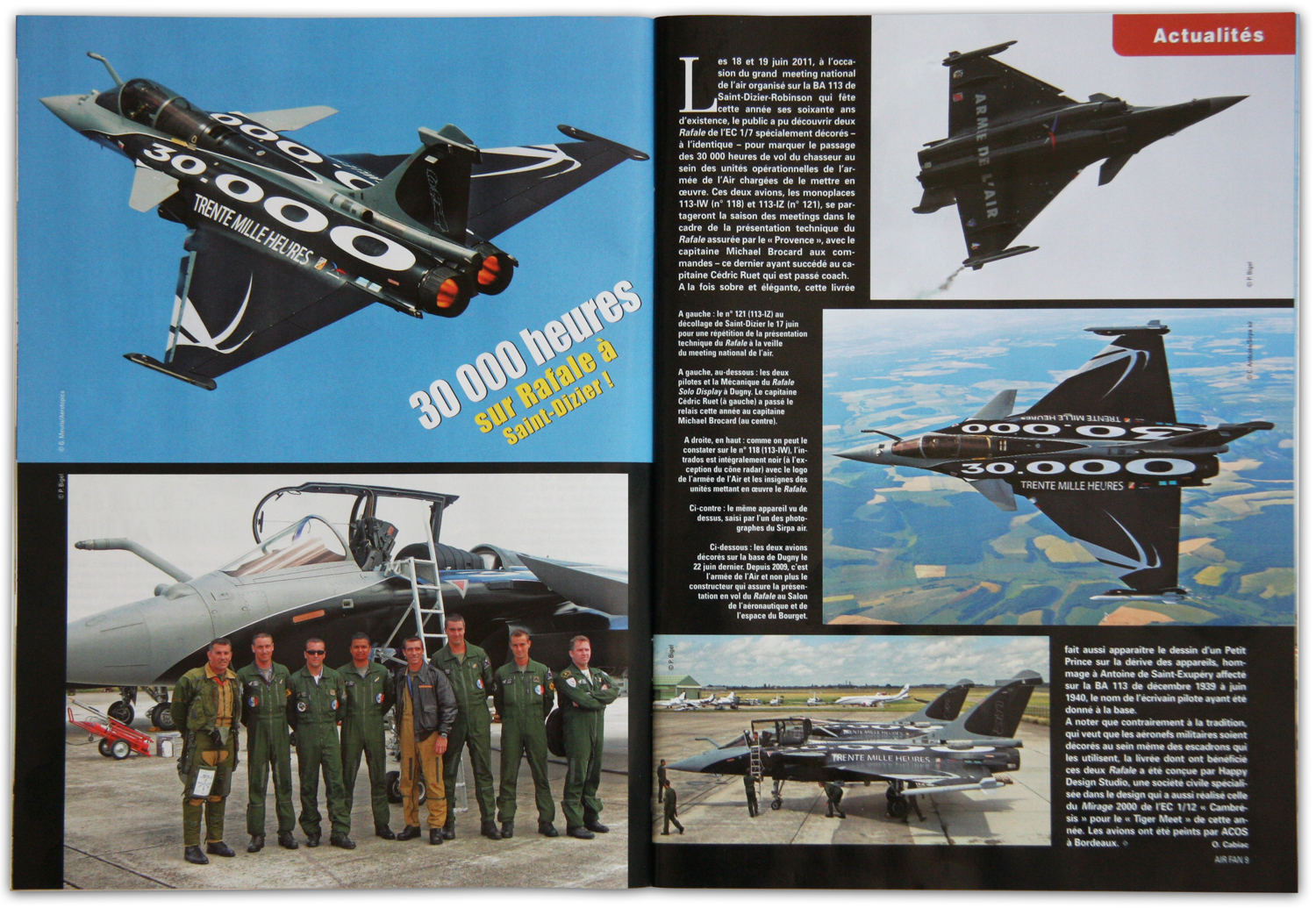
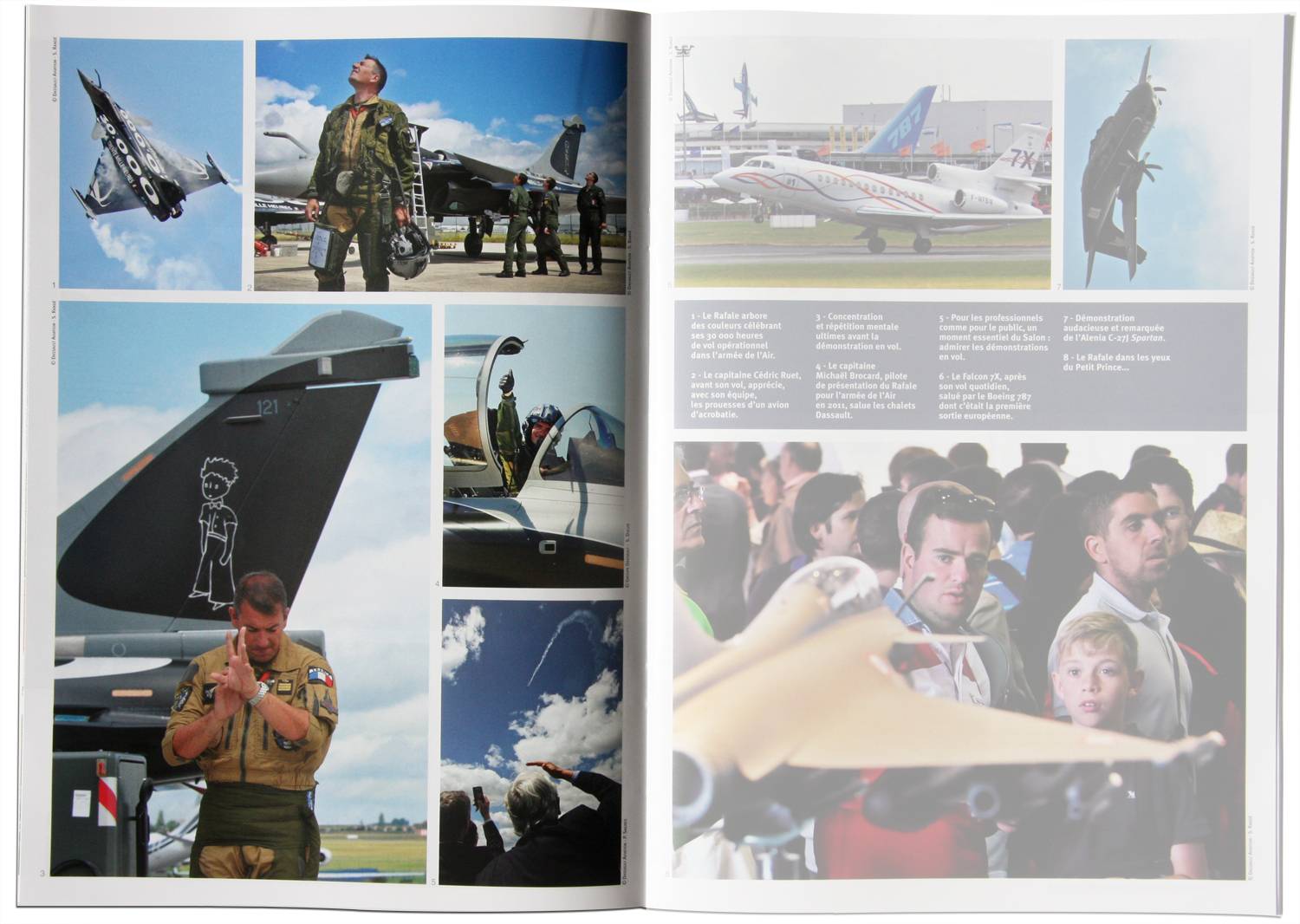
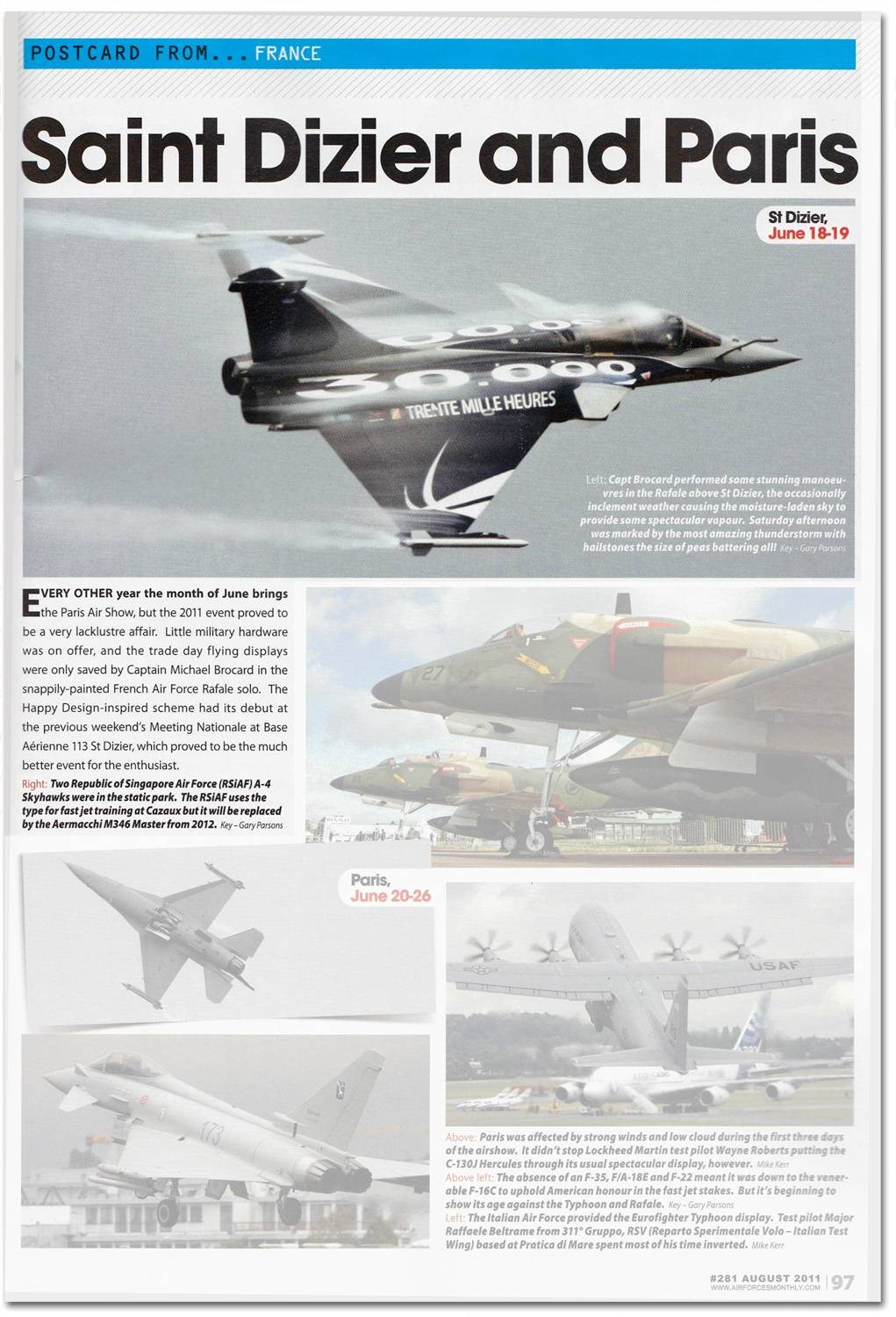
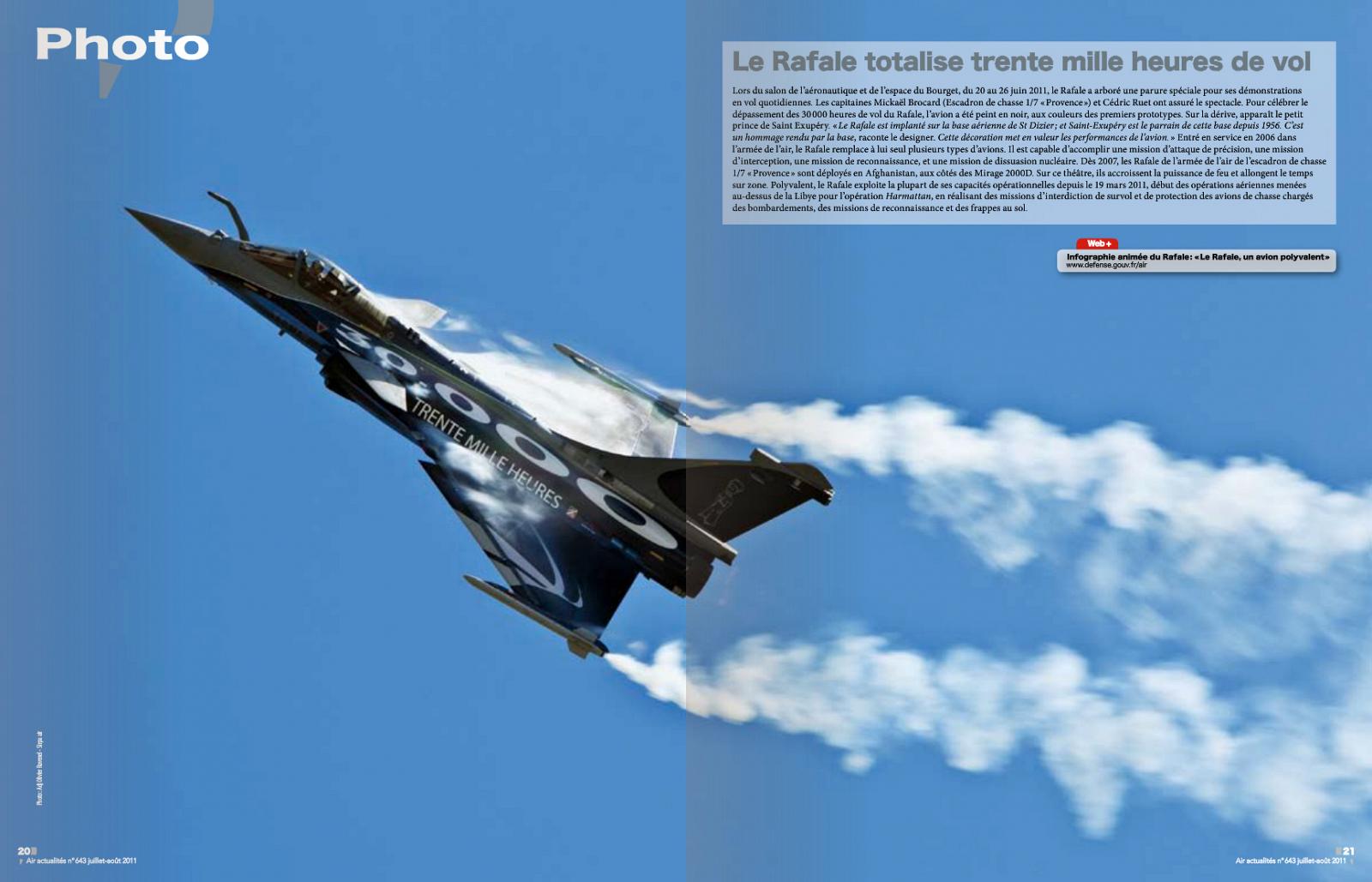
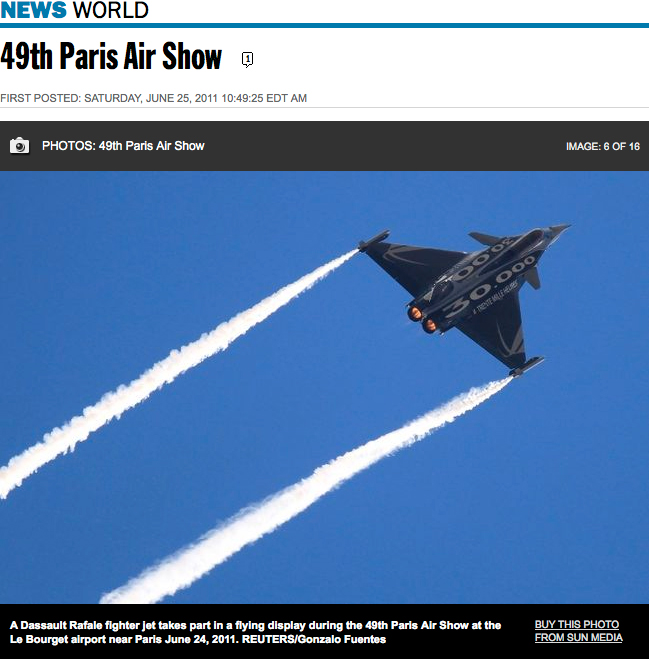
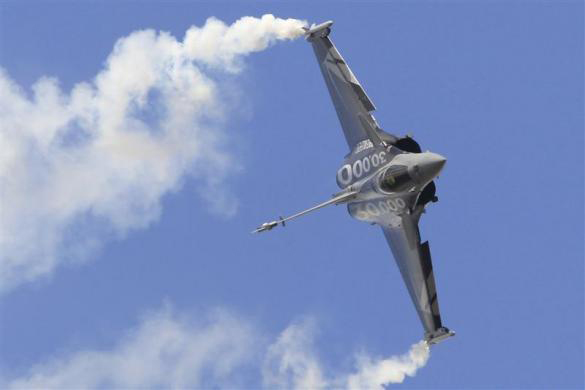
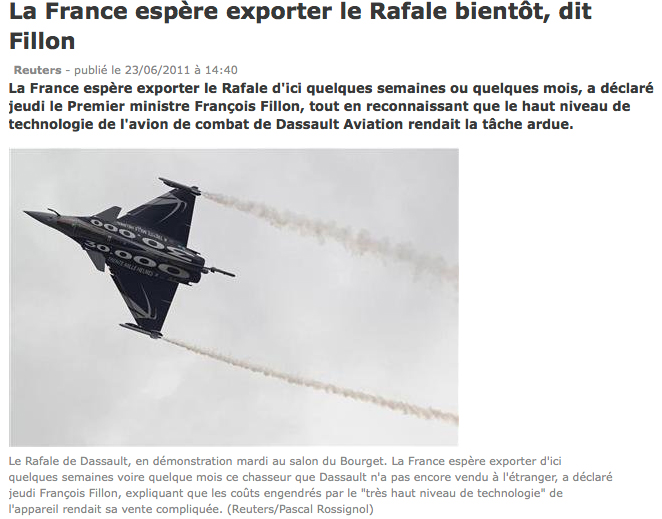
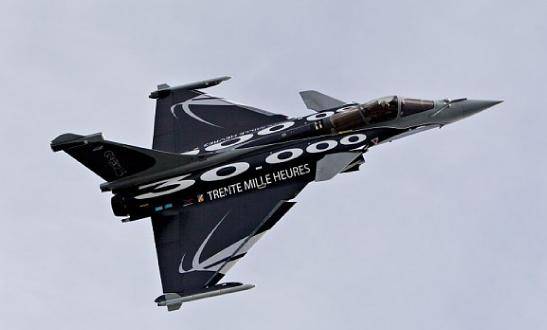
For this occasion – and also to celebrate the achievement of the 30,000 flight hours of the Dassault Rafale aircraft – two airplanes were painted in special color livery. The aircraft were presented to the public and subsequently participated in major international air shows such as the RIAT in Fairford, the MAKS in Russia, and the Paris Le Bourget Air Show.
Display pilot 2011 is captain Mickael Brocard of the Escadron de chasse 1/7 Provence.
The task of designing and creating the special color livery went to the Happy Design Studio in Strasbourg, not new to the creation of special liveries for airplanes and helicopters, both military and civil.
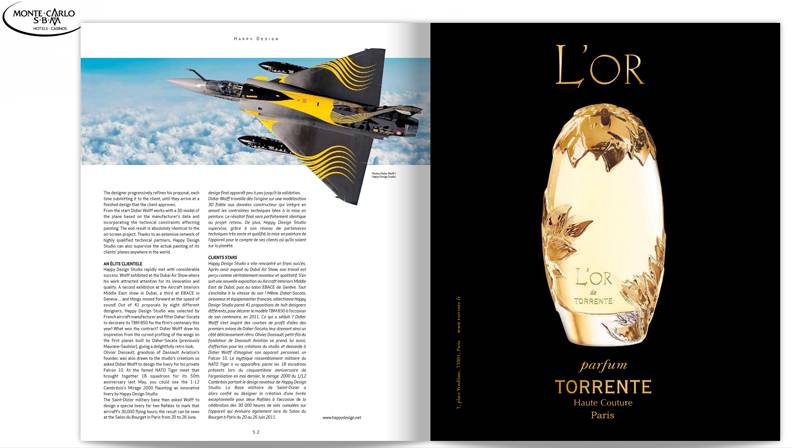
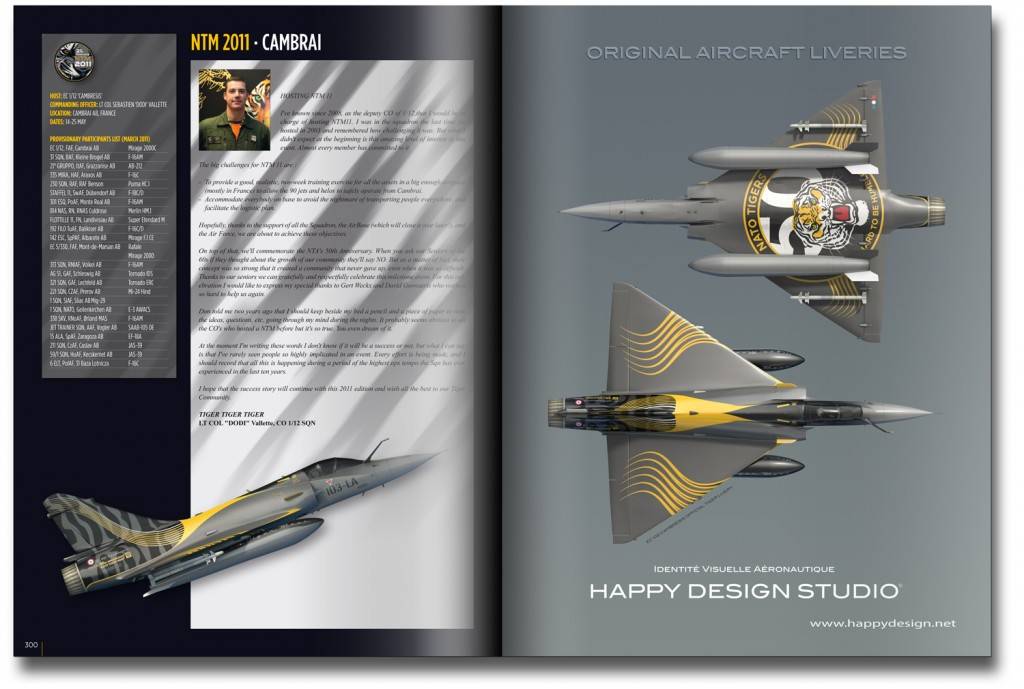
We also remember – among others – the creation of the Mirage 2000 special color of the EC.1 / 12 Cambresis for the celebrations of the 50th Anniversary of the NATO Tiger Meet Association. The Dassautl Rafale aircraft is a multipurpose fighter that can carry out attack, reconnaissance, interception and deterrence missions with nuclear weapons, which entered service in 2006 in the French Air Force will replace most of the fighters currently in service. Together with the Mirage 2000D, the Rafale has been employed in Afghanistan since 2007 and as of March 19, 2011 it went into action on Libya as part of the Harmattan operation.
We recommend watching the very special and interesting video on the creation of the Rafale 30,000 hours Special Colors in full screen.
SEPTEMBRE 2011
Read full article (text version)
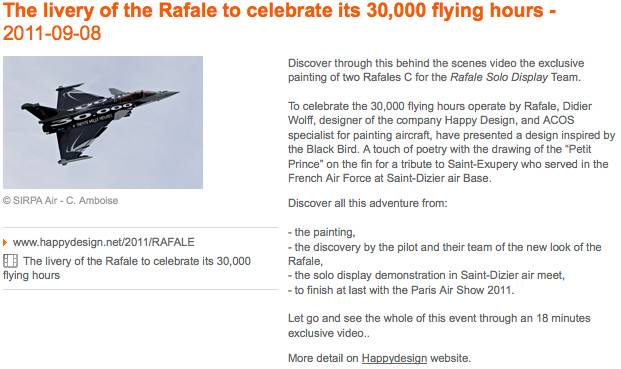
Source : Dassault Aviation / This article is reproduced for archival purposes. The livery of the Rafale to celebrate its 30,000 flying hours – 2011-09-08 Discover through this behind the scenes video the exclusive painting of two Rafales C of the Rafale Solo Display Team. To celebrate the 30,000 flying hours operated by Rafale, Didier Wolff, designer of the company Happy Design, and ACOS specialist for painting aircraft, have presented a design inspired by the Black Bird. A touch of poetry with the drawing of the “Petit Prince” on the fin for a tribute to Saint-Exupéry who served in the French Air Force at Saint-Dizier Air Base. Discover all this adventure from: the painting, the discovery by the pilot and their team of the new look of the Rafale, the solo display demonstration in Saint-Dizier air meet, to finish at last with the Paris Air Show 2011. Let go and see the whole of this event through an 18 minutes exclusive video… More detail on HappyARTICLE N° 97 / DASSAULT AVIATION


SEPTEMBRE 2011
Read full article (text version)
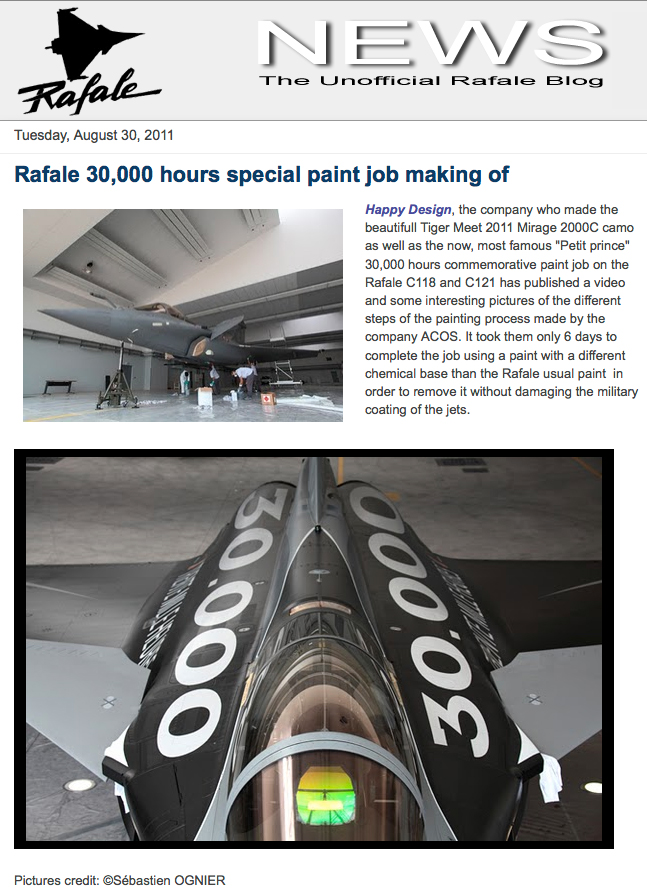
Source : Rafale Blog / This article is reproduced for archival purposes. RAFALE BLOGTuesday, August 30, 2011 Rafale 30,000 hours special paint job making of Happy Design, the company who made the beautiful Tiger Meet 2011 Mirage 2000C camo as well as the now, most famous “Petit prince” 30,000 hours commemorative paint job on the Rafale C118 and C121 has published a video and some interesting pictures of the different steps of the painting process made by the company ACOS. It took them only 6 days to complete the job using a paint with a different chemical base than the Rafale usual paint in order to remove it without damaging the military coating of the jets. Pictures credit: ©Sébastien OGNIERARTICLE N° 96 / RAFALE BLOG

SEPTEMBRE 2011
ARTICLE N° 95 / AL ARABYA NEWS


SEPTEMBRE 2011
ARTICLE N° 94 / CAVOK ASAS DE INFORMACAO


SEPTEMBRE 2011
ARTICLE N° 93 / KEY AERO
Read full article (text version)
Source: KEY AERO / This article is reproduced for archival purposes. Video: The making of the “Happy Design” Rafales Gary Parsons – 24-Aug-2011 Strasbourg-based Happy Design Studio created the unique and original livery for the French Air Force Dassault Rafale solo display aircraft, one of the leading displays at the 2011 Paris Air Show. Happy Design Studio creates and designs aircraft livery designs, not just for military aircraft but also for commercial aircraft, business aircraft, private jets and helicopters. The livery that appears on two of the French Air Force’s Rafales was debuted at Saint-Dizier in June and shows the fictional character “le petit Prince”, written by French author Saint Exupery. He served in the French Army at Base Aerienne 113 Saint Dizier, the current home of the largest number of Rafales in France. Happy Design Studio was invited to create a livery for the Rafale to celebrate 30,000 hours of flying by the aircraft from the base. Designer Didier Wolff saw the opportunity to pay tribute to Saint Exupery by representing the “petit prince” on the tail. The aircraft was featured on the cover of the September issue of AirForces Monthly. This is not the first occasion that Happy Design Studio has been involved with military aircraft. Earlier this year the studio was chosen to create the livery for the EC 1/12 Cambresis Mirage 2000C for the 50th Anniversary of the NATO Tiger Association. Speaking about the design, Didier Wolff said: “It was a great honor to be asked to create a design for the Rafale, especially as it is for such a prestigious occasion, the celebration of 30,000 flight hours. I am delighted that visitors to Saint-Dizier and subsequently Le Bourget had the opportunity to take a close look at the aircraft.” The Rafale was also seen at the Royal International Air Tattoo at RAF Fairford in July and MAKS 2011 in August.

SEPTEMBRE 2011
ARTICLE N° 92 / FLIEGER WEB


Custom color Dassault Rafale
August 26, 2011
France’s Air Force keeps their Solo Display Rafale in a special livery, designed by Strasbourg-based Happy Design Studio.
Two machines are kept in this coat of paint and have been impressing hundreds of thousands of spectators at air shows since June with their impressive flight program. In addition to the Little Prince on the fin, the Rafale also bears the inscription 30,000, which stands for the flight hours flown by the almost 100 Rafale fighter jets. The two demonstration machines are regularly stationed at the Saint Dizier base, where the pilot and writer Saint Exupery, who wrote the fairy tale The Little Prince, was also stationed. This year, the Rafale fighter jet made major appearances at the Paris Air Show, at the MAKS in Moscow and at the International Air Tattoo in Fairford.
SEPTEMBRE 2011
Read full article (text version)
Source : ASAS NOTCIAS AÉREAS / This article is reproduced for archival purposes. Happy Design cria pintura comemorativa das 30 mil horas de serviço do Rafale Quem esteve no 49 Salão Aeroespacial de Le Bourget, em junho último, em Paris (França), com certeza teve seu olhar cativado pelo caça Dassault Rafale ostentando um elegante esquema especial de pintura, comemorando as 30 mil horas de voo em serviço nos esquadres da Base Aérea de Saint-Dizier, da Armée de l’Air (AdlA, Força Aérea francesa). Apesar de ser comum ver, nesse tipo de evento, avies com pinturas ilustrativas ou comemorativas de marcas e aniversários, em muitos casos as artes são elaboradas sem um estudo de design, com elementos colocados na aeronave de forma aleatória. Em alguns casos, a mensagem só é transmitida para o público quando o avião está em voo ou então a quantidade de informaçes é tão grande que o essencial se perde entre tantos detalhes. Mas não foi o que se viu no belíssimo Rafale em Le Bourget. E isso porque a ave da Dassault teve tratamento de especialistas. Pensando num segmento em constante expansão, foi criada a Happy Design Studio, empresa de Strasbourg (França), especializada na concepção de pinturas comemorativas e personalizadas para aeronaves de todos os portes e tipos, civis e militares. “Meu trabalho requer que eu ouça atentamente e capture toda a essência do que o meu cliente deseja em relação à pintura de seu avião. Isso vai guiar a natureza das propostas artísticas e garantir que todos os requisitos sejam atendidos”, explica Didier Wolff, fundador da empresa. Depois de ouvir o cliente, diz ele, é necessário olhar com cuidado os detalhes da aeronave, pois, além de servirem como inspiração, são eles que definem a sua própria personalidade. Então, Wolff dá início à concepção da arte. No caso do Rafale, a exigência era que a pintura fosse temporária, mas cobrisse as asas e quase toda a fuselagem, dando ainda mais elegância ao caça, sem tirar seu aspecto de aeronave militar. Além disso, Wolff teria que escolher a dedo as bases das tintas, para que as mesmas não alterassem a camuflagem da aeronave quando fossem removidas. Apesar da Happy Design ser responsável apenas por conceber a arte, seus profissionais acompanharam todo o processo de pintura, para que tudo fosse conforme planejado. Em apenas cinco dias, dois Rafale (um monoplace e um biplace) foram pintados e entregues à AdlA. Essa não foi a primeira vez que a Happy Design projetou a pintura de um caça da AdlA; neste ano, um Mirage 2000D do EC 1/2 Cambresis, que foi o anfitrião da TigerMeet 2011, recepcionou os esquadres de caça participantes ostentando esta elegante pintura comemorativa. FOTOS DE KATSUHIKO TOKUNAGA / DACACT INC 22 www.revistaasas.com.br ASASARTICLE N° 91 / ASAS


SEPTEMBRE 2011
ARTICLE N° 90 / AIR FORCES MONTHLY


JUILLET 2011
ARTICLE N° 89 / MILITARY AEROSPACE INTERNAL SECURITY


JUILLET 2011
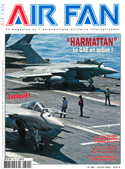
ARTICLE N° 88 / AIR FAN


JUILLET 2011
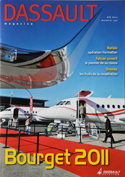
ARTICLE N° 87 / DASSAULT MAGAZINE


JUILLET 2011
ARTICLE N° 86 / AIR INTERNATIONAL


JUILLET 2011
ARTICLE N° 85 / AEROSPACE


JUILLET 2011
ARTICLE N° 84 / AIR FORCES MONTHLY


JUILLET 2011
ARTICLE N° 83 / AIR FAN


JUILLET 2011
Read full article (text version)
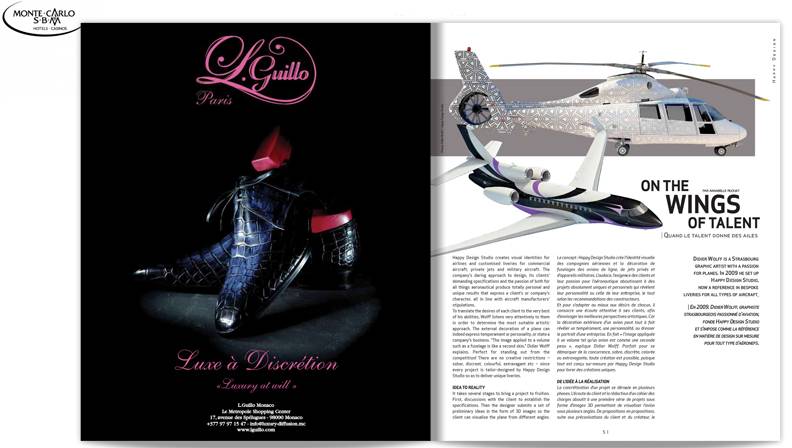
Source : Monte Carlo Society / This article is reproduced for archival purposes. ON THE WINGS OF TALENT Happy Design Studio founder Didier Wolff creates special aviation liveries for aircraft, private jets and military aircraft. The company designs special markings, graphics and imagery coordinated with the specific aircraft, its geometry, mission and brand, creating unique visual impact that appears elegant in the air, yet remains consistent with manufacturing constraints. In aviation, the surface of each aircraft is the key to the success of a design. Didier Wolff explains that every aircraft is unique: the tapered nose, the air intake shape, the wing sweep and the tail design all contribute to its personality. The designer must capture that personality and transform it into a coherent visual language. Didier Wolff says that the design process always begins with listening carefully to the client. From there he develops several artistic proposals, always ensuring that operational and maintenance requirements are respected. IDEA TO REALITY If basic shapes and lines give project its foundation, design must also take into account the practical realities. The designer works closely with engineers and technicians to ensure the concept can actually be applied to the aircraft structure. A key challenge is that many liveries must be temporary. Paint must not damage the aircraft’s base coating and must be removable without altering the original camouflage or protective layers. CLIENTS Happy Design Studio has worked on projects for both civil and military aviation. Among the best-known projects are the Rafale commemorative livery celebrating 30,000 flight hours of the Saint-Dizier squadrons and special paint schemes for Mirage 2000 aircraft during Tiger Meet exercises. The studio also develops customized designs for private jets and VIP aircraft, where aesthetics, brand identity and aerodynamics must coexist. JUIN 2011ARTICLE N° 82 / MONTE CARLO SOCIETY


JUILLET 2011
ARTICLE N° 81 / AVIATION BUZZ


JUIN 2011
ARTICLE N° 80 / LE FIGARO


JUIN 2011
ARTICLE N° 79 / PARIS AIRSHOW NEWS


JUIN 2011
Read full article (text version)
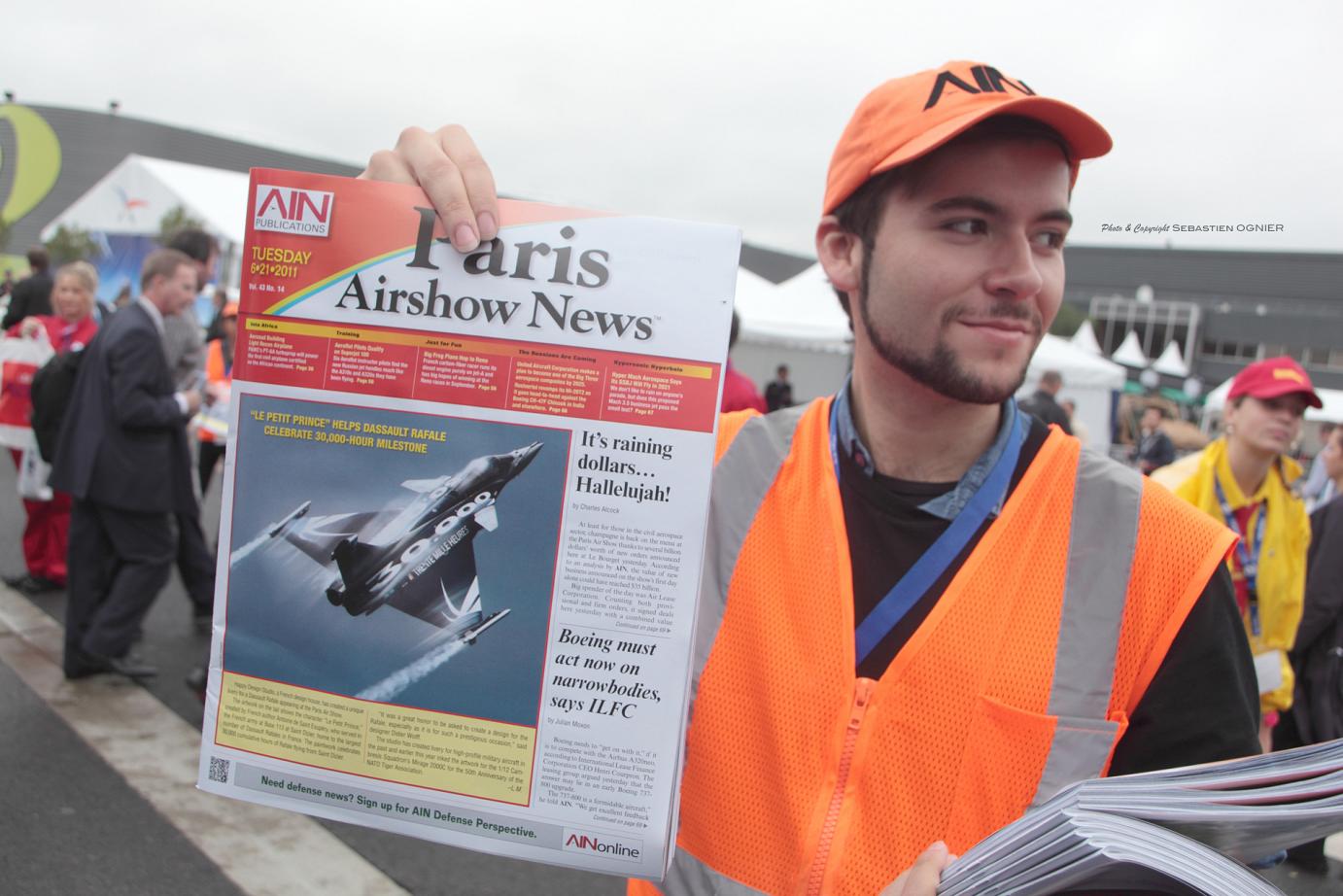
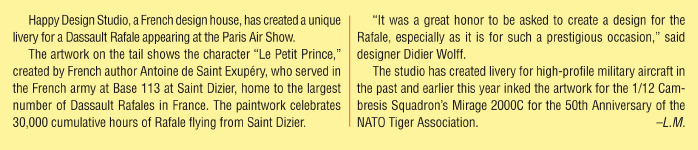
Source : Paris AirShow News / This article is reproduced for archival purposes. Happy Design Studio, a French design house, has created a unique livery for a Dassault Rafale appearing at the Paris Air Show. The artwork on the tail shows the character “Le Petit Prince,” created by French author Antoine de Saint-Exupéry, who served in the French air arm based at Saint-Dizier, home to the largest number of Dassault Rafales in France. The paintwork celebrates 30,000 cumulative hours of Rafale flying from Saint-Dizier. “It was a great honor to be asked to create a design for the Rafale, especially as it is for such a prestigious occasion,” said designer Didier Wolff. The studio has created liveries for high-profile military aircraft in the past and earlier this year inked the artwork for the 1/12 Cambrésis Squadron’s Mirage 2000C for the 50th Anniversary of the NATO Tiger Association.ARTICLE N° 78 / PARIS AIR SHOW NEWS


JUIN 2011
Read full article (text version)
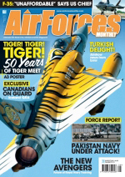
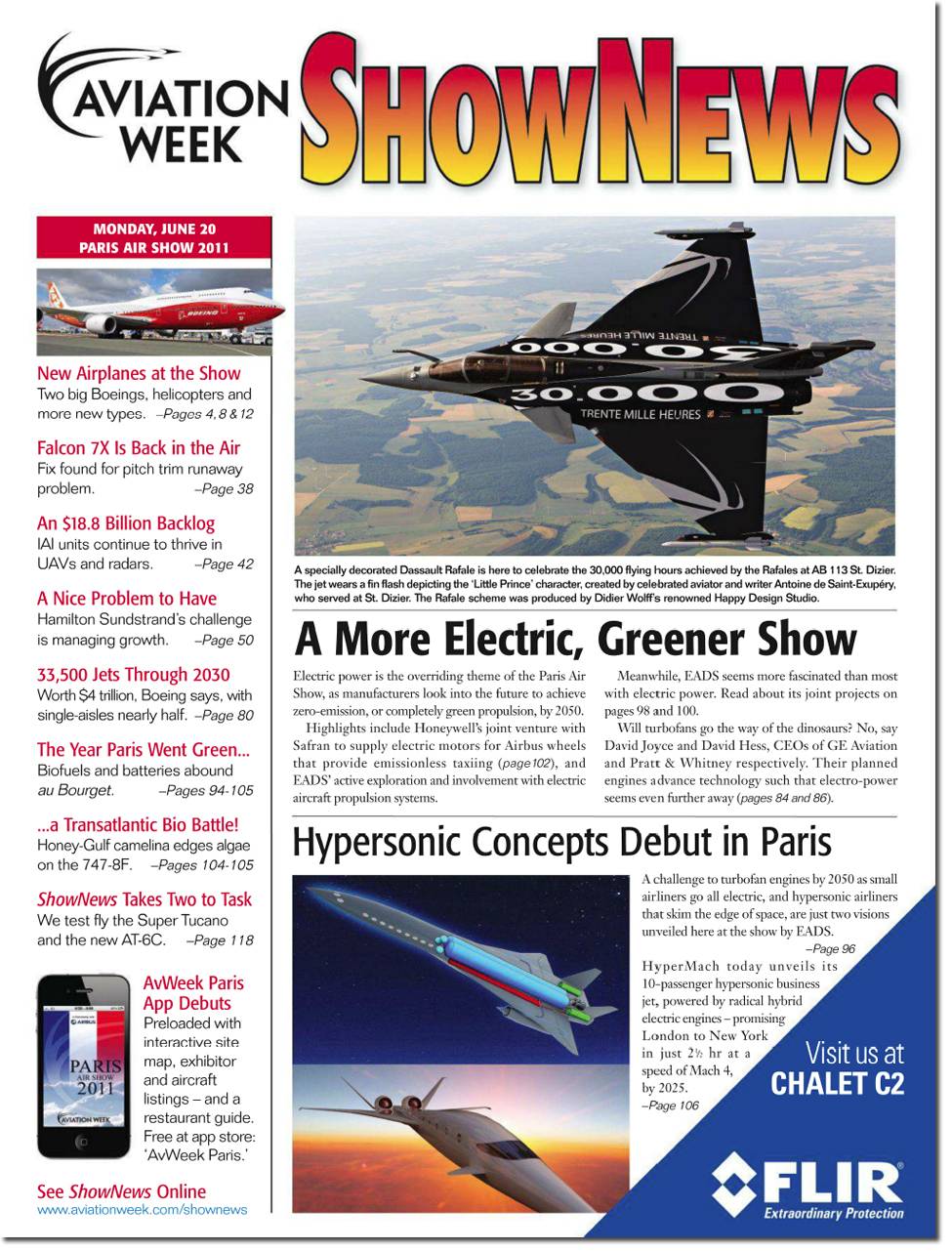
Source : Aviation Show News / This article is reproduced for archival purposes. A specially decorated Dassault Rafale is here to celebrate the 30,000 flying hours achieved by the Rafales at AB 113 St. Dizier. The jet wears a fin flash depicting the “Little Prince” character, created by celebrated aviator and writer Antoine de Saint-Exupéry, who served at St. Dizier. The Rafale scheme was produced by Didier Wolff’s renowned Happy Design Studio.ARTICLE N° 77 / AVIATION WEEK SHOW NEWS

JUIN 2011
ARTICLE N° 76 / AIR & COSMOS


JUIN 2011
ARTICLE N° 75 / SHOW DAILY NEWS


JUIN 2011
ARTICLE N° 74 / FLIGHT CORPORATE


JUIN 2011
ARTICLE N° 73 / EUROPE 1

JUIN 2011
ARTICLE N° 72

JUIN 2011
ARTICLE N° 71 / NEW DAY


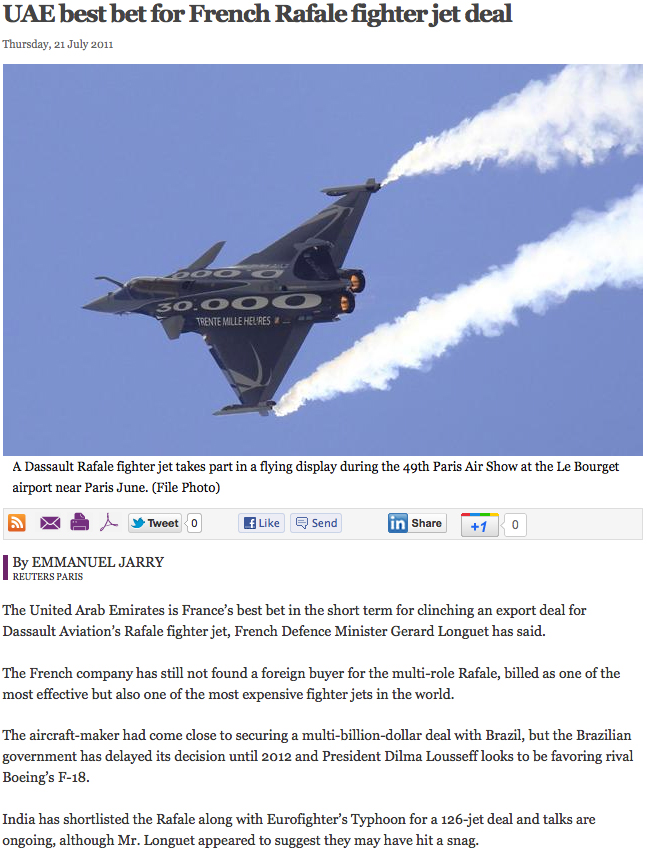
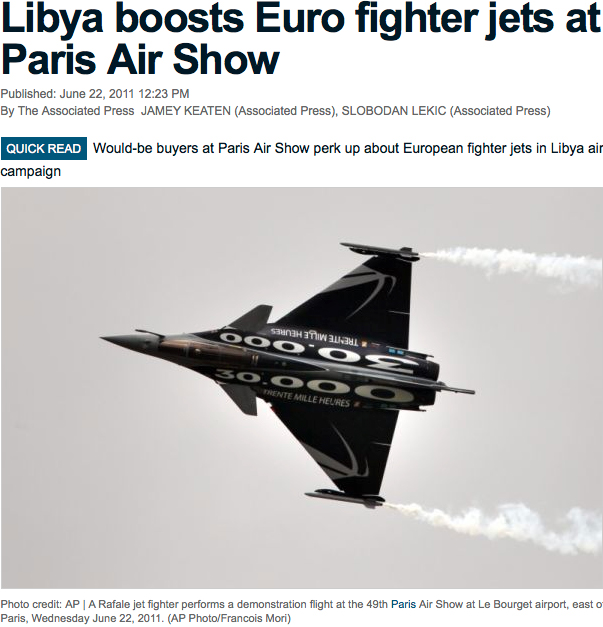
(AP) — In the war in Libya, the French Rafale fighter jet has nearly done it all: no-fly zone enforcement, air-to-ground strikes, reconnaissance, overflight missions. One thing the plane has never done is sell overseas. The Rafale and a European market rival, the Typhoon, have been among standout performers in the NATO air campaign against Moammar Gadhafi’s forces — offering an unexpected…
JUIN 2011
ARTICLE N° 70 / TORONTO SUN


JUIN 2011
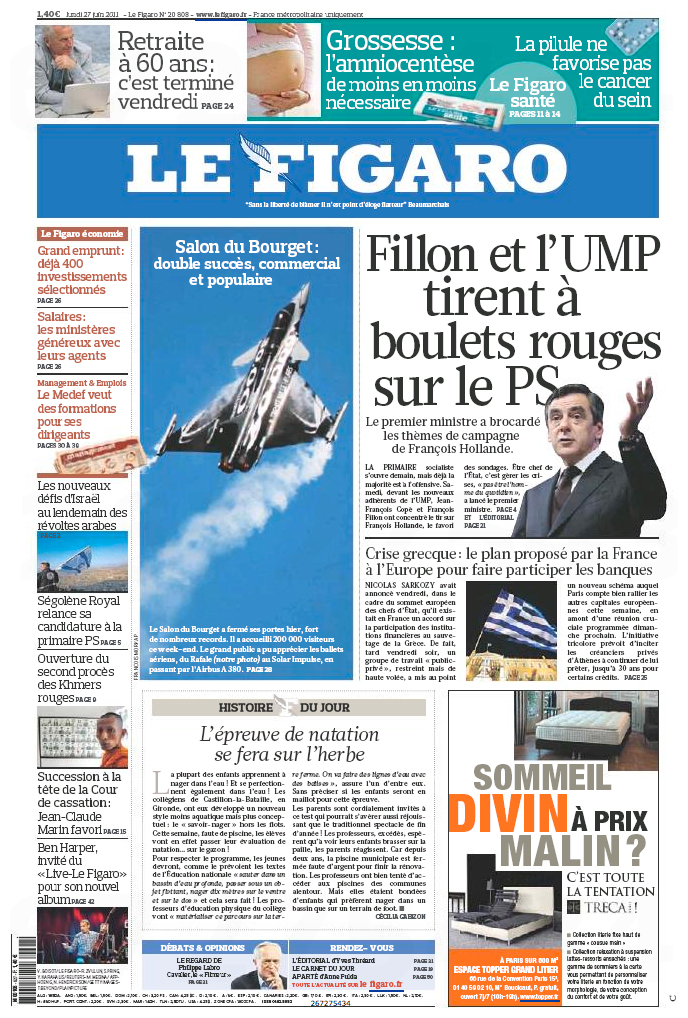
ARTICLE N° 69 / LE FIGARO


The general public can admire this weekend at the Paris Air Show the flight demonstrations of the Rafale and the Eurofighter. In the background, a very tough commercial battle.
Always popular with professionals, the flight demonstrations of combat aircraft are even more popular with the general public to whom the Paris Air Show opened its doors on Friday for three days. These “lords” of the air, concentrated in very high technology, will deliver breathtaking presentations in deafening noise.
This year, it is the European fighters – the Dassault Aviation Rafale and the Eurofighter from the EADS-BAE Systems-Finmeccanica trio – which occupy the field. The Americans were discreet by bringing the F-15 and the F-16 but not the Boeing F-18 Superhornet or the Lockheed F-22 Raptor. The Russians are conspicuous by their absence while the new Sino-Pakistani JF-17 withdrew a few days before the opening of the show.
In civil aeronautics, the commercial battle was animated by a festival of orders. In the military, it’s different because trade shows are not the preferred place to sign contracts. Both the negotiations are long and complex. On the other hand, foreign delegations, including export prospects, flocked to Le Bourget.
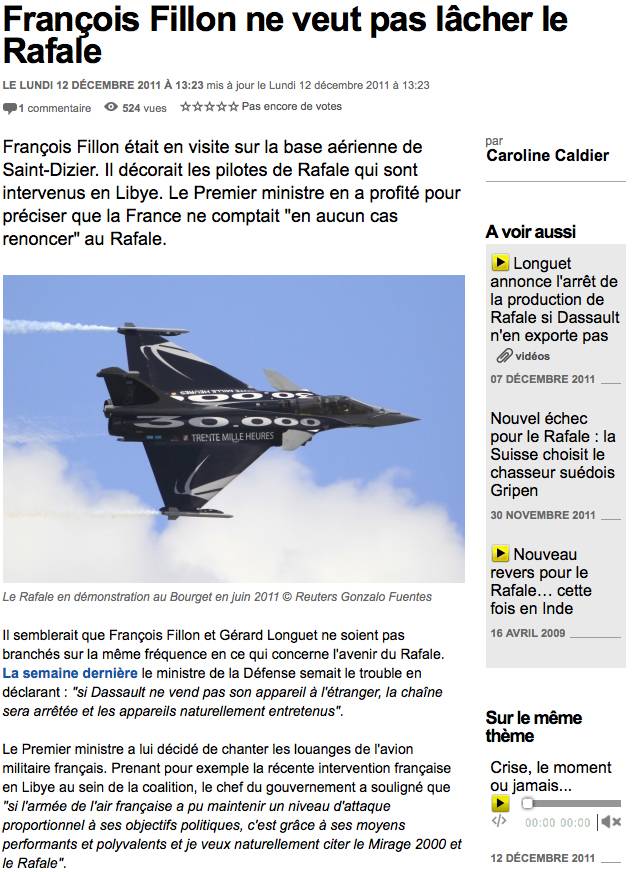
For France, the stakes are high. The Rafale irrigates the industrial fabric, particularly in Ile-de-France and Aquitaine. The French hunter employs 500 industrial partners and represents more than 8,000 jobs. Nicolas Sarkozy, last Monday, and François Fillon, Thursday, lingered on the stand of the Air Force.
Intense competition
“We are making every effort to help Dassault Aviation market this aircraft, it is obviously difficult because it is a very high level of technology aircraft,” said the Prime Minister. The competition is “extremely tough with the United States” too, “we are not hiding any of these difficulties (…) but we have good hopes of succeeding in exporting the Rafale in the coming weeks or months”. A hope fueled by ongoing negotiations, particularly with the United Arab Emirates. This, at a time when the Rafale is demonstrating the extent of its capabilities and versatility – air support, reconnaissance, deep strikes, ground-to-air missions… – since the start of operations in Libya where it is on the front line. Charles Edelstenne, CEO of Dassault Aviation, remained cautious. “I never give news until it is firm and sure. (…) For the moment we are in the hold and we are rowing”, he declared.
JUIN 2011
ARTICLE N° 68 / L’EXPRESS


At the end of April, India retained the Rafale and the Typhoon from the European consortium Eurofighter for a contract for 126 combat aircraft worth a total of 11 billion dollars (7.7 billion euros).
In Brazil, to which France hopes to sell 36 Rafales, Dilma Rousseff’s arrival as president of the country in early 2011 probably postponed the decision until next year, while negotiations are also underway with the United Arab Emirates.
“We are making every effort to help Dassault Aviation market this plane, it is obviously difficult because it is a plane with a very high level of technology”, said François Fillon during a press briefing at the air show in Paris. Bourget after having visited it.
The financial and technological investment necessary for the implementation of the Rafale weapons system “is reserved for a few countries that have the means”, he observed, also citing the “extremely tough” competition with the United States. United.
“We are not concealing any of these difficulties, but the discussions we have initiated with several countries are still ongoing and we have good hopes of being able to successfully export the Rafale to one of these countries in the coming weeks or months,” said Francois Fillon.
The CEO of Dassault Aviation declined to comment on the progress of the negotiations.
JUIN 2011
ARTICLE N° 67 / TTU ONLINE

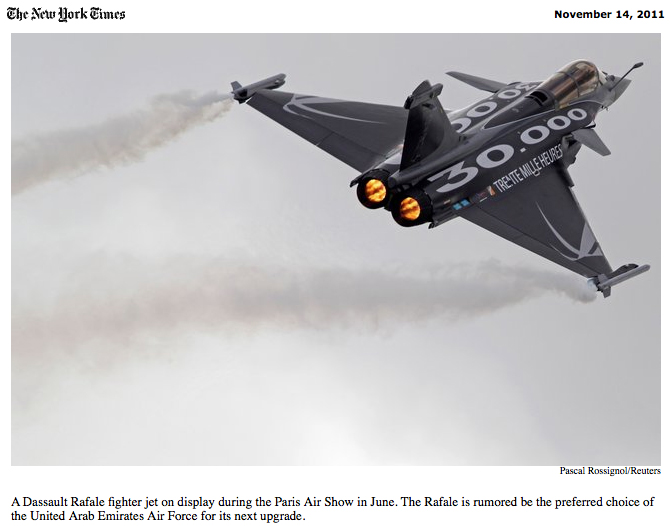
The Rafale on display at the Paris Air Show
Credits: Sirpa Air
DIFFICULT NEGOTIATION OF THE RAFALE IN THE EMIRATES
After conducting exclusive negotiations with Dassault Aviation for the purchase of Rafale multirole fighters, the Emirati Air Force has reportedly begun to study other options for its future combat aircraft.
Initiated four years ago, negotiations with the French group have still not been successful, opening the door of competition to the American Lockheed Martin, indicates a source from Abu Dhabi. The Emirati source underlines that Abu Dhabi has complained on several occasions about the lack of flexibility of the French industrialist in the negotiations on the Rafale, while the multiple interventions of President Sarkozy have failed to iron out the difficulties.
In addition to the question of the price of the planes, the difficulties relate mainly to four requests from the Emiratis: the supply of a more powerful engine than that which currently equips the Rafale, the resumption of their Mirage 2000-9 (62 in number) and the possibility of using the armaments of the 2000-9 on Rafale.
During his last visit to Abu Dhabi, French Defense Minister Gérard Longuet reportedly presented a new offer, at an overall price of nine billion euros. This is the third offer, the first having been calculated at thirteen billion and the second at ten billion.
The Elysée would have asked the member companies of the Rafale Team to work together so that each takes its share of the additional reduction of one billion euros. For its part, Abu Dhabi is still sticking to a budget of seven billion.
Taking advantage of the disagreement between the French and the Emiratis, the American administration pushed the Lockheed Martin option, which managed to open negotiations with the UAE to assess their needs. The American group, for its part, offers the fifth-generation F-35 JSF combat aircraft.
Knowing that it will only be able to deliver this aircraft in 2020 (at the earliest), given the delay in the program, Washington would have offered Abu Dhabi to provide additional F-16 Block 60s in the meantime. The Emirati Air Force currently has 80 such aircraft. The Americans even offered to deliver second-hand Usaf F-16s, bringing them to the Block 60 standard, to make up for the capacity gap, while waiting to deliver all the F-35s. Washington will then have to take back all the F-16s as new planes are delivered.
While French negotiators felt that opening talks with Lockheed Martin was just a way to put pressure on them, the progress of these talks signals that they may well succeed. Especially since the modernization of the weapons systems of the Mirage 2000-9 has just been launched by the Emiratis, which removes the prospects of a takeover by France required in the event of the purchase of the Rafale.
If the mission of the Rafale Team seems to be getting complicated, it is nevertheless doubtful that Lockheed’s F-35 offer will ultimately respect the envelope of 7 billion dollars available to the Emiratis.
JUIN 2011
ARTICLE N° 66 / AERO CONTACT


JUIN 2011
ARTICLE N° 65 / BFM BUSINESS


JUIN 2011
ARTICLE N° 64 / FLIGHT GLOBAL

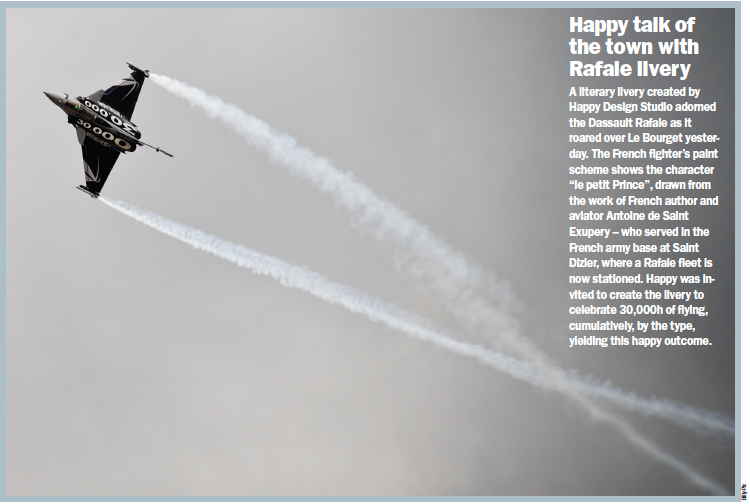
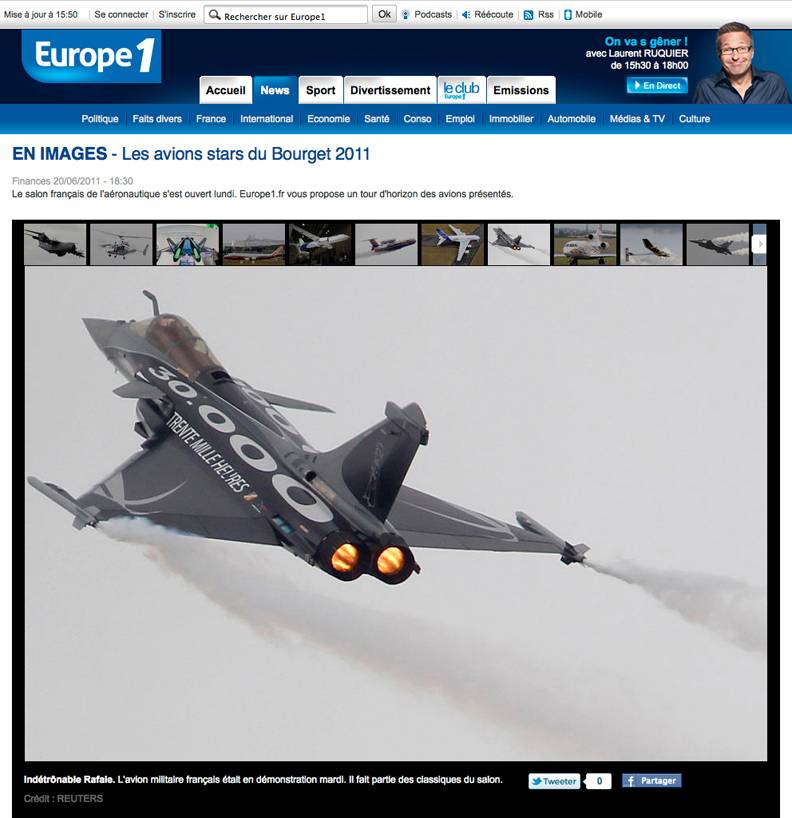
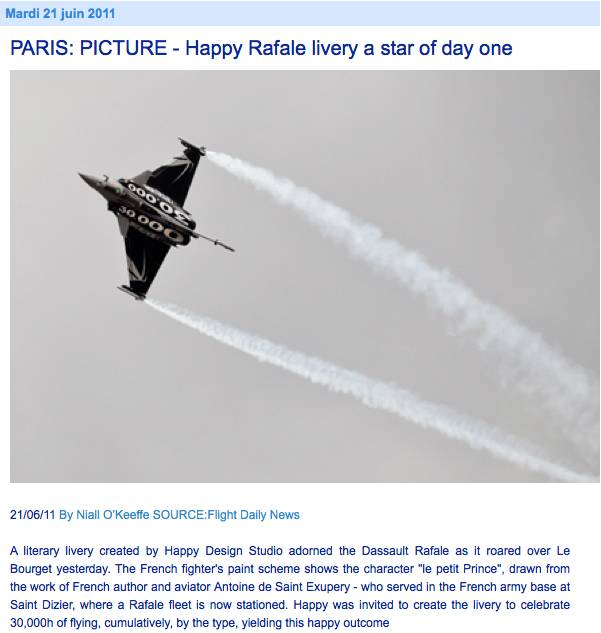
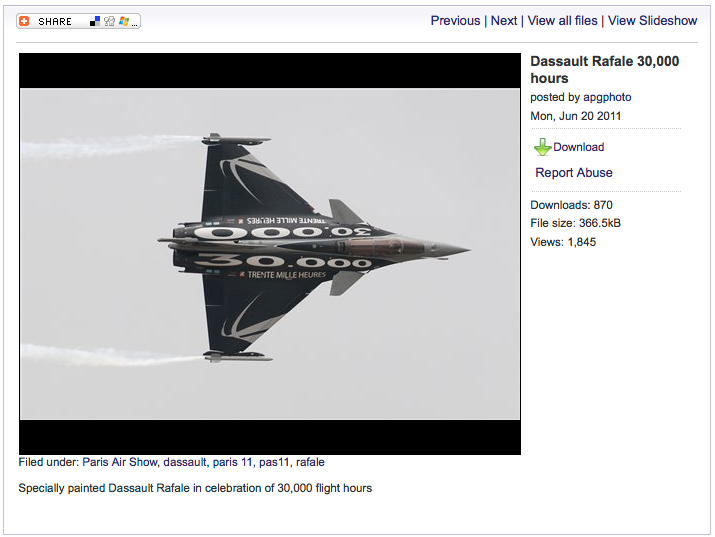
A literary livery created by Happy Design Studio adorned the Dassault Rafale as it roared over Le Bourget yesterday. The French fighter’s paint scheme shows the character “le petit Prince”, drawn from the work of French author and aviator Antoine de Saint Exupery – who served in the French army base at Saint Dizier, where a Rafale fleet is now stationed. Happy was invited to create the livery to celebrate 30,000h of flying, cumulatively, by the type, yielding this happy outcome.
JUIN 2011
ARTICLE N° 63 / THE TELEGRAPH
JUIN 2011
ARTICLE N° 62 / THE ECONOMIC TIMES

JUIN 2011
ARTICLE N° 61 / FLIGHT DAILY NEWS

JUIN 2011
ARTICLE N° 60


JUIN 2011 / CAVOK
Read full article (text version)
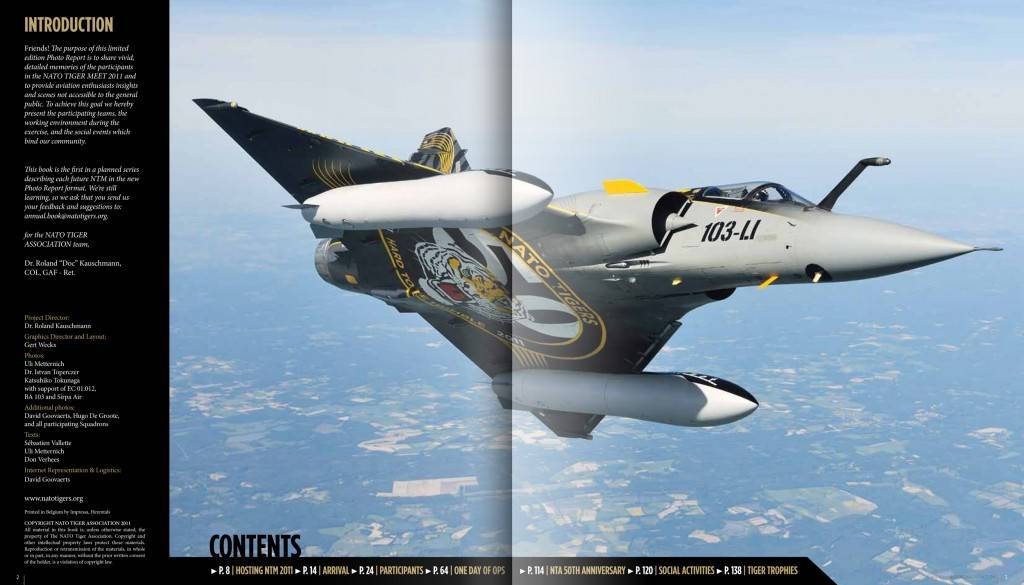
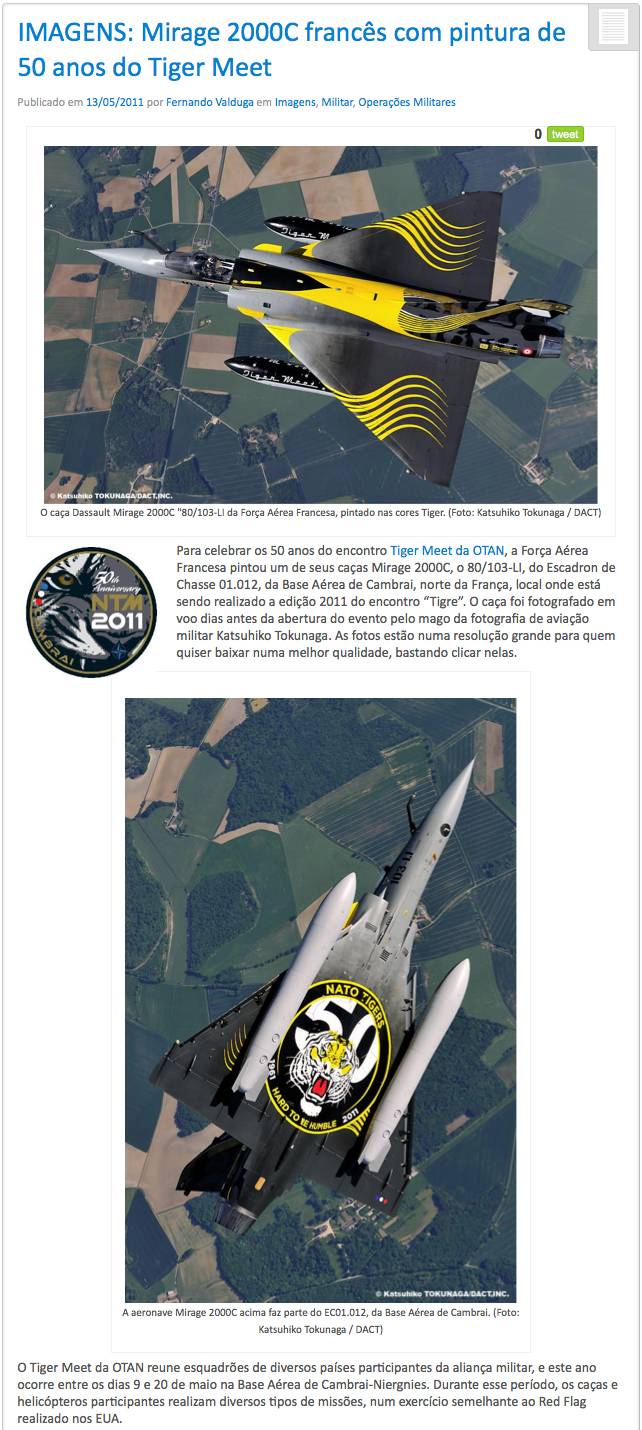
Sourtce : CAVOK ASSAS DA INFORMATICAOI / This article is reproduced for archival purposes. Mirage 2000C francês com pintura de 50 anos do Tiger Meet Publicado em 13/05/2011 por Fernando Valduga em Imagens, Militar, Operaçes Militares O caça Dassault Mirage 2000C “80/103-LL” da Força Aérea Francesa, pintado nas cores Tiger com uma livrée comemorativa criada pelo designer francês Didier Wolff do Happy Design Studio. (Foto: Katsuhiko Tokunaga / DACT) Para celebrar os 50 anos do encontro Tiger Meet da OTAN, a Força Aérea Francesa pintou um de seus caças Mirage 2000C, o 80/103-LL, do Esquadrão de Chasse 01.012, da Base Aérea de Cambrai, norte da França, local onde está sendo realizada a edição 2011 do encontro “Tiger”. A pintura especial da aeronave foi concebida por Didier Wolff, fundador do Happy Design Studio, responsável pelo design da livrée comemorativa aplicada ao caça. O avião foi fotografado em voo dias antes da abertura do evento pelo mago da fotografia de aviação militar Katsuhiko Tokunaga. As fotos estão numa resolução grande para quem quiser baixar numa melhor qualidade, bastando clicar nelas. A aeronave Mirage 2000C acima faz parte do EC01.012, da Base Aérea de Cambrai. (Foto: Katsuhiko Tokunaga / DACT) O Tiger Meet da OTAN reúne esquadres de diversos países participantes da aliança militar, e este ano ocorre entre os dias 9 e 20 de maio na Base Aérea de Cambrai-Niergnies. Durante esse período, os caças e helicópteros participantes realizam diversos tipos de misses, num exercício semelhante ao Red Flag realizado nos EUA.ARTICLE N° 59


JUIN 2011
Read full article (text version)
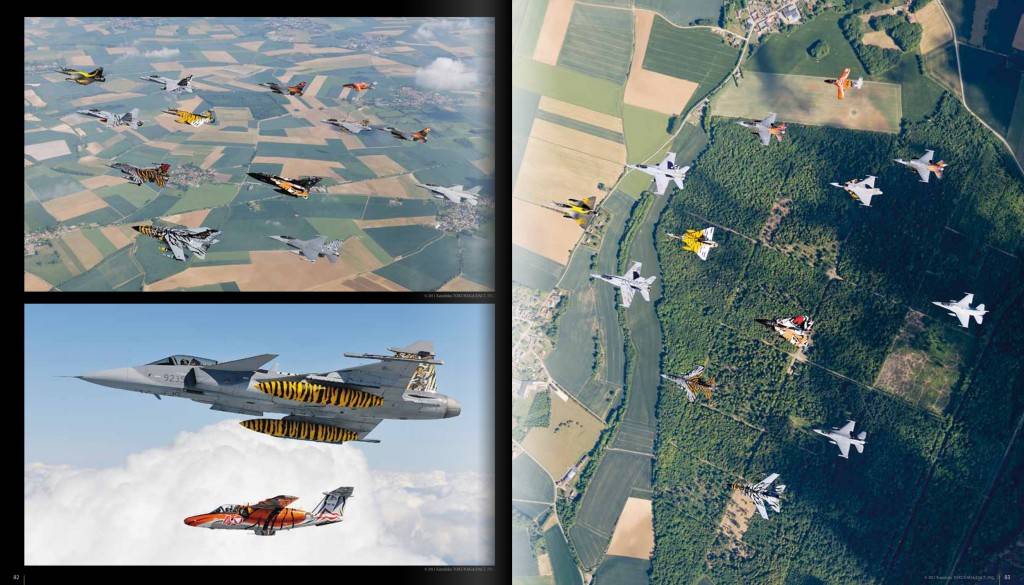
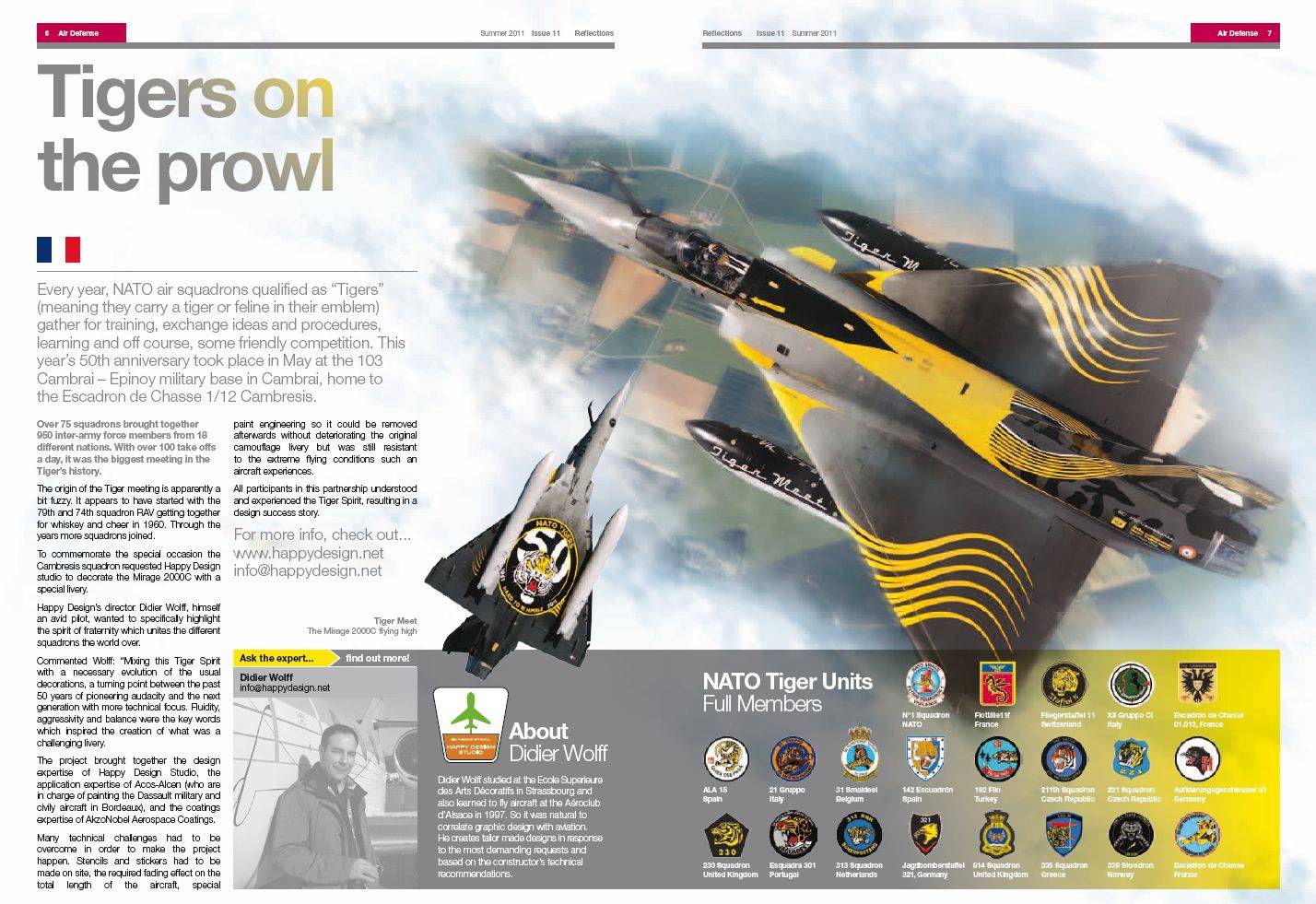
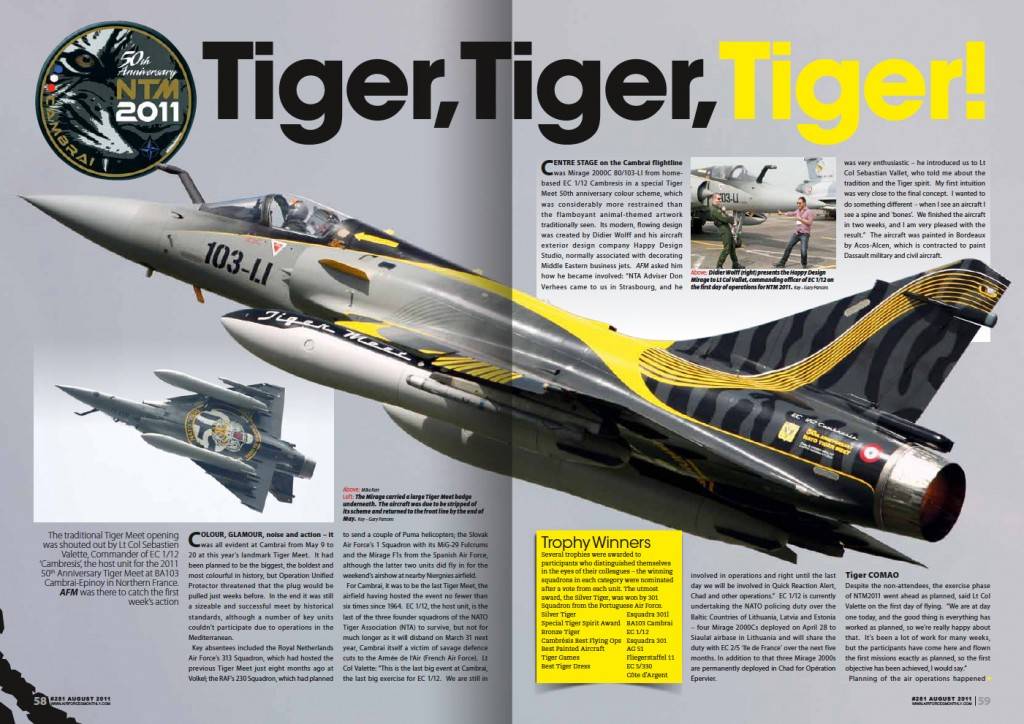
Source : Akzonobel Aerospace Coatings / This article is reproduced for archival purposes. Tigers on the prowl Every year, NATO air squadrons qualified as “Tigers” (meaning they carry a tiger or feline in their emblem) gather for training, exchange ideas and procedures, learning and of course, some friendly competition. This year’s 50th anniversary took place in May at the 103 Cambrai–Epinoy military base in Cambrai, home to the Escadron de Chasse 1/12 Cambresis. Over 75 squadrons brought together 950 inter-nation force members from 18 different nations. With over 100 take offs a day, it was the biggest meeting in the Tiger’s history. The origin of the Tiger meeting is apparently a bit fuzzy. It appears to have started with the 79th and 74th squadron RAF getting together for whiskey and cheer in 1960. Through years more squadrons joined. To commemorate the special occasion the Cambresis squadron requested Happy Design Studio to decorate the Mirage 2000C with a special livery. Happy Design’s director Didier Wolff, himself an avid pilot, wanted to specifically highlight the spirit of fraternity which unites the different squadrons the world over. Commented Wolff: “Mixing this Tiger Spirit with a necessary evolution of the usual decorations, a turning point between the past 50 years of pioneering audacity and the next generation with more technical focus. Fluidity, aggressivity and balance were the key words which inspired the creation of what was a challenging livery.” The project brought together the design expertise of Happy Design Studio, the application expertise of Ado-Alsace (who are in charge of painting the Dassault military and civil aircraft in Bordeaux), and the coatings expertise of AkzoNobel Aerospace Coatings. Many technical challenges had to be overcome in order to make the project happen. Stencils and stickers had to be made on site, the required fading effect on the total length of the aircraft, special paint engineering so it could be removed afterwards without deteriorating the original camouflage livery but was still resistant to the extreme flying conditions such an aircraft experiences. All participants in this partnership understood and experienced the Tiger Spirit, resulting in a design success story. For more info, check out www.happydesign.net info@happydesign.net Tiger Meet – The Mirage 2000C flying high. Ask the expert… find out more! Didier Wolff info@happydesign.net About Didier Wolff Didier Wolff studied at the Ecole Superieure des Arts Decoratifs in Strasbourg and also learned to fly aircraft at the Aeroclub d’Alsace in 1997. He was natural to create a graphic design with aviation. He creates tailor made designs in response to the most demanding requests and based on the constructor’s technical recommendations. NATO Tiger Units – Full Members.ARTICLE N° 58 / Akzonobel Aerospace Coatings


JUIN 2011
ARTICLE N° 57 / COMBAT AIRCRAFT


MAI 2011
Read full article (text version)
Source : Air Forces Magazine / This article is reproduced for archival purposes. Tiger, Tiger, Tiger! The tradition of the Tiger Meet opening was violated out by Lt Col Sebastien Valette, Commander of EC 1/12 Cambresis, the host unit for the 2011 50th Anniversary Tiger Meet at BA103 Cambrai-Epinoy in Northern France. AFM was there to catch the first week’s action. COLOUR, GLAMOUR, noise and action – it was all evident at Cambrai from May 9 to 20 at this year’s landmark Tiger Meet. It had been planned to be the biggest, the boldest and most colourful in history, but Operation Ellamy to protect threatened that the plug would be pulled two weeks before. In the end it was a sizeable and successful meet by historical standards, although a number of key units couldn’t participate due to operations in the Mediterranean. Key absentees included the Royal Netherlands Air Force’s 313 Squadron, which had hosted the previous Tiger Meet just eight months ago at Volkel; the RAF’s 230 Squadron, which had planned to send a couple of Puma helicopters; the Slovak Air Force’s 1 Squadron with its MiG-29 Fulcrum; and the Mirage F1s from the Spanish Air Force, although the latter two units did fly in for the weekend visitors’ day festivities. For Cambrai, it was to be the last Tiger Meet, the airfield having hosted the event twice before, in 1964. EC 1/12 hosted the meet on behalf of the three founding squadrons of the NATO Tiger Association (NTA) to survive, but not for much longer as it will disband on August 31 next year. Cambrai itself is a wing of stage defence due to the Armée de l’Air French Air Force. The special Tiger Meet livery applied to the Mirage 2000C for the 50th anniversary was designed and created by Happy Design Studio (HDS) by Didier Wolff. Lt Col Valette: “This is the last big event at Cambrai.” We were very enthusiastic. He introduced us to Lt Col Sebastian Valette, who told me about the tradition and the Tiger spirit. My first intuition was very close to the final concept: I wanted to do something different – when I see an aircraft I see a spine and bones. We finished the aircraft in two weeks, and I am very pleased with the result. The aircraft was painted in Bordeaux by Ado-Alsace, which is contracted to paint military and civilian aircraft. Trophy Winners Several trophies were awarded to participants who distinguished themselves during the two weeks of the meeting, squadrons in each category were nominated after a vote from each unit. The most coveted trophy, the Bronze Tiger, was won by the 31 Smaldeel from Belgium. Other awards included: Silver Tiger – EC 1/12 Cambrai; Bronze Tiger – EC 1/12 Cambrai; Best Painted Aircraft – EC 1/12 Cambrai; Best Flying Unit – 313 Squadron; Best Ground Crew – 192 Filo Turkey; CO de Argent – EC 1/12 Cambrai. Tiger COMAO Despite the non-attendees, the exercise phase of NTM2011 went ahead as planned, said Lt Col Valette on the day of flying. “We are at day one today, and the good thing is everything has worked as planned, so we’re really happy about that. It’s been a lot of work for many weeks, but the participants have come here and flown the first missions exactly as planned, so the front objectives have been achieved,” said the officer. Planning of the air operations happened at the wing headquarters and lasted until the day of the event. During the exercise phase, which included Quick Reaction Alert (QRA) training, the NATO aircraft flew several missions over northern France, Belgium and Germany.ARTICLE N° 56 / AIR FORCES MONTHLY


MAI 2011
Read full article (text version)
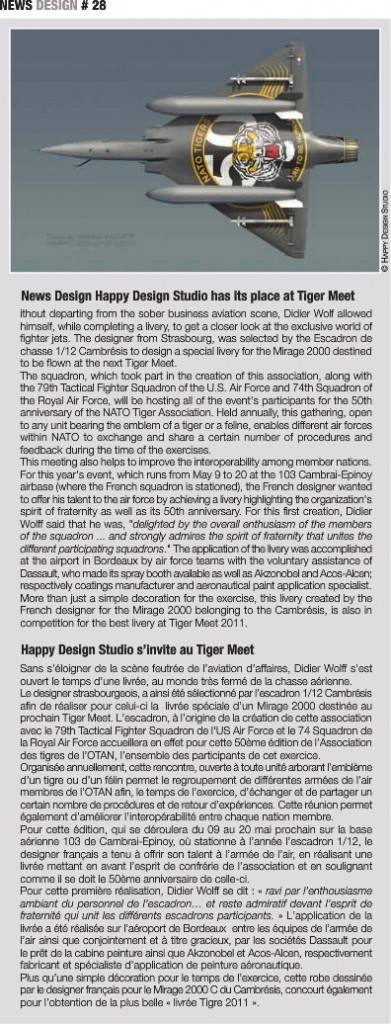
SOURCE:ULTIMATE JET MAGAZINE / This article is reproduced for archival purposes. News Design Happy Design Studio has its place at Tiger Meet Without departing from the sober aesthetics so dear to its creator Didier Wolff himself, while completing a livery to get a closer look at the exclusive world of fighter jets, the designer from Strasbourg was selected by the Escadron de Chasse 1/12 Cambresis to design a special livery for the Mirage 2000 destined to be flown at the NATO Tiger Meet. The squadron, which took part in the creation of this association along with the 79th Tactical Fighter Squadron of the U.S. Air Force and 74th Squadron of the Royal Air Force, will be hosting all of the event’s participants for the 50th anniversary of the NATO Tiger Association. Held annually, this gathering, open to any unit bearing the emblem of a tiger or a feline, enables different air forces within NATO to exchange and share a certain number of procedures and feedback during the time of the exercises. This meeting also helps to improve the interoperability among member nations. For this year’s event, which runs from May 9 to 20 at the 103 Cambrai-Epinoy airbase (where the French squadron is stationed), the French designer wanted to offer his talent to the air force by achieving a livery highlighting the organization’s spirit of fraternity as well as its 50th anniversary. The Tiger Meet anniversary livery for the Mirage 2000C was designed by Happy Design Studio (HDS) and Didier Wolff (DW). Didier Wolff said that he was “delighted by the overall enthusiasm of the members of the squadron, and strongly admires the spirit of fraternity that unites the different participating squadrons.” The application of the livery was accomplished at the airport in Bordeaux by air force teams with the voluntary assistance of Dassault, who made its spray booth available, as well as AkzoNobel and Ado-Alsace, respectively coatings manufacturer and aeronautical paint application specialist. More than just a simple decoration for the exercise, this livery created by the French designer for the Mirage 2000 belonging to the Cambresis is also in competition for the best livery at Tiger Meet 2011.ARTICLE N° 55 / ULTIMATE JET


MAI 2011
Read full article (text version)
Source : ALTITUDE ARABIA HAPPY DESIGN STUDIO NEW LIVERY FOR DASSAULT’S FALCON 10 Didier Wolff of the Happy Design Studio recently unveiled his design for the new Falcon 10 aircraft owned by Dassault family member Olivier Dassault. The studio managed the entire design project. Because each design is created based on an accurate 3D model, all technical constraints linked to the final painting of the aircraft are taken into consideration from the start to ensure the result matches the initial project. A commander in the French Air Force, Dassault qualified as a pilot on all the aircraft in the Falcon range. He holds many world records, including the Paris to Abu Dhabi flight with a Falcon 900 EX in 1996. “Fascinated since childhood by the sky’s immensity, I became a pilot and realised my dreams of travelling,” said Dassault. “Heading for the sky towards infinity, you go beyond time and space. ”This article is reproduced for archival purposesARTICLE N° 54 / ALTITUDES ARABIA

MAI 2011
Read full article (text version)
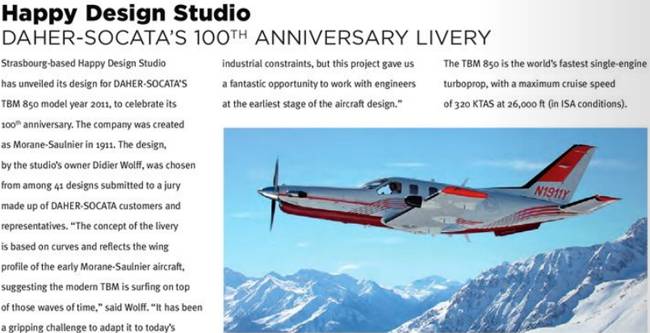
Source :ALTITUDE ARABIA Happy Design Studio – DAHER-SOCATA’s 100th Anniversary Livery Strasbourg-based Happy Design Studio has unveiled its design for DAHER-SOCATA’s TBM 850 model year 2011 to celebrate the company’s 100th anniversary. The company was created as Morane-Saulnier in 1911. The design, created by Happy Design Studio and its owner Didier Wolff (HDS / DW), was chosen from among 41 designs submitted to a jury made up of DAHER-SOCATA customers and representatives. The concept of the livery is based on flowing curves that reflect the wing profile of the early Morane-Saulnier aircraft, suggesting that the modern TBM is “surfing” on a century of aeronautical innovation. According to Didier Wolff, the project represented a gripping challenge: translating historic aeronautical heritage into a contemporary aircraft design while respecting industrial constraints. Working closely with engineers from the earliest stage of the aircraft design, the studio developed a visual language that connects the TBM’s modern performance with its historical lineage. The TBM 850, known as the world’s fastest single-engine turboprop, can reach a maximum cruise speed of approximately 320 knots TAS at 26,000 feet in ISA conditions. The anniversary livery designed by Happy Design Studio highlights this performance and heritage through dynamic lines flowing along the fuselage and wings, visually linking the aircraft to its century-long lineage beginning with Morane-Saulnier. This article is reproduced for archival purposes.ARTICLE N° 53 / ALTITUDES ARABAIA


AVRIL 2011
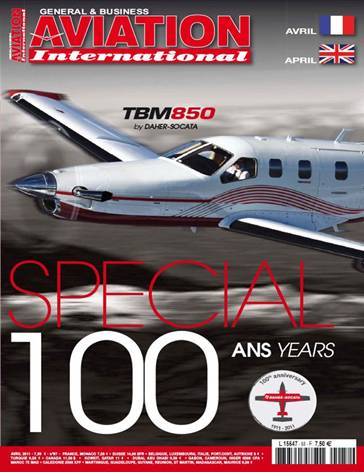
ARTICLE N° 52 / AVIATION INTERNATIONAL


AVRIL 2011
ARTICLE N° 51


AVRIL 2011
ARTICLE N° 50
BUSINESS AVIATION NETWORK
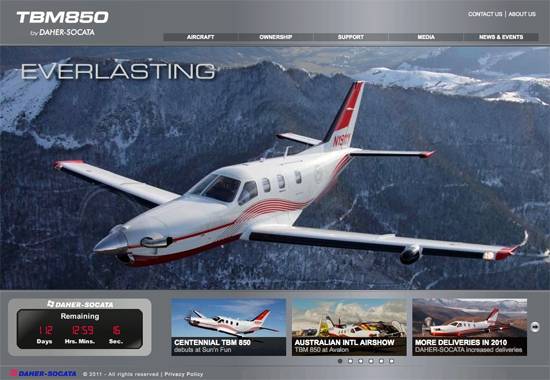
DAHER-SOCATA’s centennial TBM 850 makes its U.S. debut at the SUN ’n FUN fly-in
Lakeland, Florida, March 29, 2011 – DAHER-SOCATA is initiating its U.S. activities to celebrate the company’s 100 years of aviation excellence with this week’s SUN ’n FUN fly-in appearance of the Model Year 2011 TBM 850, which is configured in a unique centennial paint scheme.
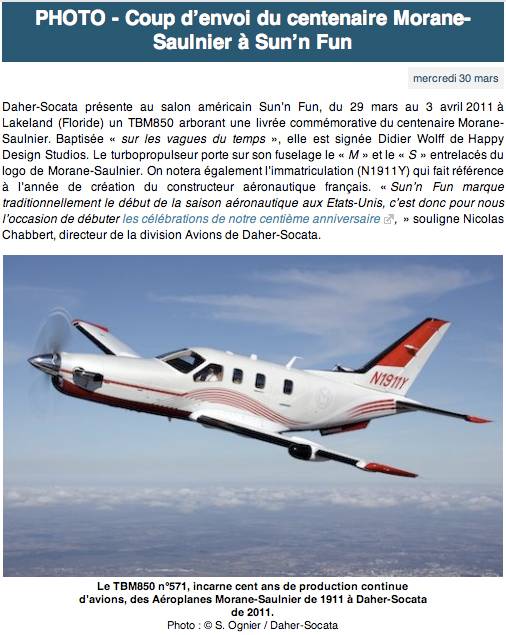
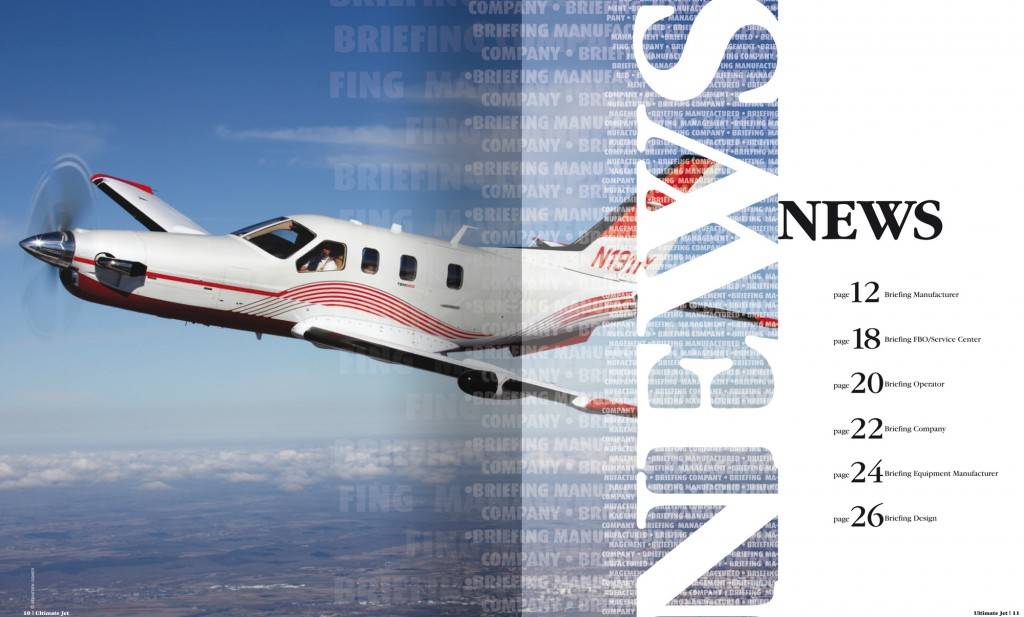
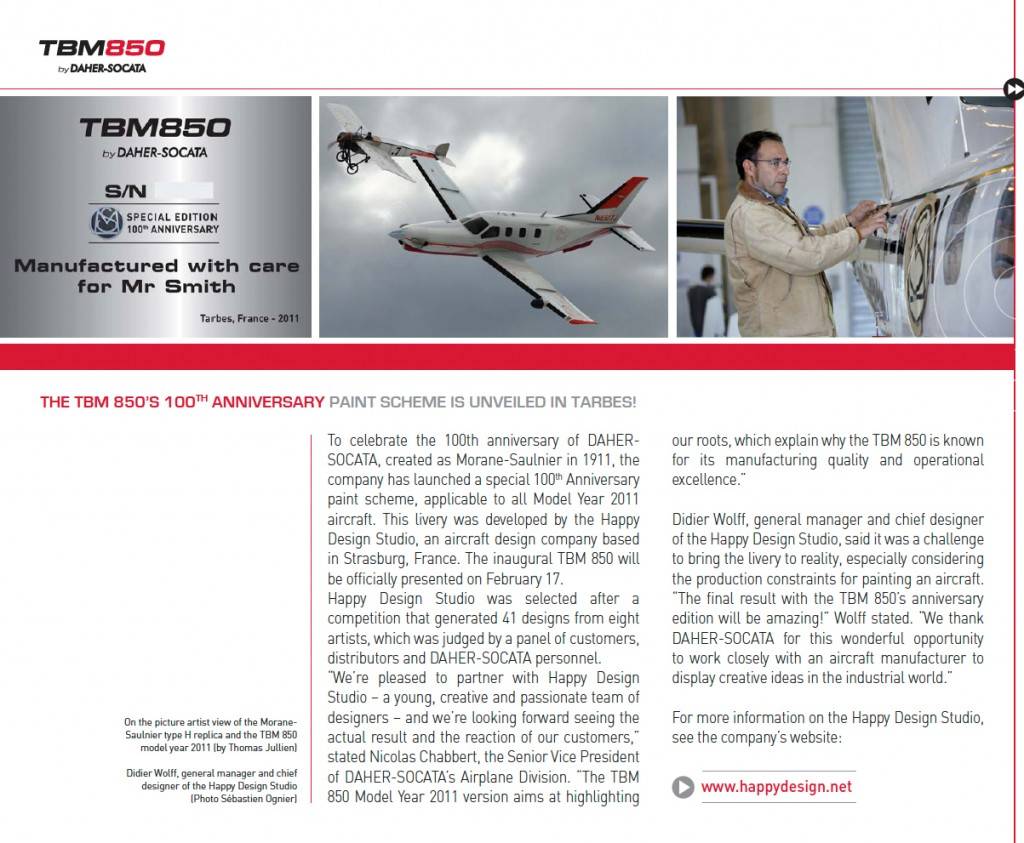
The special edition Model Year 2011 TBM 850 very fast turboprop aircraft carries a distinctive “waves of time” livery, designed by Didier Wolff of Happy Design Studios.
This TBM 850, which is serial number 571, symbolically represents the 100 years of continuous aircraft production that traces its roots to DAHER-SOCATA’s predecessor company, Aeroplanes Morane-Saulnier – created in 1911. In addition to its custom red and white paint scheme, the centennial TBM 850 has been registered with the N1911Y tail number.
For its 100-year celebrations, DAHER-SOCATA is providing the TBM 850 with an Exclusive Maintenance Program for five years (including five free annual inspections) or 1,000 flight hours with free scheduled maintenance costs. In addition, warranties are extended to five years for avionics, five years for systems and seven years for the airframe.
The TBM 850 is the world’s fastest single-engine turboprop, with a maximum cruise speed of 320 KTAS at 26,000 ft. (in ISA conditions). As an 850-shp. version of DAHER-SOCATA’s proven six-seat TBM 700 turboprop business aircraft, the TBM 850 combines cruise speeds and travel times typical of light jets with the economical direct operating costs of a turboprop, along with excellent range and payload capacity. Since its 2005 launch, the TBM 850 has become an international success – with more 220 aircraft delivered as of January 1, 2011. The combined TBM 700 and TBM 850 fleet now stands at 545 units worldwide.
AVRIL 2011
ARTICLE N° 49 / AERO MORNING

Le DAHER-SOCATA TBM 850 “Centenaire”/ Sun’n Fun
Le DAHER-SOCATA TBM 850 “Centenaire” fait ses débuts au salon Sun ’n Fun
Lakeland, Floride, 29 mars, 2011 – DAHER-SOCATA donne le coup d’envoi aux Etats-Unis des célébrations de ses 100 ans de construction d’avions avec la présentation au salon Sun ’n Fun de son TBM 850 modèle 2011, qui arbore une décoration originale pour marquer le centenaire.
La version 2011 du monoturbopropulseur à grande vitesse TBM 850 arbore une livrée originale « sur les vagues du temps » conçue spécialement par le designer Didier Wolff de Happy Design Studios.
Ce TBM 850, qui porte le numéro de série 571, marque 100 ans de production continue d’avions, ayant ses racines dans la création de la société des Aéroplanes Morane-Saulnier en 1911. Autre clin d’oeil à l’histoire, ce TBM 850 est immatriculé N1911Y.
A l’occasion de cette célébration, DAHER-SOCATA offre aux acquéreurs d’un TBM 850 en 2011, un programme exclusif de maintenance. Ce programme permet de réduire considérablement les coûts de maintenance, couvrant les frais de maintenance programmée jusqu’à la 5ème inspection annuelle ou à concurrence de 1 000 heures de vol pour l’acquéreur initial. Et les garanties pour l’avionique et les systèmes sont portées à 5 ans et à 7 ans pour la cellule de l’avion.
« Sun’n Fun marque traditionnellement le début de la saison aéronautique aux Etats-Unis, c’est donc pour nous l’occasion de débuter les célébrations de notre centième anniversaire, » a déclaré Nicolas Chabbert, directeur de la division Avions de DAHER-SOCATA. « Cette semaine sur l’aéroport de Lakeland va nous permettre de présenter le TBM 850 modèle 2011 à l’ensemble de la communa uté de l’aviation générale. »
Le TBM 850 est le monoturbopropulseur le plus rapide du monde avec une vitesse de croisière maximale de 320 KTAS (593 km/h) à 26,000 ft. (7940 m).
Version à moteur de 850 ch de l’avion d’affaires à turbopropulseur TBM 700, reconnu pour sa fiabilité, le TBM 850 conjugue la vitesse de croisière et les temps de vol typiques des jets légers avec les coûts d’exploitation, la faible signature environnementale, la distance franchissable et l’excellente charge marchande des avions à turbopropulseur.
Depuis son lancement en 2005, le TBM 850 est devenu un succès international avec plus de 222 avions livrés au 1er Janvier 2011. La flotte combinée de TBM 700 et TBM 850 atteint désormais les 545 unités. En 2010, l’activité de l’ensemble de la flotte TBM a dépassé les 800 000 heures de vol.
AVRIL 2011
Read full article (text version)
Source Aero Buzz Kick-off of the Morane-Saulnier centenary at Sun’n Fun Daher-Socata presented at the American Sun’n Fun airshow, held from March 29 to April 3, 2011 in Lakeland, Florida, a TBM850 carrying a commemorative livery for the Morane-Saulnier centenary. The design, titled “Sur les vagues du temps” (“On the waves of time”), was created by Didier Wolff of Happy Design Studio (HDS / DW). The turboprop features on its fuselage the letters “M” and “S”, recalling the Morane-Saulnier logo. The aircraft registration N1911Y also references the year 1911, when the historic French aircraft manufacturer Morane-Saulnier was founded. The presentation at Sun’n Fun traditionally marks the beginning of the aeronautical season in the United States and therefore served as the launch point for the centenary celebrations. Nicolas Chabbert, head of Daher-Socata’s Airplane Division, noted that it was a symbolic moment to begin the company’s centennial anniversary events. The TBM850 serial number 571 represents a century of continuous aircraft production, from the Aéroplanes Morane-Saulnier in 1911 to Daher-Socata in 2011. Photo credit: S. Ognier / Daher-Socata. This article is reproduced for archival purposes.ARTICLE N° 48 / AERO BUZZ


MARS 2011
ARTICLE N° 47 / MONTE CARLO SOCIETY


MARS 2011
Read full article (text version)
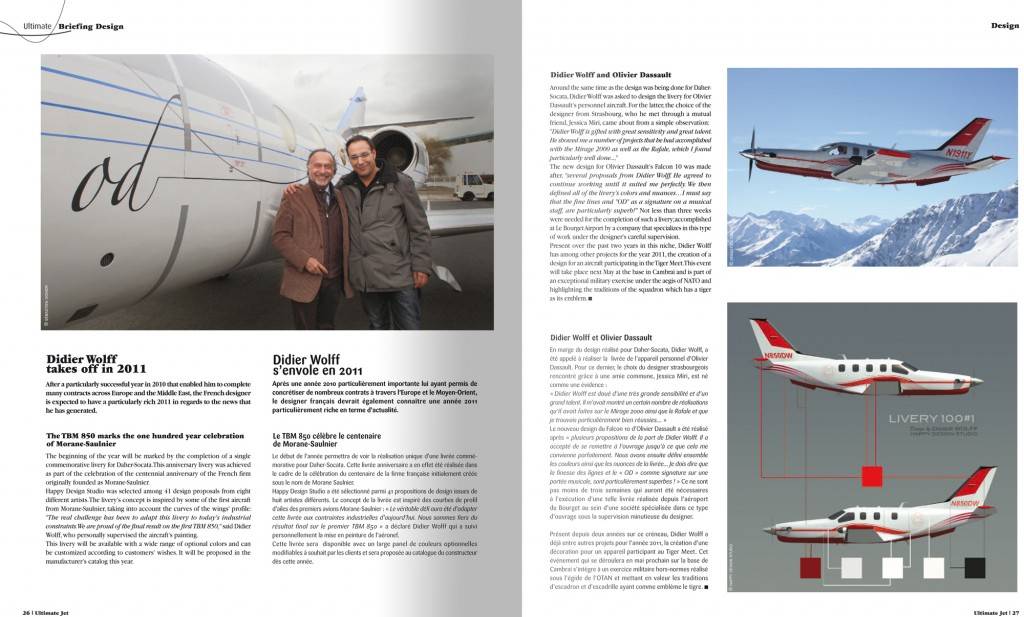
Source : Ultimate Jet / This article is reproduced for archival purposes. MARS 2011 ARTICLE N° 46 Didier Wolff takes off in 2011 After a particularly successful year in 2010 that enabled him to complete many contracts across Europe and the Middle East, the French designer is expected to have a particularly rich 2011 with regards to the news that he has generated. The TBM 850 marks the one hundred year celebration The beginning of the year will be marked by the completion of a single commemorative livery for Daher-Socata. This anniversary livery was achieved as part of the celebration of the centenary anniversary of the French firm originally founded as Morane-Saulnier. Happy Design Studio was selected among 41 design proposals from eight different artists. The livery concept is inspired by the profile of the first aircraft from Morane-Saulnier, taking into account the curves of the wings and the aerodynamic lines of the modern TBM850. The design was created by Happy Design Studio and Didier Wolff (HDS / DW). The next challenge has been to adapt this livery to today’s industrial constraints while respecting the aircraft manufacturer’s engineering requirements. With the TBM850 selected as the flagship aircraft for the centenary celebrations, the project demonstrates the studio’s capacity to combine historical references with modern aeronautical design. The aircraft will be presented during the aeronautical season in the United States and proposed in the manufacturer’s catalogue. Didier Wolff evolves in 2011 The TBM 850 celebrates the centenary of Morane-Saulnier and marks an important step in the development of the designer’s activities internationally. The Strasbourg-based studio continues to expand its presence in the aeronautical design field, particularly in Europe and the Middle East. This project confirms the growing recognition of Happy Design Studio and Didier Wolff for original aircraft liveries, both in the civil and military sectors. The commemorative TBM850 livery was designed by Happy Design Studio and Didier Wolff (HDS / DW). Working closely with engineers and the aircraft manufacturer, the studio ensured that the visual concept respected the structural and aerodynamic constraints of the aircraft while maintaining a strong and elegant identity. The project illustrates the approach developed by the designer: creating distinctive liveries that combine artistic expression with the technical realities of aviation.ARTICLE N° 46 / ULTIMATE JET


FÉVRIER 2011
Read full article (text version)
Source : BUSINESS JET INTERIORS / This article is reproduced for archivals purposes. BRAND POWER Four Design and brand experts explain how to get logo and livery design right, and speculate on how technology will enable different ways of branding in the future. Four Design and brand experts explain how to get logo and livery design right, and speculate on how technology will enable different ways of branding in the future. finish wars: paint or film? Paint has been the traditional finish of airline liveries but it’s hellishly expensive. By contrast he reckons a similar job done with a film decal could come in at a third of the price and be faster to complete. And it’s not just small and temporary promotional designs that can be achieved with such an approach. For example, Wolff says the permanent Emirates tail fin was “all stickers”. However not every surface on a large aircraft is suitable for stickers. Wolff notes that areas subject to strong aerodynamic forces and heat — such as the nose and engine zones — are less suited to film applications and still require traditional paint. In most cases, though, a hybrid approach combining paint and film can provide both efficiency and visual precision. When he was a little simpler and applications more limited, things looked very elegant. In my head I replay old BOAC schemes and those early, beautiful American Airlines graphics, and yes they were great,” he says. Conversely, the explosion of the budget airline model has led to much simpler liveries. “As airlines look to reduce costs and standardise fleets, the design tends to become more basic.” Despite this trend, Wolff argues that creativity in aircraft liveries is far from finished. With new materials, digital design tools and improved production techniques, designers can still develop distinctive identities for airlines and aircraft owners. According to Wolff, the future of aircraft liveries lies in balancing aesthetic ambition with the industrial and operational realities of aviation. The Rafale special livery shown on this page was designed by Happy Design Studio and Didier Wolff.ARTICLE N° 45 / BUSINESS JET INTERIORS

BRAND POWER Four Design and brand experts explain how to get logo and livery design right, and speculate on how technology will enable different ways of branding in the future.
Four Design and brand experts explain how to get logo and livery design right, and speculate on how technology will enable
different ways of branding in the future.
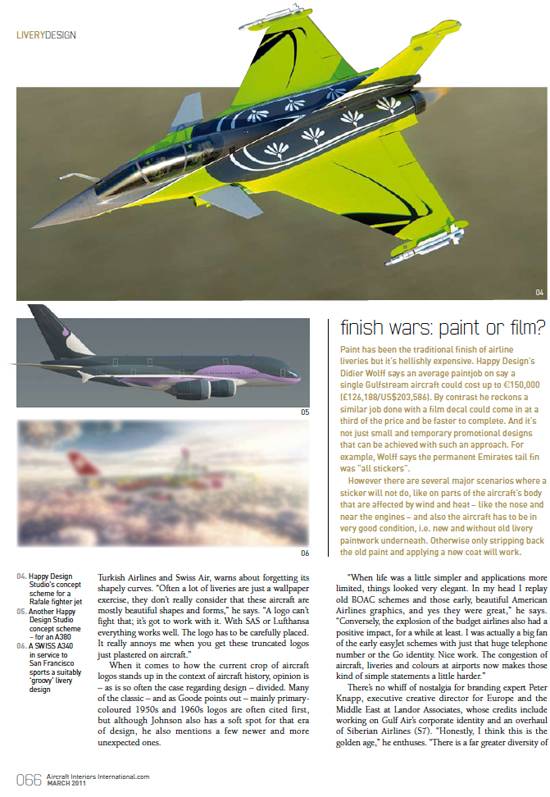
FÉVRIER 2011
Read full article (text version)
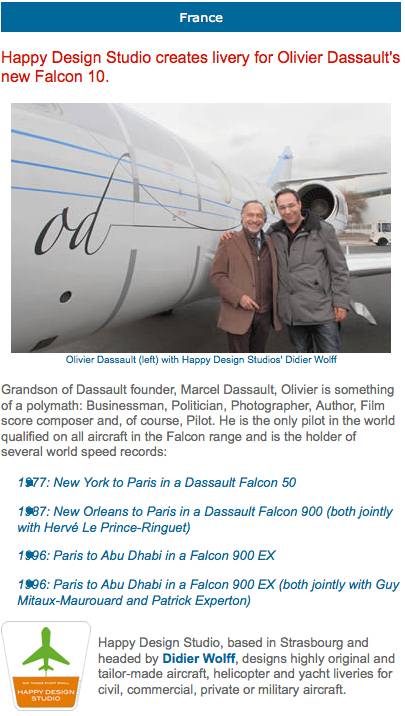
Source : BLUE SKY / This article is reproduced for archival purposes. France – Happy Design Studio creates livery for Olivier Dassault’s new Falcon 10. Olivier Dassault, grandson of Dassault founder Marcel Dassault, commissioned Happy Design Studio to create the livery for his new Falcon 10. The design was created by Happy Design Studio and its founder Didier Wolff (HDS / DW). Olivier Dassault was known as a true polymath: businessman, politician, photographer, film producer, composer and pilot. He was also the only pilot in the world qualified on the entire Falcon range and held several world speed records. Among these records: 1977 – New York to Paris in a Dassault Falcon 50; 1987 – New Orleans to Paris in a Dassault Falcon 900 (jointly with Hervé Le Prince-Ringuet); 1996 – Paris to Abu Dhabi in a Falcon 900 EX; 1996 – Paris to Abu Dhabi in a Falcon 900 EX (jointly with Guy Mitaux-Maurouard and Patrick Experton). Happy Design Studio, based in Strasbourg and headed by Didier Wolff, designs highly original tailor-made liveries for aircraft, helicopters and yachts across civil, commercial, private and military sectors.ARTICLE N° 44 / BLUE SKY


FÉVRIER 2011
ARTICLE N° 43 / BUSINESS JET INTERIORS

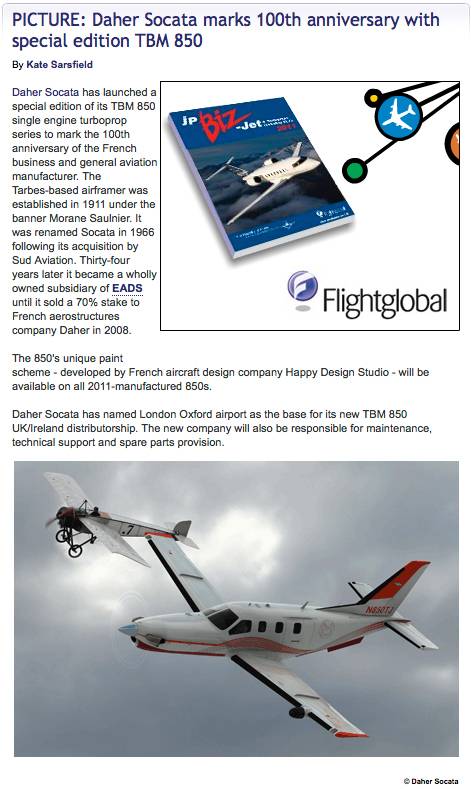
Happy Design Studio livery chosen for TBM850′s anniversary
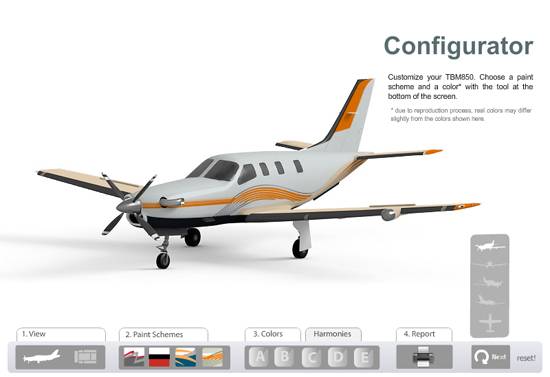
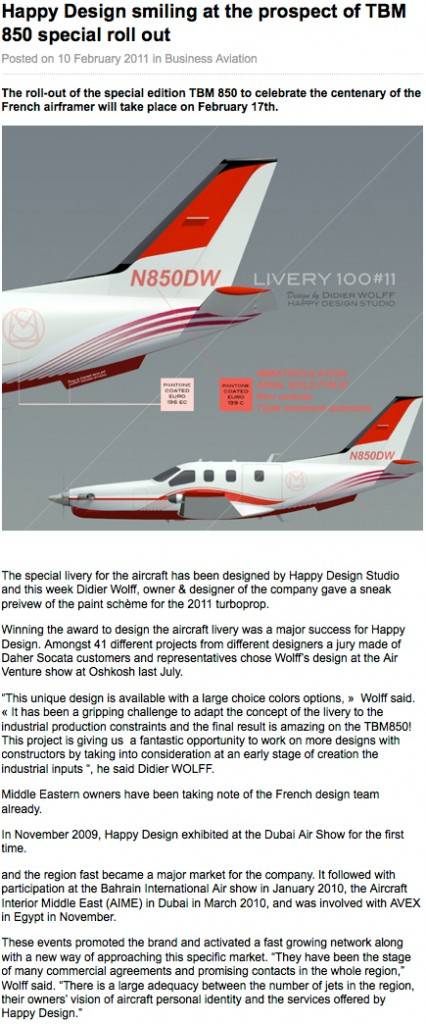
Happy Design Studio has been chosen by Daher-Socata to deliver a livery for the TBM 850 single-engine turboprop to celebrate the model’s 100th anniversary. Happy Design Studio’s design was chosen from 41 projects by eight designers. The design is available with a large choice of colour options and is the new paint scheme for production line TBM850s for 2011.
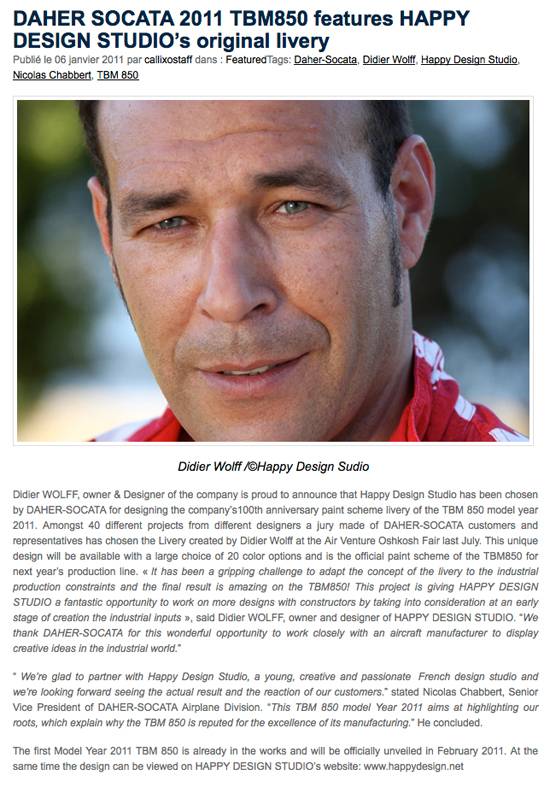
“It has been a gripping challenge to adapt the concept of the livery to the industrial production constraints and the final result is amazing on the TBM850,” said Didier Wolff, owner and designer at Happy Design Studio.
FÉVRIER 2011
Read full article (text version)
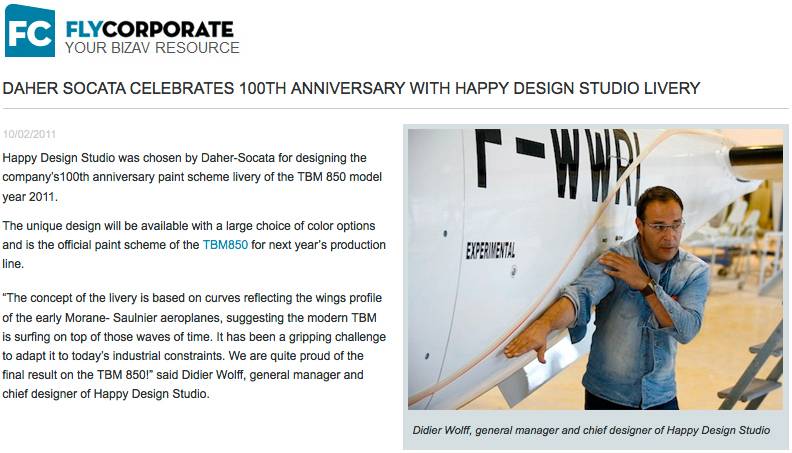
Source : FLY CORPORATE / This article is reproduced for archival purposes. DAHER SOCATA celebrates its 100th anniversary with a Happy Design Studio livery. Happy Design Studio was selected by Daher-Socata to design the company’s 100th anniversary paint scheme for the TBM 850 model year 2011. The commemorative livery was created by Happy Design Studio and its founder Didier Wolff (HDS / DW). The unique design was made available with a wide choice of color options and became the official paint scheme of the TBM850 production line for that model year. According to Didier Wolff, the concept of the livery was inspired by the flowing curves reflecting the wing profile of early Morane-Saulnier aircraft, suggesting that the modern TBM is “surfing” on those waves of time. Translating this historical inspiration into a contemporary aircraft while respecting modern industrial and engineering constraints represented a significant challenge during the design process. The final result highlights the link between a century of French aeronautical heritage and the performance of the modern TBM850, while illustrating Happy Design Studio’s approach to aircraft livery design: combining artistic expression with the strict technical requirements of aviation manufacturing.ARTICLE N° 42 / FLY CORPORATE

FÉVRIER 2011
Read full article (text version)
Source ARABIAN AEROSPACE / This article is reproduced for archival purposes. Happy Design smiling at the prospect of TBM 850 special roll out Posted on 10 February 2011 in Business Aviation The roll-out of the special edition TBM 850 to celebrate the centenary of the French airframer will take place on February 17th. The special livery for the aircraft has been designed by Happy Design Studio and this week Didier Wolff, owner and designer of the company, gave a sneak preview of the paint scheme for the 2011 turboprop. The commemorative TBM850 centenary livery was created by Happy Design Studio and Didier Wolff (HDS / DW). Winning the award to design the aircraft livery was a major success for Happy Design. Amongst 41 different projects from different designers a jury made of Daher Socata customers and representatives chose Wolff’s design at the Air Venture show at Oshkosh last July. “This unique design is available with a large choice of colors options,” Wolff said. “It has been a gripping challenge to adapt the concept of the livery to the industrial production constraints of the final result is amazing on the TBM850! This project is giving us a fantastic opportunity to work on more designs with constructors by taking into consideration an early stage of creation the industrial inputs,” he said Didier Wolff. Middle Eastern owners have been taking note of the French design team already. In November 2009, Happy Design exhibited at the Dubai Air Show for the first time and the region fast became a major market for the company. It followed with participation at the Bahrain International Air Show in January 2010, the Aircraft Interior Middle East (AIME) in Dubai in March 2010, and involvement with AVEX Egypt in November. These events promoted the brand and activated a fast growing network along with a new way of approaching this specific market. “They have been the stage of many commercial agreements and promising contacts in the whole region,” Wolff said. “There is a large adequacy between the number of jets in the region, their owners’ vision of aircraft personal identity and the services offered by Happy Design Studio.”ARTICLE N° 41 / ARABIAN AEROSPACE


FÉVRIER 2011
Read full article (text version)
Source FLIGHTGLOBAL / This article is reproduced for archival purposes. Daher Socata marks 100th anniversary with special edition TBM 850 By Kate Sarsfield Daher Socata has launched a special edition of its TBM 850 single engine turboprop series to mark the 100th anniversary of the French business and general aviation manufacturer. The Tarbes-based airframer was established in 1911 under the banner Morane Saulnier. It was renamed Socata in 1966 following its acquisition by Sud Aviation. Thirty-four years later it became a wholly owned subsidiary of EADS until it sold a 70% stake to French aerostructure company Daher in 2008. The TBM 850’s unique paint scheme was developed by French aircraft design company Happy Design Studio and created by its founder Didier Wolff. The livery will be available on 2011-manufactured TBM 850 aircraft. Daher Socata has named London Oxford Airport as the base for its new TBM 850 UK/Ireland distributorship. The new company will also be responsible for maintenance, technical support and spare parts provision.ARTICLE N° 40 / FLIGHT GLOBAL


FÉVRIER 2011
Read full article (text version)
Source : Ultimate Jet Magazine / This article is reproduced for archival purposes. THE TBM 850’s 100TH ANNIVERSARY PAINT SCHEME IS UNVEILED IN TARBES! To celebrate the 100th anniversary of DAHER-SOCATA, created as Morane-Saulnier in 1911, the company has launched a special 100th Anniversary paint scheme applicable to all Model Year 2011 aircraft. This livery was developed by Happy Design Studio and designed by Didier Wolff (HDS / DW), an aircraft design company based in Strasbourg, France. The inaugural TBM will be officially presented on February 17. Happy Design Studio was selected after a competition that generated 41 designs from eight artists, which was judged by a panel of customers, distributors and DAHER-SOCATA personnel. “We’re pleased to partner with Happy Design Studio – a young, creative and passionate team of designers – and we’re looking forward to seeing the actual result and the reaction of our customers,” stated Nicolas Chabbert, the Senior Vice President of DAHER-SOCATA’s Airplane Division. The TBM 850 Model Year 2011 version aims at highlighting our roots, which explain why the TBM 850 is known for its manufacturing quality and operational excellence. Didier Wolff, general manager and chief designer of Happy Design Studio, said it was a challenge to bring the livery to reality, especially considering the production constraints for painting an aircraft. “The final result with the TBM 850’s anniversary edition will be amazing!” Wolff stated. “We thank DAHER-SOCATA for this wonderful opportunity to work closely with an aircraft manufacturer to display creative ideas in the industrial world.” For more information on Happy Design Studio, see the company’s website: www.happydesign.net. DAHER SOCATA 2011 TBM850 features Happy Design Studio’s original livery Published 06 January 2011 Didier Wolff, owner and designer of Happy Design Studio, announced that the company had been selected by DAHER-SOCATA to design the 100th anniversary paint scheme for the TBM 850 Model Year 2011. The commemorative livery was created by Happy Design Studio and Didier Wolff (HDS / DW). Among about 40 different projects from designers, a jury composed of DAHER-SOCATA customers and representatives selected Wolff’s design at the AirVenture Oshkosh Fair the previous July. The unique design will be available with a large choice of around 20 colour options and will become the official paint scheme of the TBM850 for the next production year. Didier Wolff explained that adapting the concept to the industrial production constraints of the aircraft was a demanding challenge, but the final result on the TBM850 proved highly successful. The project also represents an opportunity for Happy Design Studio to collaborate closely with an aircraft manufacturer and integrate industrial constraints at the earliest stage of design. Nicolas Chabbert, Senior Vice President of DAHER-SOCATA’s Airplane Division, commented that the company was pleased to partner with Happy Design Studio, describing it as a young, creative and passionate French design studio. He added that the TBM 850 Model Year 2011 edition highlights the manufacturer’s roots and heritage, which contribute to the aircraft’s reputation for manufacturing quality and operational excellence. The first Model Year 2011 TBM850 aircraft was already under development at the time and scheduled to be officially unveiled in February 2011. The design could also be viewed on the Happy Design Studio website.ARTICLE N° 39 / ULTIMATE JET